JSW MG Motor Targets 50% EV Parts Localisation in India
JSW MG Motor India's plan to source at least half of its electric-vehicle components domestically has turned a spotlight on the readiness of India's EV supply chain, from batteries to power electronics.
Commentary & Analysis ·
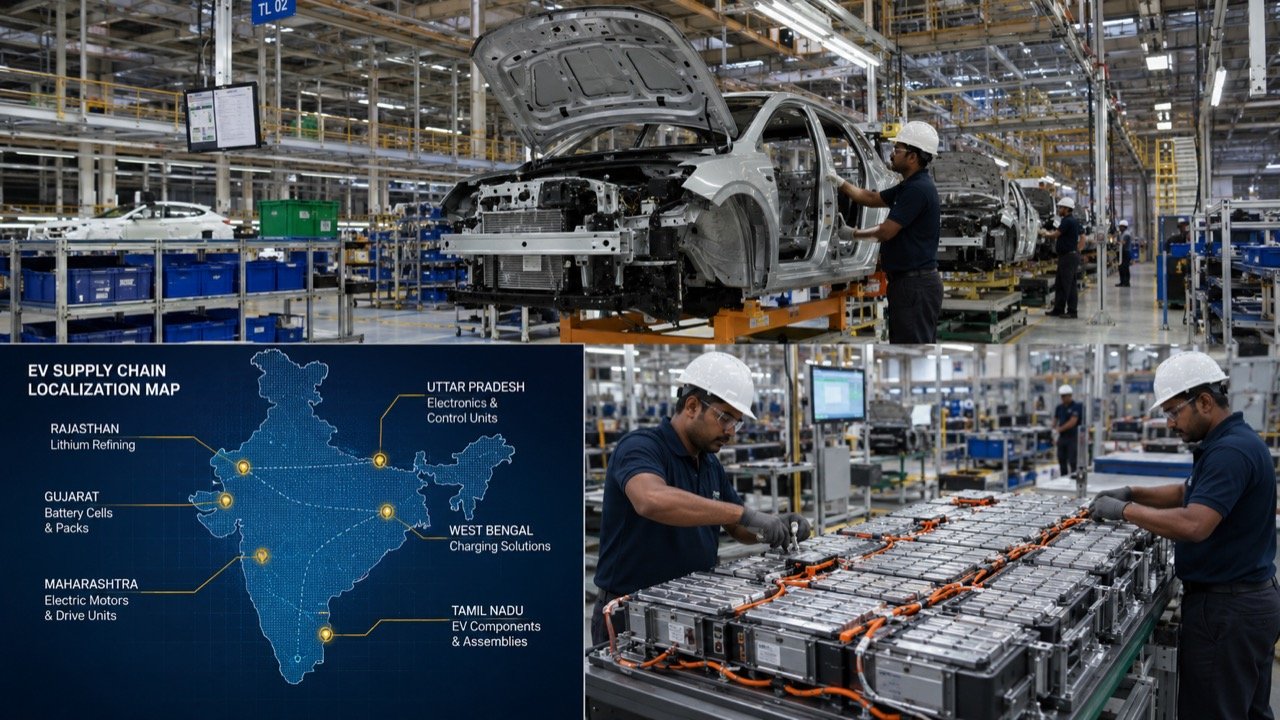
JSW MG Motor India plans to localise at least half of its electric-vehicle parts, a sourcing target that has put the depth of India's EV supply chain squarely back in the business-news spotlight. Business Standard reported the localisation goal as the carmaker works to widen its base of domestic suppliers. The pledge lands at a moment when India's electric-car market is being driven as much by manufacturing strategy as by new model launches. For JSW MG Motor — the joint venture between the JSW Group and China's SAIC — deeper local sourcing is a route to lower costs, more competitive sticker prices and a stronger claim to being an Indian manufacturer.
On the face of it, the announcement reads as a routine corporate target, the sort of figure that appears in an investor presentation and is then quietly revisited a year later. But the 50 per cent threshold is worth taking seriously precisely because of who is setting it. JSW MG Motor sits at an unusual junction in India's auto industry: a homegrown industrial conglomerate paired with a Chinese manufacturer that already has deep global sourcing networks. A localisation commitment from that combination signals something about where the incentives in Indian EV manufacturing are now pointing, regardless of whether the number is eventually hit in full.
More than an assembly story
EV growth depends on far more than vehicles rolling off a line. Batteries, power electronics, software and charging components together determine cost, supply resilience and what consumers ultimately pay. Localising these layers can cut import dependence, but only if domestic suppliers can match global quality while scaling volumes — a combination Indian component makers are still building toward.
This distinction matters because "localisation" is a term that can be stretched to mean very different things. A carmaker can hit an impressive-sounding percentage by sourcing low-value items domestically — seats, wiring harnesses, plastic trim, glass — while continuing to import the components that actually carry the bulk of an EV's cost and technological complexity. Battery cells, power electronics such as inverters and onboard chargers, and the software stacks that manage energy and drivetrain performance are where the real value, and the real strategic dependency, sits. A 50 per cent target calculated by part count or by simple cost share can look very different depending on which components are counted, and depending on which ones are conveniently left out of the count.
Part of a wider clean-mobility shift
The move fits a broader industry migration toward domestic manufacturing in clean mobility, encouraged by production-linked incentives and rising regulatory expectations. Carmakers across the market are balancing affordability against technology partnerships, and localisation targets have become a key signal of long-term commitment to the Indian market.
Seen against this backdrop, JSW MG Motor's announcement is less an isolated corporate decision than a data point in a pattern that policymakers have been trying to encourage for several years. Production-linked incentive schemes were explicitly designed to nudge manufacturers away from complete-knock-down assembly and toward genuine domestic value addition, on the theory that a country cannot build a durable EV industry, or the jobs and supplier ecosystem that come with it, by simply screwing together imported kits. Every time a manufacturer publicly commits to a localisation number, it reinforces the expectation that this is now the baseline behaviour for staying competitive in the Indian market, not an optional extra.
There is also a competitive dynamic at work. As more carmakers in India publish localisation targets, the numbers themselves become a form of market signalling aimed at regulators, potential component suppliers and consumers who increasingly ask where a vehicle is actually made. A joint venture with a foreign partner has particular reason to lean into this signalling, since it faces more scrutiny over how much of its manufacturing footprint is genuinely rooted in India versus imported through the partner's existing global supply chain.
What supplier readiness actually requires
The measured takeaway is that a 50 per cent target is a strategic goal, not a finished achievement: results will hinge on supplier readiness and production economics. Building that readiness is not simply a matter of willingness on the part of Indian component makers. It requires capital investment in precision manufacturing, access to the raw materials and chemistry expertise that battery and power-electronics production demand, and enough assured order volumes to justify the tooling and quality-certification costs involved. None of this happens overnight, and it does not happen at all unless carmakers are prepared to commit to multi-year sourcing relationships rather than opportunistic, price-driven switching.
This is where the gap between announcing a target and delivering on it tends to open up. A carmaker can express genuine intent to localise and still find, eighteen months later, that the domestic suppliers it hoped to rely on cannot yet match the cost, consistency or certification standards of established overseas vendors. Whether JSW MG Motor's target survives that test will depend on decisions made well outside the marketing department — in procurement contracts, supplier development programmes and capital allocation choices that are far less visible to the public than the headline percentage.
The NE Times View
Localisation promises are easy to announce and hard to deliver, and India should welcome this one while watching the execution. If JSW MG Motor genuinely shifts half its EV bill of materials to Indian suppliers, the benefits will spill well beyond one company — building component capability that every domestic EV maker can draw on. A supplier that develops the expertise to manufacture power electronics or battery packs for one carmaker does not forget that expertise when it goes looking for its next customer; capability built for one contract tends to become an asset for the wider industry.
The harder question is whether battery cells and power electronics, the highest-value pieces, are part of the 50 per cent or quietly left out. This is not a cynical point so much as a practical one: without knowing the composition of the target, readers and analysts alike are left to take the headline number on faith. A localisation figure built substantially around low-complexity components would still be a positive step, but it would not represent the kind of supply-chain deepening that changes India's strategic position in global EV manufacturing.
For readers, the number to track is not the target but the share of real value added in India as these vehicles reach showrooms. That is a harder figure to obtain than a press-release percentage, but it is the one that will actually determine whether this announcement marks a meaningful shift in India's EV manufacturing base or simply a well-timed statement of intent.
Key takeaways
- JSW MG Motor India, the JSW Group–SAIC joint venture, has set a target of localising at least half of its electric-vehicle parts, as reported by Business Standard.
- The target's real significance depends on whether high-value components such as battery cells and power electronics are included, rather than lower-value items like trim and wiring.
- Domestic suppliers still face the challenge of matching global quality standards while scaling production volumes, meaning execution will lag well behind the announcement.
- The push aligns with a broader industry trend toward local manufacturing, supported by production-linked incentives and rising regulatory expectations across India's EV sector.
- The metric worth watching over time is the actual share of value added in India in vehicles reaching showrooms, not the headline localisation percentage itself.
You may also like to read
Sanand Semiconductor Plant: What CG Semi's Launch Means for India
Commercial production at CG Semi's chip assembly and test facility in Sanand, marked by remarks from Prime Minister Modi, has renewed focus on how far India's semiconductor manufacturing push has actually come.
Maersk Orders 1,000 India-Made Containers From DCM Shriram
Maersk has unveiled its first India-made EXIM shipping container and placed an order for 1,000 more with DCM Shriram, a commercial vote of confidence in India's push to manufacture the hardware of global trade.
Tata Motors Lifts Prices From July, Doubles Down On EV And Hydrogen
Tata Motors will raise passenger vehicle prices by up to 1.5 percent from July 1 to offset input-cost pressure, even as chairman N. Chandrasekaran reaffirms heavy investment in electric and hydrogen mobility.
India Copper Capacity Push Grows Urgent as Clean Energy Demand Rises
Rising demand from solar, wind, electric vehicles and grid expansion is turning India's copper supply into a strategic industrial question, with capacity gaps threatening costs and project timelines.
More from this section
More
Adani Case: US DOJ Pushes for Permanent Dismissal of Charges
The US Department of Justice has urged a judge to permanently dismiss charges against Gautam Adani, calling the case legally flawed — a reversal with consequences for markets, diplomacy and cross-border enforcement.

Akasa Air Inducts 40th Aircraft in Indian Aviation Scale-Up
Akasa Air's 40th aircraft, ferried to Bengaluru via Seattle, Reykjavik and Cairo, marks a fleet milestone for the young carrier and a fresh signal that India's aviation market remains firmly in expansion mode.
BARC Ratings Suspension Leaves Indian TV Industry Flying Blind
BARC's pause on television ratings has put India's broadcast measurement system under fresh scrutiny, leaving broadcasters, advertisers and media planners without the weekly audience data that anchors the TV economy.