India Stocks Back on Global Investor Radar as AI Trade Cools
Indian equities are re-entering global allocation conversations as investors reassess crowded AI-linked trades and look for markets offering domestic demand, lower volatility and steadier earnings visibility.
Commentary & Analysis ·

Indian equities are drawing fresh attention from global investors as momentum behind the worldwide artificial intelligence trade shows signs of cooling. After spending months on the sidelines of the AI-driven rally that lifted technology-heavy markets elsewhere, India is finding its way back into allocation discussions. According to a Moneycontrol report, fund managers are increasingly framing Indian stocks as a potential hedge for portfolios exposed to turbulence in AI-heavy markets. Comparatively lower volatility and easing commodity prices are cited as factors improving the outlook for Indian assets.
For much of the period in which artificial intelligence names dominated global market narratives, Indian equities were treated as a sideshow. Capital chased the AI theme wherever it appeared most concentrated, and markets perceived as slower-moving or more traditionally driven by domestic consumption, banking and infrastructure found themselves overlooked. That India is now re-entering the conversation is notable less for what it says about India itself and more for what it says about the AI trade: when a theme becomes crowded enough that professional allocators start pricing in the risk of a correction, the search for alternatives begins in earnest.
Why the rotation matters
Global capital constantly compares markets against one another. When AI-linked positions start to look crowded or expensive, investors tend to rotate toward economies underpinned by domestic demand, stable corporate earnings and policy visibility. India ticks several of those boxes when macro conditions are supportive, which is why the reassessment of the AI trade is opening a window for Indian equities.
This is a structural feature of how institutional money moves, not a peculiarity of the present moment. Large funds are mandated to manage risk across an entire portfolio, and concentration in any single theme, however compelling its growth story, eventually triggers a rebalancing instinct. India's appeal in this context is not that it offers a rival growth narrative to artificial intelligence, but that it offers a different risk profile altogether: an economy whose equity market performance is tied more to domestic consumption patterns, credit growth, government spending and corporate earnings cycles than to the sentiment swings of a handful of globally interconnected technology bets.
Renewed interest is not the same as a guaranteed rally. The signal here is rotation: India is returning to the shortlists of global allocators rather than being priced for an immediate surge. That distinction matters for retail investors tempted to chase headlines. A shortlist appearance is a preliminary step in a much longer allocation process that involves due diligence on currency stability, regulatory clarity, sector-specific earnings visibility and comparative valuations against other emerging markets. None of that is settled by a single report or a single week of favourable positioning commentary.
The mechanics of a hedge argument
Describing Indian stocks as a hedge against AI-trade turbulence is a specific and meaningful framing. It implies that fund managers are not necessarily bullish on India in isolation, but are instead looking to reduce correlation risk within diversified portfolios. If a significant slice of global equity exposure is tied to a handful of AI-linked names and the sectors that supply and service them, then any sharp correction in that trade could ripple through portfolios that look diversified on paper but are, in practice, thematically concentrated. Markets with lower volatility and different underlying drivers become attractive precisely because they may not move in lockstep with a downturn elsewhere.
Easing commodity prices reinforce this picture for India specifically, given the country's dependence on imported energy and raw materials. Lower input costs support corporate margins and help contain inflationary pressure, both of which feed into a more stable earnings and monetary policy backdrop. That stability, in turn, is what allows fund managers to make the hedge argument with some confidence rather than treating it as speculative positioning.
Risks and signals to watch
Familiar risks remain in play, including stretched valuations in pockets of the market, the need for earnings delivery, currency movement and shifts in global risk appetite. None of these risks are new to Indian markets, but they take on added significance at a moment when the investment case rests partly on a comparative argument rather than a purely domestic one. If Indian corporate earnings disappoint, or if valuations in favoured sectors run ahead of fundamentals, the hedge argument weakens regardless of what happens to the AI trade elsewhere.
The indicators worth tracking from here are foreign portfolio flows, which sectors take leadership, and whether the broad indices can sustain gains beyond a short-term bounce. Foreign portfolio flow data offers the clearest real-time signal of whether the rotation being discussed by fund managers is translating into actual capital deployment, as opposed to remaining a talking point in research notes. Sector leadership matters because it reveals whether the renewed interest is broad-based, reflecting confidence in the wider economy, or narrowly concentrated in a few export-oriented or domestically insulated industries. And the durability of any index gains, tested over months rather than days, will separate a genuine rotation from a brief tactical adjustment that unwinds as soon as sentiment around AI stabilises.
What this means for different market participants
For global fund managers, the calculus is about portfolio construction rather than conviction in India as a standalone growth story. Their interest is conditional on India continuing to offer the lower volatility and macro stability that make the hedge case credible. For domestic institutional investors and policymakers, the moment is an opportunity, provided it is not squandered through complacency. Sustained foreign interest depends on continued predictability in economic policy, coherent regulatory signalling and corporate earnings that meet expectations rather than merely meeting hopeful projections built into share prices.
For retail investors, the temptation will be to treat any mention of renewed global interest as a cue to chase the rotation narrative. That would misread the nature of the signal. What is being described is a gradual, conditional reassessment by professional allocators, not a verdict that Indian equities are set for an immediate and pronounced climb. Retail participants are generally better served by paying attention to the same fundamentals that professional investors are watching, namely earnings delivery, sector-level performance and the durability of flows, rather than reacting to the headline of renewed interest itself.
The NE Times View
India's return to global allocation conversations is a reminder that patience can be a market strategy in itself. Having largely missed the AI melt-up, Indian equities now look attractive precisely because they were not swept into that crowded trade. The opportunity for India is to convert this window of attention into durable inflows by delivering on earnings and keeping macro policy predictable. For ordinary investors, the sensible takeaway is not to chase a rotation story but to note that steady domestic fundamentals are once again being rewarded. If foreign flows firm up alongside domestic participation, the foundation for the next leg of the market could be sturdier than the last.
This episode also underlines a broader truth about how global capital assesses emerging markets such as India: attention tends to arrive not because a market has done something dramatic, but because other markets have become less certain. That is a fragile basis for a rally, but it is also an opening that a disciplined economy can build on if it uses the moment to reinforce, rather than merely enjoy, the qualities that made it attractive in the first place.
Key takeaways
- Global fund managers are increasingly viewing Indian equities as a hedge against turbulence in AI-heavy markets, according to a Moneycontrol report, citing lower volatility and easing commodity prices.
- The shift represents a rotation in allocation conversations rather than a guaranteed rally, and retail investors should be wary of reading it as a signal to chase headlines.
- Key risks remain, including stretched valuations, the need for earnings delivery, currency movement and shifts in global risk appetite.
- Watch foreign portfolio flows, sector leadership and whether index gains prove durable beyond a short-term bounce to distinguish genuine rotation from a brief tactical adjustment.
- The NE Times View holds that India's opportunity lies in converting this window of attention into durable inflows by delivering on earnings and maintaining predictable macro policy.
You may also like to read

Board of Trade Meets as Exporters Press on FTAs and GST Refunds
Commerce Minister Piyush Goyal chaired a Board of Trade meeting where exporters pushed for faster GST refunds, lower logistics costs and workable free trade agreements amid global demand uncertainty.
TCS Earnings, Crude Oil and Global Cues Set to Steer Dalal Street
Indian equities head into a cue-heavy week as the June-quarter earnings season opens with TCS, while crude oil prices and global risk signals shape how investors position across sectors.
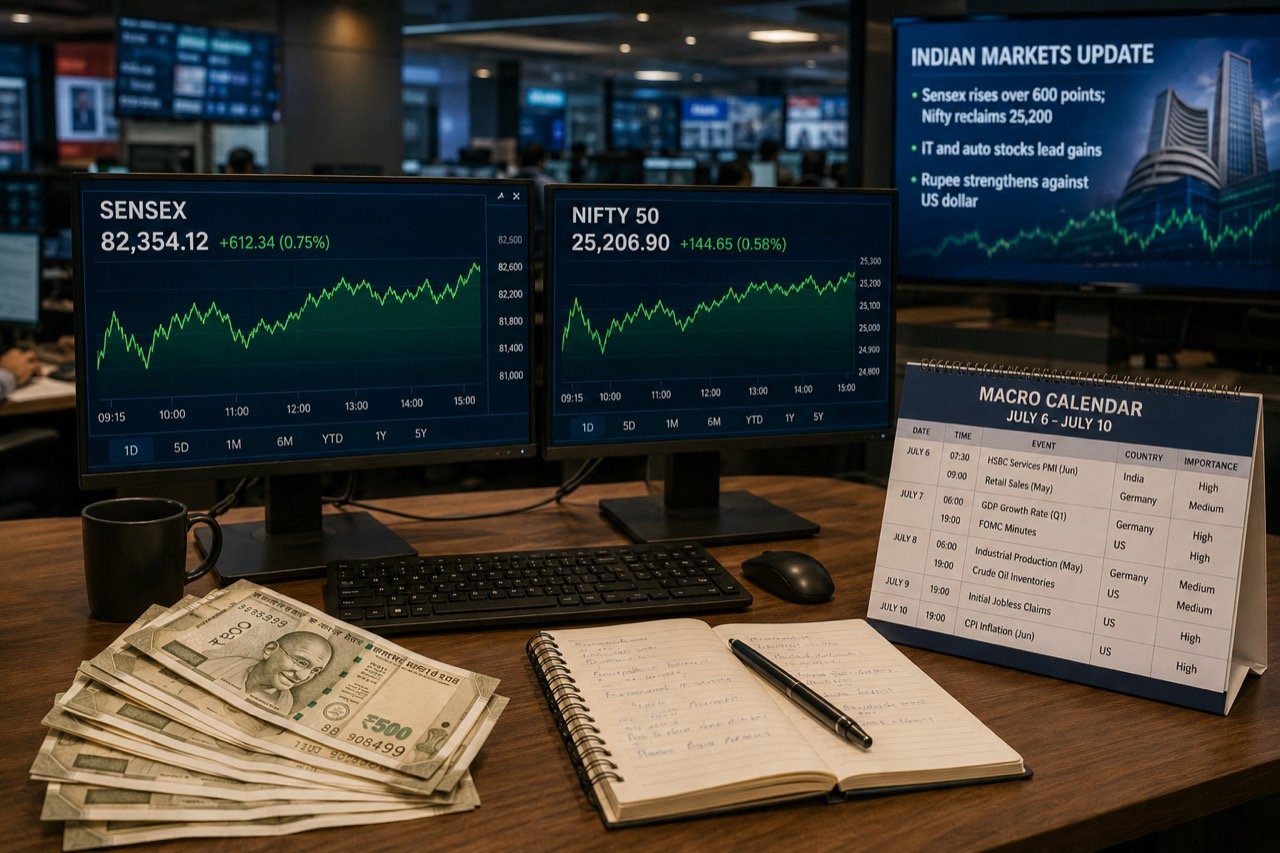
Sensex, Nifty Week Ahead: Trade Deal Hopes and Q1 Earnings in Focus
Indian equities enter a news-heavy week with trade-deal expectations, quarterly earnings, foreign flows and global cues all converging to set the direction for the Sensex and Nifty.

India Targets $1 Trillion in FY26 Exports as Trade Push Widens
The commerce ministry has reaffirmed a $1 trillion export goal for FY26 at a Board of Trade meeting led by Piyush Goyal, leaning on a seven-point action plan spanning merchandise, services and defence exports.
More from this section
More
Adani Case: US DOJ Pushes for Permanent Dismissal of Charges
The US Department of Justice has urged a judge to permanently dismiss charges against Gautam Adani, calling the case legally flawed — a reversal with consequences for markets, diplomacy and cross-border enforcement.

Akasa Air Inducts 40th Aircraft in Indian Aviation Scale-Up
Akasa Air's 40th aircraft, ferried to Bengaluru via Seattle, Reykjavik and Cairo, marks a fleet milestone for the young carrier and a fresh signal that India's aviation market remains firmly in expansion mode.
BARC Ratings Suspension Leaves Indian TV Industry Flying Blind
BARC's pause on television ratings has put India's broadcast measurement system under fresh scrutiny, leaving broadcasters, advertisers and media planners without the weekly audience data that anchors the TV economy.