TCS Earnings, Crude Oil and Global Cues Set to Steer Dalal Street
Indian equities head into a cue-heavy week as the June-quarter earnings season opens with TCS, while crude oil prices and global risk signals shape how investors position across sectors.
Commentary & Analysis ·

Dalal Street enters the new trading week with an unusually crowded calendar of triggers. TCS kicks off the June-quarter earnings season, crude oil remains volatile, and global macro signals continue to swing risk appetite — a combination that gives investors their first company-level evidence after weeks of positioning on broad themes. The convergence matters because each signal pulls a different lever. IT results shape sentiment around export-facing technology stocks, while oil prices feed directly into inflation expectations, the current account math and input costs for sectors ranging from aviation to paints and oil marketing companies.
For much of the preceding weeks, markets have been trading on narrative rather than numbers — broad themes about rate trajectories, global risk appetite and sectoral rotation, with relatively little hard, audited evidence to test those narratives against. That changes this week. TCS's results are the first concrete data point of the new earnings season, and they arrive at a moment when investors are hungry for something more substantial than macro chatter to anchor their positioning.
Why TCS sets the tone
TCS traditionally opens India's IT reporting season, and its numbers tend to colour expectations for the entire sector. This is not simply a matter of TCS being the largest player by revenue; it is also a function of timing. Because TCS reports first, its commentary becomes the lens through which investors read every subsequent IT result that week and beyond. Investors will parse revenue growth, margins, deal pipeline commentary and demand signals from key Western markets, since these are the metrics that reveal whether enterprise technology spending is accelerating, stalling or merely holding steady.
Even cautious guidance can drag peers lower, while stronger-than-expected commentary can lift confidence across the board. This asymmetry is worth dwelling on. IT services stocks tend to move as a pack far more than fundamentals alone would justify, because the sector's fortunes are so closely tied to a shared set of external demand drivers — discretionary technology budgets in the United States and Europe, currency movements, and the pace at which large clients commit to multi-year deals. A single bellwether's tone on client budgets or project ramp-ups can therefore ripple through the valuations of companies that have not yet reported, simply because the market assumes shared exposure to the same demand environment.
For the wider market, IT is also one of the few sectors where India's fortunes are directly linked to the health of Western corporate spending. A soft print from TCS would not just be a company-specific concern; it would raise questions about whether global enterprises are tightening technology budgets more broadly, with implications for the rupee, for export revenues, and for the many mid-cap IT and technology-adjacent names that populate investor portfolios.
Crude oil, flows and the global backdrop
Crude remains the second big variable in this week's calculus. India imports the bulk of its oil, so sustained price moves ripple through inflation, fiscal assumptions and corporate margins in ways that are structural rather than incidental. A sustained rise in crude prices tends to widen the current account deficit, pressure the rupee, and squeeze margins at companies for whom fuel or petroleum-linked inputs are a major cost — this is why sectors such as aviation, paints and oil marketing companies are watched so closely whenever crude becomes volatile. Conversely, softer crude can ease some of that pressure, giving policymakers and corporates alike a little more room to manoeuvre.
Alongside oil, foreign investor flows, currency movement and global risk appetite will all feed into near-term direction. These are not independent variables — they interact. A weaker rupee driven by costlier oil imports can, for instance, make Indian equities look less attractive to foreign portfolio investors on a dollar-adjusted basis, even if local earnings are holding up. This is why the outlook for the week is best read as a web of interconnected signals rather than a checklist of isolated data points; it is a week to read domestic earnings and global macro together rather than in isolation.
The practical implication for investors is that no single number — not TCS's revenue growth, not a one-day move in Brent crude, not a single day of foreign institutional flows — should be treated as decisive on its own. It is the combination and the direction of travel across all three that will determine whether the week's tone is constructive or cautious.
What this means for different market participants
Institutional investors will likely use TCS's commentary on deal pipelines and margin trends as an input into sector allocation decisions across the broader IT basket, rather than reacting to the headline revenue number alone. Retail investors, by contrast, are more exposed to the temptation of reading too much into intraday price swings before the substance of management commentary has been fully absorbed by the market.
For sectors sensitive to crude — aviation, paints, tyres, and oil marketing companies among them — corporate treasurers and analysts will be watching not just the spot price but the trajectory, since input-cost planning and margin guidance for the coming quarters depend on whether current levels are seen as a temporary spike or a more durable shift. None of this amounts to a prediction of gains or losses. The outlook is best treated as a map of what markets will watch, with earnings commentary and management guidance likely to matter more than any single headline number.
The NE Times View
Weeks like this reward patience over reflexes. Retail investors are bombarded with intraday noise precisely when the genuinely useful information — audited results, management guidance, order-book detail — arrives on a slower clock. The temptation is to trade on headlines: a crude price tick, a single day's foreign flow number, a rumour about IT hiring. But headlines of this kind are, by their nature, noisy and often reversed within days, whereas the substance investors actually need — sustained trends in deal wins, margin trajectories, and management's own read on client budgets — takes longer to reveal itself and rewards those willing to wait for it.
The sensible play is to let TCS's commentary settle before extrapolating to the whole IT pack, and to treat crude-driven swings as macro weather rather than a verdict on individual businesses. Weather changes day to day; it does not, by itself, tell you whether a company's underlying business model is sound. Conflating the two — treating every oil price wobble as a referendum on a company's fundamentals — is a common and avoidable error. India's earnings season will supply real evidence soon enough; reacting to rumour ahead of it is how small portfolios get hurt. The discipline required here is not complicated, but it is uncomfortable: doing less, and waiting longer, than the news cycle seems to demand.
Key takeaways
- TCS's results open India's IT earnings season and typically set the tone for how the entire sector, and its peers, are read by the market.
- Crude oil price moves matter structurally for India because of its heavy import dependence, with knock-on effects for inflation, the current account and margins in oil-sensitive sectors like aviation and paints.
- Foreign investor flows, currency movement and global risk appetite are interlinked with both earnings and oil, meaning the week's direction should be read holistically rather than through any single data point.
- Management commentary and guidance are likely to matter more than headline revenue or profit figures in shaping how markets interpret this earnings season.
- The prudent approach for investors is to wait for audited results and detailed guidance to settle before reacting, rather than trading on intraday noise or rumour.
You may also like to read
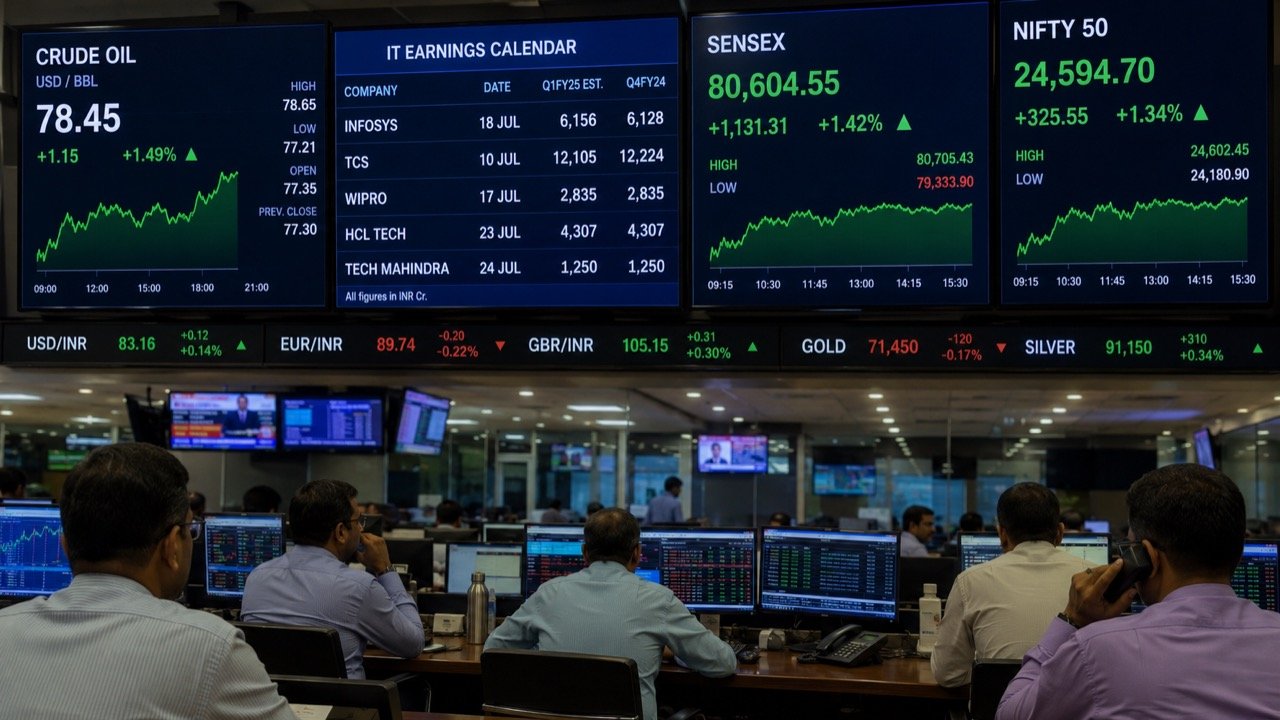
TCS Earnings, Crude Oil and Macro Cues to Steer Markets This Week
Indian equities head into the week with attention split between the start of earnings season led by TCS, movements in crude oil prices, and a stream of macro signals shaping investor sentiment.

Sensex Crashes Nearly 900 Points as Global Risk-Off Mood Hits Indian Markets
Indian equities tumbled on Tuesday as the Sensex shed about 893 points and the Nifty slipped below 23,900, dragged by weak global cues, IT and metal selling and foreign outflow fears.
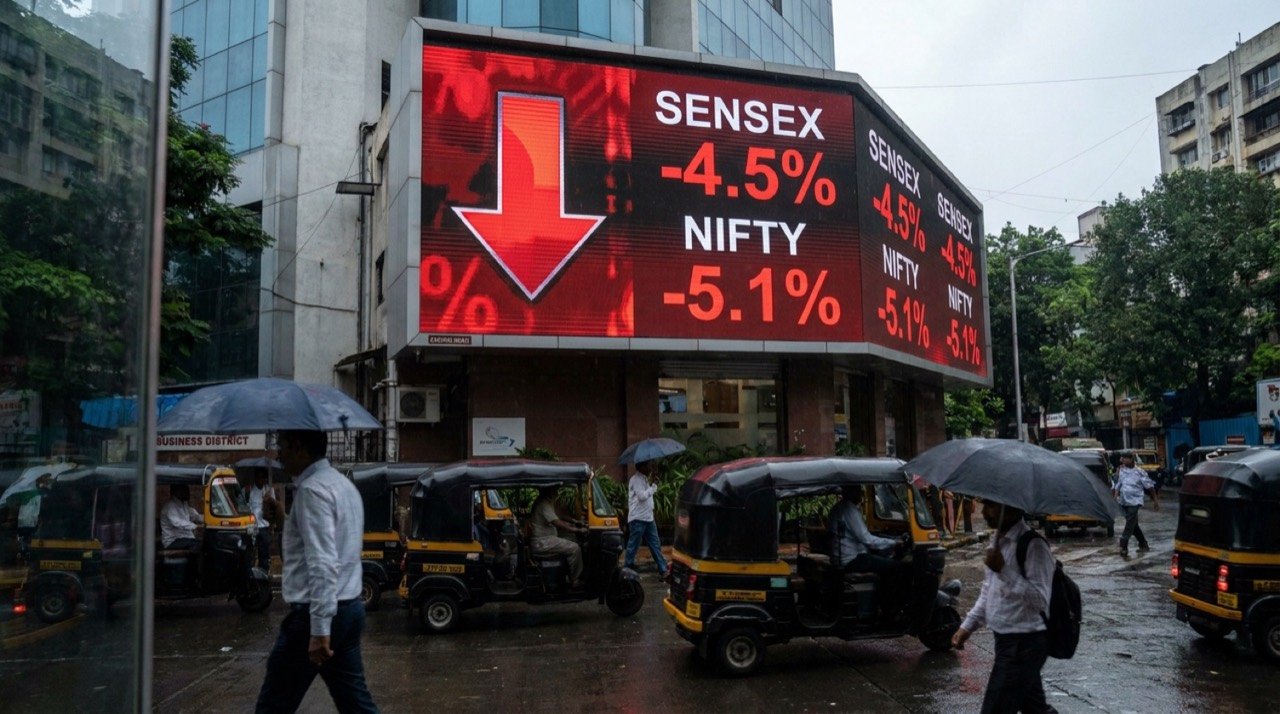
Sensex Sheds 893 Points as Global Risk and West Asia Tensions Weigh on Indian Equities
Indian benchmark indices closed sharply lower on June 23 as weak global cues and West Asian uncertainty dragged the Sensex below 76,300 and the Nifty under 23,850.

Sensex Drops 372 Points, Nifty Slips Below 24,000 On IT, Auto Drag
Indian benchmarks closed lower on June 29 as the Sensex fell 372 points to 76,728 and the Nifty ended at 23,946, with IT, auto and oil and gas stocks dragging while pharma outperformed.
More from this section
More
Adani Case: US DOJ Pushes for Permanent Dismissal of Charges
The US Department of Justice has urged a judge to permanently dismiss charges against Gautam Adani, calling the case legally flawed — a reversal with consequences for markets, diplomacy and cross-border enforcement.

Akasa Air Inducts 40th Aircraft in Indian Aviation Scale-Up
Akasa Air's 40th aircraft, ferried to Bengaluru via Seattle, Reykjavik and Cairo, marks a fleet milestone for the young carrier and a fresh signal that India's aviation market remains firmly in expansion mode.
BARC Ratings Suspension Leaves Indian TV Industry Flying Blind
BARC's pause on television ratings has put India's broadcast measurement system under fresh scrutiny, leaving broadcasters, advertisers and media planners without the weekly audience data that anchors the TV economy.