TCS Earnings, Crude Oil and Macro Cues to Steer Markets This Week
Indian equities head into the week with attention split between the start of earnings season led by TCS, movements in crude oil prices, and a stream of macro signals shaping investor sentiment.
Commentary & Analysis ·
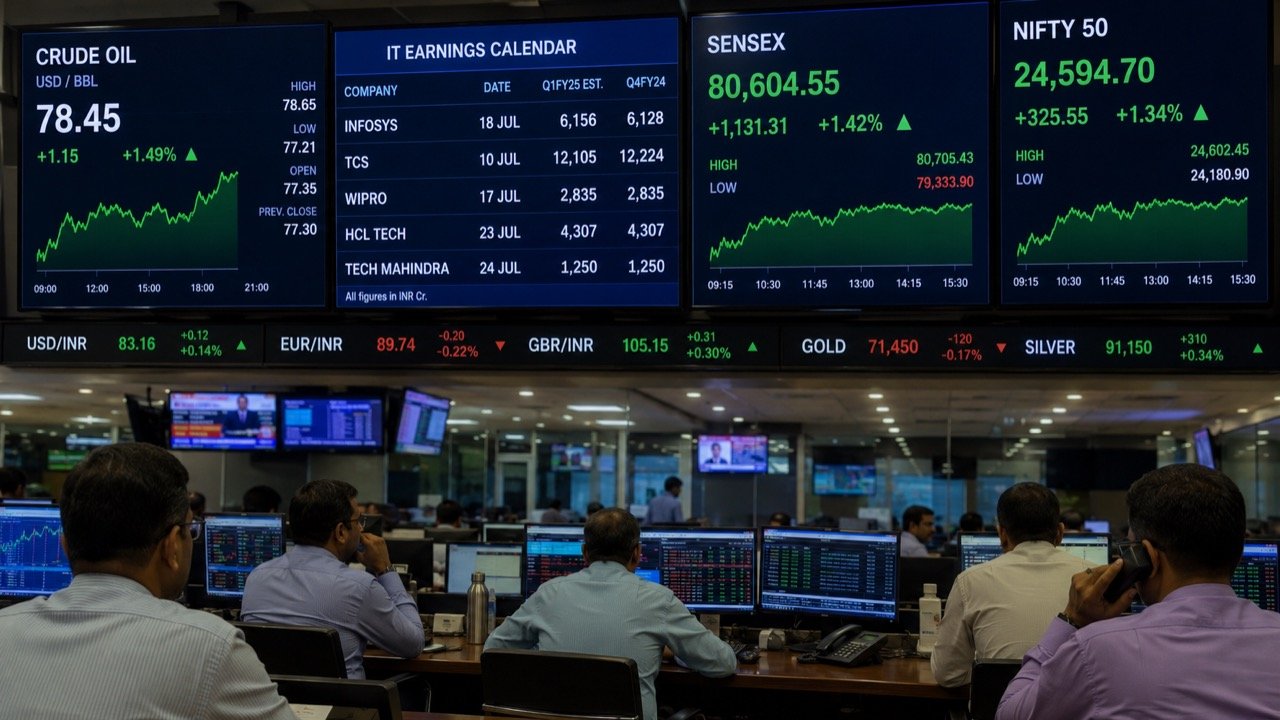
Indian markets enter the new trading week with no single dominant driver but plenty of crosscurrents. Investors are expected to track crude oil prices, the opening act of the corporate earnings season and a set of broader macro signals, with Tata Consultancy Services' results flagged among the key triggers to watch. Rather than a clean narrative in one direction, the week is shaping up as a test of how well markets can process several moving parts at once, none of which is decisive on its own.
Earnings season opens with IT in focus
TCS traditionally sets the tone for the results season, and its numbers will help investors judge whether technology demand and margins are holding up. As the bellwether that reports first among the major IT services firms, its results function almost like an advance signal for the sector as a whole, shaping expectations for the peers that follow in the coming weeks. Management commentary on deal pipelines and client spending is likely to matter as much as the headline figures, since it offers a read on how global corporations are budgeting for the year ahead.
This distinction between the headline numbers and the management commentary is worth dwelling on. Revenue and profit figures describe what has already happened in the quarter gone by; forward-looking commentary on deal wins, client budgets and discretionary spending describes what is likely to happen next. For a sector as globally exposed as Indian IT services, where a large share of revenue comes from clients in North America and Europe, the tone of that commentary can reveal whether overseas corporations are tightening technology budgets, holding steady, or beginning to loosen purse strings again. Investors will therefore be listening less for a single blockbuster number and more for the qualitative signal embedded in how executives describe the pipeline.
Crude prices and the macro backdrop
Crude oil remains a swing factor for Indian assets. Because the country imports a large share of its oil needs, softer or stable prices ease pressure on the trade balance, inflation and corporate input costs, while any spike works in the opposite direction. This is one of the more mechanical transmission channels in Indian macroeconomics: a rise in crude prices widens the import bill, weakens the currency, feeds into inflation readings, and eventually filters into decisions on interest rates. Companies that rely on crude-linked inputs, from paints to tyres to aviation, also see their cost structures shift with the price of the barrel, which in turn affects corporate earnings and equity valuations.
Alongside oil, macro data releases, foreign investor flows and global interest-rate expectations are all in the mix for sentiment. Foreign portfolio flows in particular tend to be sensitive to the interest-rate outlook in developed markets, since a more attractive yield elsewhere can draw capital away from emerging markets such as India, while an easier global rate environment tends to support flows back in. None of these factors moves in isolation, and their combined effect is what makes weeks like this difficult to characterise with a single storyline.
Why no single trigger dominates
The balanced reading is that no single trigger will decide market direction on its own. Traders are likely to respond to the combination of earnings commentary, oil movement and global risk appetite, making this a week where headlines from several fronts could pull indices in different directions. This kind of multi-driver environment is arguably more common than the simpler narratives that dominate financial headlines, where a single data point or announcement is often credited with moving an entire market. In practice, sentiment is usually the product of several inputs landing at once, and this week appears to be a clear example of that dynamic playing out across sectors as varied as technology, energy-sensitive industries and rate-sensitive segments of the market.
For sector-specific investors, this also means correlations may behave unusually. A strong TCS print could lift IT stocks even as a crude price uptick weighs on paint, tyre or aviation counters on the same trading day. Broader indices, which aggregate these divergent sectoral moves, may consequently show more muted net movement than the underlying volatility within individual sectors would suggest.
What ordinary investors should watch
For most retail investors, the practical question is not which of these triggers will fire first, but how to interpret the resulting noise without overreacting. Earnings season commentary, in particular, tends to generate a steady stream of analyst notes, target price revisions and media coverage, much of which is calibrated to short-term trading rather than the kind of multi-year horizon that most long-term savers should be working with. Crude oil price moves, similarly, generate daily headlines that can feel urgent but often average out over the medium term. Recognising the difference between information that changes a long-term thesis and information that merely adds short-term volatility is one of the more valuable skills an investor can develop during weeks like this.
The NE Times View
Weeks like this reward patience over prediction. With earnings, oil and global cues all in play, chasing every intraday swing is a losing game for ordinary investors. The more useful exercise is to listen to what TCS and its peers say about demand, because that commentary shapes the earnings narrative for the whole quarter. It is worth remembering that the value of this commentary lies less in any single soundbite and more in the cumulative picture it builds as more companies report through the season, giving a fuller sense of whether the broader economy, both in India and among its major trading partners, is accelerating, stabilising or slowing.
For long-term savers, a news-heavy week is a reminder that systematic investing exists precisely so you do not have to guess which of five triggers will fire first. Rather than trying to time entry or exit points around oil price swings or an earnings print, a disciplined approach that stays invested through the noise tends to capture the underlying growth in earnings and the economy without the added risk of mistiming a call on any one variable. This is a week to watch closely, not trade impulsively. The signals worth tracking, TCS's deal pipeline commentary, the direction of crude prices, and shifts in foreign investor sentiment, are best absorbed as inputs into a longer-term view rather than triggers for immediate action.
Key takeaways
- TCS's results open the earnings season and its commentary on deal pipelines and client spending matters as much as the headline numbers.
- Crude oil prices remain a key swing factor for India given its heavy reliance on imported oil, affecting the trade balance, inflation and corporate costs.
- Macro data, foreign investor flows and global interest-rate expectations add further layers of uncertainty to market direction this week.
- No single trigger is likely to dominate; markets will likely respond to the combined effect of earnings, oil and global risk appetite.
- Long-term investors are best served by systematic investing and patience rather than attempting to trade around each individual signal.
You may also like to read

TCS Earnings, Crude Oil and Global Cues Set to Steer Dalal Street
Indian equities head into a cue-heavy week as the June-quarter earnings season opens with TCS, while crude oil prices and global risk signals shape how investors position across sectors.

FIIs Offload Rs 1,350 Crore As DIIs Step In To Steady Markets
Foreign institutional investors sold Indian equities worth Rs 1,350 crore on June 29 while domestic institutions bought Rs 2,801 crore, cushioning benchmarks on a volatile day that ended in the red.

Sensex Crashes Nearly 900 Points as Global Risk-Off Mood Hits Indian Markets
Indian equities tumbled on Tuesday as the Sensex shed about 893 points and the Nifty slipped below 23,900, dragged by weak global cues, IT and metal selling and foreign outflow fears.
Fuel Marketing Margins Rebound for Indian OMCs as Crude Eases After West Asia Shock
Petrol and diesel marketing margins at state-run oil firms BPCL, IOC and HPCL are recovering as crude prices ease, brightening the profit outlook even as inventory losses and LPG under-recoveries cloud the June quarter.
More from this section
More
Adani Case: US DOJ Pushes for Permanent Dismissal of Charges
The US Department of Justice has urged a judge to permanently dismiss charges against Gautam Adani, calling the case legally flawed — a reversal with consequences for markets, diplomacy and cross-border enforcement.

Akasa Air Inducts 40th Aircraft in Indian Aviation Scale-Up
Akasa Air's 40th aircraft, ferried to Bengaluru via Seattle, Reykjavik and Cairo, marks a fleet milestone for the young carrier and a fresh signal that India's aviation market remains firmly in expansion mode.
BARC Ratings Suspension Leaves Indian TV Industry Flying Blind
BARC's pause on television ratings has put India's broadcast measurement system under fresh scrutiny, leaving broadcasters, advertisers and media planners without the weekly audience data that anchors the TV economy.