FIIs Offload Rs 1,350 Crore As DIIs Step In To Steady Markets
Foreign institutional investors sold Indian equities worth Rs 1,350 crore on June 29 while domestic institutions bought Rs 2,801 crore, cushioning benchmarks on a volatile day that ended in the red.
Commentary & Analysis ·

Institutional flow data for June 29 captured a now-familiar tug of war in Indian equities. Foreign institutional investors were net sellers to the tune of Rs 1,350 crore, while domestic institutional investors stepped in as net buyers of Rs 2,801 crore, according to market data reported by Moneycontrol. The session itself ended lower, with volatility picking up. On the surface, this looks like an unremarkable data point buried in the daily churn of market reporting. Look a little closer, however, and it captures something more interesting: a running contest between two very different pools of capital, each with its own motivations, time horizons and constraints, and the way that contest plays out has quietly become one of the more important undercurrents shaping Indian equities.
Why flow data matters
Flow numbers are among the most closely tracked daily indicators because they help explain why markets hold up, or fail to, under pressure. Foreign selling tends to weigh on indices, particularly large-cap names where FII ownership is concentrated. These are typically the most liquid, most widely held stocks in the market, the ones foreign funds can enter and exit quickly without moving prices too much against themselves. That liquidity is precisely why they are also the first to feel the impact when foreign money heads for the exit. Domestic buying, driven by mutual funds and insurance-linked investors, can absorb much of that pressure, but the mechanics of how it does so are worth understanding rather than taking for granted. Mutual funds sitting on inflows from systematic investment plans, and insurers managing large pools of premium income, do not typically trade on the same short-term triggers as foreign funds. Their buying tends to be programmatic, spread out, and less reactive to any single day's headlines, which is exactly what gives it the stabilising character analysts keep pointing to.
Domestic liquidity as a shock absorber
The June 29 pattern fits a recurring theme in recent years: global risk-off episodes push foreign money out of Indian equities, but steady domestic inflows soften the blow. This does not guarantee that indices rise, but it can limit the depth of corrections and shift how individual sectors behave during a sell-off. It is worth being precise about what this mechanism can and cannot do. It cannot repeal the logic of valuations, nor can it insulate India entirely from a genuinely severe global shock. What it can do, and evidently has been doing, is change the shape of the decline, turning what might once have been a sharp, disorderly sell-off into something closer to an orderly, cushioned adjustment. For a market that has historically been criticised for its sensitivity to foreign sentiment, that is not a trivial change. It affects how much damage a bad global news cycle does to Indian portfolios, how quickly sentiment recovers, and how much volatility ordinary investors are exposed to along the way.
Reading the signal, and its limits
Analysts caution against treating a single day's data as a trend. FII behaviour swings with the rupee, crude oil prices, US interest rates and global risk appetite, while DII buying reflects domestic fund inflows and allocation calls. The meaningful signal emerges only when a pattern persists across several sessions. This caution deserves to be taken seriously rather than treated as boilerplate. A single day of FII selling against DII buying could reflect nothing more than portfolio rebalancing by one or two large foreign funds, or a temporary reallocation decision within a domestic institution, rather than any broader judgement about India's prospects. It is the accumulation of such days into a pattern, sustained over weeks or months, that actually tells a story about where conviction lies. Conflating a single session with a durable trend is one of the more common ways that market commentary misleads rather than informs, and it is worth resisting even when the numbers on a given day seem to fit a satisfying narrative.
What retail investors should take away
For retail participants, flow data is context, not a trading system. It frames why the market moved, but it is no substitute for company fundamentals, valuation discipline and sensible risk management. There is a temptation, especially among newer investors, to treat FII and DII numbers as a kind of scoreboard, buying when domestic money is winning and growing anxious when foreign money is retreating. That instinct is understandable but ultimately unhelpful. Flow data explains the weather, not the underlying climate of a company's earnings power, balance sheet strength or competitive position. An investor who lets daily institutional flows dictate individual stock decisions is, in effect, outsourcing judgement to a metric that was never designed to carry that weight. The more productive use of this data is as background awareness, useful for understanding market-wide moves, but not a substitute for the slower, more deliberate work of evaluating what one actually owns.
The NE Times View
The real story in these numbers is the quiet structural shift in who owns India's stock market. A decade ago, an FII selling day of this size would have rattled the indices far more; today, the SIP-fuelled wall of domestic money routinely absorbs foreign exits. That is a source of genuine resilience, but it carries its own risk: domestic investors are increasingly the marginal buyers at elevated valuations, and their conviction has not yet been tested by a prolonged bear market. It is one thing for domestic flows to steady a market during a single volatile session; it is quite another for that same wall of money to hold firm through months of falling prices, disappointing earnings, and eroding sentiment, the conditions under which even the most disciplined systematic investors have historically been tempted to redeem rather than continue investing. Readers should welcome the stability domestic flows provide while remembering that liquidity support is not the same as value. A market propped up by steady buying can still be expensively priced, and the presence of a reliable buyer says nothing about whether the price being paid is reasonable. Watching whether DIIs keep buying through a sustained global downturn will tell us far more than any single session's data, and it is that longer test, not any one day's tug of war between foreign sellers and domestic buyers, that will ultimately reveal how durable India's new ownership structure really is.
Key takeaways
- On June 29, FIIs were net sellers of Rs 1,350 crore while DIIs were net buyers of Rs 2,801 crore, and the session still closed lower amid rising volatility.
- Domestic institutional buying, powered by mutual fund SIP inflows and insurance-linked investment, has increasingly acted as a cushion against foreign selling in India's large-cap stocks.
- Analysts stress that a single day of divergent FII-DII flows is not a trend; the signal that matters emerges only when such patterns persist across multiple sessions.
- Retail investors should treat flow data as context for market moves, not as a substitute for fundamental analysis, valuation discipline and risk management.
- The structural rise of domestic ownership offers real resilience, but its true test will come only if DII buying continues through a prolonged, sustained global downturn.
You may also like to read

Netweb Shares Slide 11% Before Board Meets On Fundraise Plan
Netweb Technologies India stock logged its steepest single-day fall since January 2025, dropping as much as 11 percent after the company said its board would meet to consider raising fresh capital.

Sensex Drops 372 Points, Nifty Slips Below 24,000 On IT, Auto Drag
Indian benchmarks closed lower on June 29 as the Sensex fell 372 points to 76,728 and the Nifty ended at 23,946, with IT, auto and oil and gas stocks dragging while pharma outperformed.
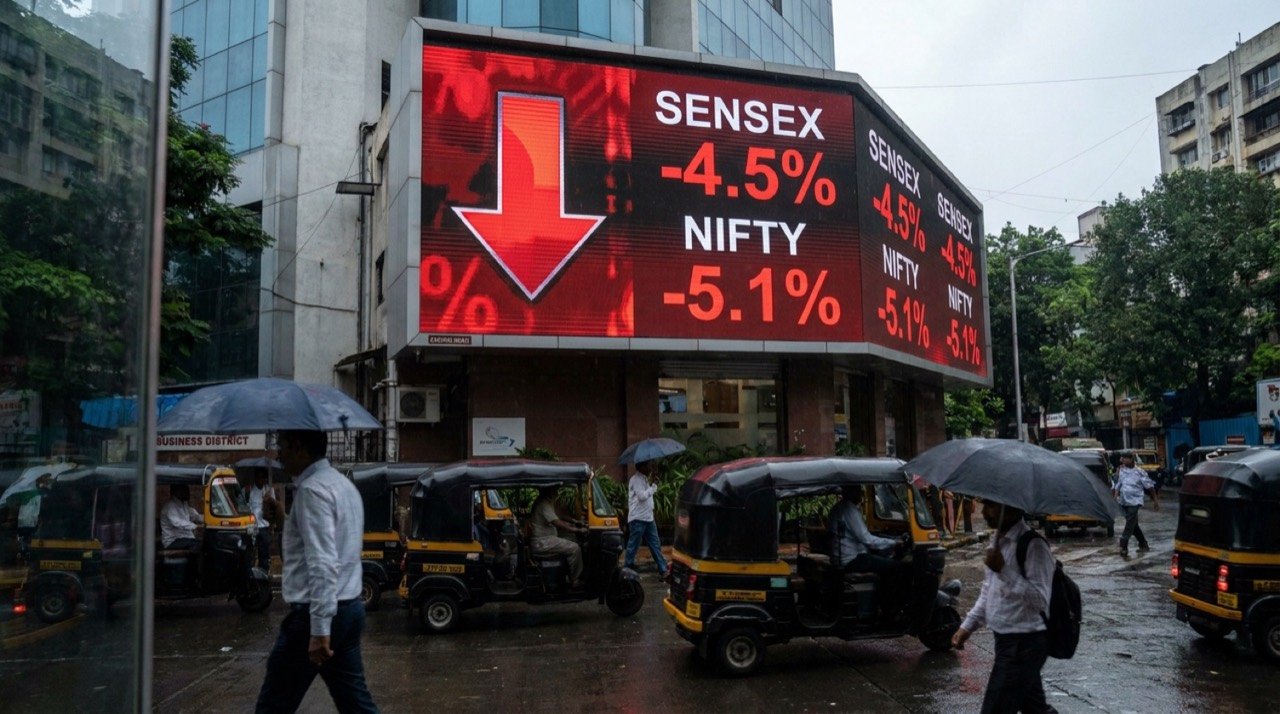
Sensex Sheds 893 Points as Global Risk and West Asia Tensions Weigh on Indian Equities
Indian benchmark indices closed sharply lower on June 23 as weak global cues and West Asian uncertainty dragged the Sensex below 76,300 and the Nifty under 23,850.

Sensex Crashes Nearly 900 Points as Global Risk-Off Mood Hits Indian Markets
Indian equities tumbled on Tuesday as the Sensex shed about 893 points and the Nifty slipped below 23,900, dragged by weak global cues, IT and metal selling and foreign outflow fears.
More from this section
More
Adani Case: US DOJ Pushes for Permanent Dismissal of Charges
The US Department of Justice has urged a judge to permanently dismiss charges against Gautam Adani, calling the case legally flawed — a reversal with consequences for markets, diplomacy and cross-border enforcement.

Akasa Air Inducts 40th Aircraft in Indian Aviation Scale-Up
Akasa Air's 40th aircraft, ferried to Bengaluru via Seattle, Reykjavik and Cairo, marks a fleet milestone for the young carrier and a fresh signal that India's aviation market remains firmly in expansion mode.
BARC Ratings Suspension Leaves Indian TV Industry Flying Blind
BARC's pause on television ratings has put India's broadcast measurement system under fresh scrutiny, leaving broadcasters, advertisers and media planners without the weekly audience data that anchors the TV economy.