Netweb Shares Slide 11% Before Board Meets On Fundraise Plan
Netweb Technologies India stock logged its steepest single-day fall since January 2025, dropping as much as 11 percent after the company said its board would meet to consider raising fresh capital.
Commentary & Analysis ·

Shares of Netweb Technologies India came under heavy selling pressure on June 29, sliding as much as 11 percent in what reports described as the stock's sharpest single-day decline since January 2025. The trigger was straightforward on paper: the company announced that its board would convene to consider a fundraise. Yet the market's reaction was swift and severe, disproportionate, on the face of it, to a routine corporate governance step. That disproportion is itself the story. Netweb has ridden one of the Indian market's most fashionable investment themes, high-performance computing and AI infrastructure, and the episode is a useful case study in how richly valued, narrative-driven stocks behave when confronted with even mundane uncertainty.
A single announcement, an outsized reaction
An 11 percent single-day fall is a significant move for any listed company, let alone one that has been treated by investors as a proxy for India's AI and compute build-out. What makes the reaction notable is that the news itself, a board meeting to consider a fundraise, contains no information about size, structure, pricing or purpose. Markets were not reacting to a defined plan; they were reacting to the mere possibility of one. That is a telling signal about how the stock had been priced coming into the announcement. When a company is trading on optimism about future growth rather than on established, predictable earnings, any development that introduces ambiguity, however procedural, tends to be punished quickly and disproportionately. The sell-off says as much about the starting valuation as it does about the fundraise itself.
Why a fundraise announcement unsettles investors
A capital-raising announcement is not inherently negative news. Companies raise capital for entirely constructive reasons: to fund expansion, invest in new manufacturing or server capacity, strengthen balance sheets ahead of larger opportunities, or reduce reliance on debt. But until the structure, size and purpose of a raise are disclosed, markets default to pricing in the worst-case scenario. Three questions dominate investor thinking in this kind of vacuum. First, dilution: how many new shares will be issued, and at what cost to existing shareholders' proportional ownership and earnings per share. Second, valuation: at what price will new capital be raised relative to the prevailing market price, and does that pricing implicitly signal that management views the current valuation as full, or even generous. Third, timing: why now, and does the urgency of the move hint at needs beyond straightforward growth funding. None of these questions can be answered from a bare announcement that a board will "consider" a fundraise. That interpretive gap is where share prices become volatile, and it explains why a pre-meeting sell-off does not necessarily represent a market verdict on the company's underlying strategy. More often, it reflects investors marking down the stock until the ambiguity is resolved, with the option to mark it back up once clarity arrives.
The particular vulnerability of AI-linked stocks
This episode also illustrates the demanding expectations attached to companies positioned within India's AI and server-infrastructure story. Firms exposed to this theme, supplying the servers, computing hardware and data-centre infrastructure that underpin artificial intelligence workloads, have attracted intense investor enthusiasm as India seeks to build out its domestic digital and compute capacity. That enthusiasm has translated into premium valuations, and premium valuations come with a trade-off: they leave far less margin for error or ambiguity than valuations grounded in more conservative assumptions. A stock priced for rapid, uninterrupted growth has, in effect, already spent much of its future good news. When any development, even one as neutral as a scheduled board meeting, threatens to complicate that growth narrative, the market's response tends to be swift and outsized, precisely because there is so little valuation cushion to absorb the shock. This is not unique to Netweb; it is a structural feature of investing in thematic, narrative-led sectors, and it is worth bearing in mind by anyone holding a portfolio tilted toward India's AI infrastructure buildout more broadly.
What happens next: the board's decision and its fine print
The next milestone for shareholders is straightforward: the board's decision itself, and crucially, the details that accompany it. Markets will be looking closely at the quantum of the raise relative to the company's existing market capitalisation, the instrument chosen (whether equity, convertible instruments, or another route), the price at which any new shares are issued relative to recent trading levels, and, most importantly, management's stated rationale for the funds. A raise earmarked for capacity expansion, new manufacturing lines, or scaling up server and data-centre capability would likely be read as consistent with the growth story that has attracted investors in the first place. A raise whose purpose is less clearly tied to growth, or whose terms suggest significant dilution at an unfavourable price, would be read far more sceptically, and could compound rather than resolve the uncertainty that triggered the initial sell-off.
The NE Times View
The 11 percent drop says more about the market's nerves than about Netweb's fundamentals. Indian investors have bid AI infrastructure names to valuations that leave little room for ambiguity, so even a routine corporate action like a fundraise consideration becomes a stress test. If the board presents a clearly articulated, growth-focused raise with sensible dilution, the sell-off may prove an overreaction, the kind of knee-jerk repricing that reverses once facts replace speculation. If the rationale is vague, or the terms appear to favour the company's immediate liquidity needs over shareholder value, the correction could mark the start of a broader reality check for the sector, one in which investors begin applying more rigorous scrutiny to other richly valued AI infrastructure names as well. Either way, retail investors who have been chasing the AI theme in Indian markets should treat this as a reminder that hot narratives still answer to cold capital-markets arithmetic. Enthusiasm for a sector's long-term prospects does not exempt individual stocks from the ordinary mechanics of dilution, valuation discipline and disclosure. The coming board decision will be an early test of whether Netweb's premium positioning in India's compute infrastructure story can withstand a dose of old-fashioned financial scrutiny.
Key takeaways
- Netweb Technologies shares fell as much as 11 percent on June 29, their sharpest single-day decline since January 2025, after the company said its board would meet to consider a fundraise.
- The sell-off reflects investor uncertainty over dilution, valuation and timing rather than any confirmed negative detail, since the structure and purpose of the raise have not yet been disclosed.
- Premium valuations attached to India's AI and server-infrastructure theme leave little room for ambiguity, making such stocks prone to sharp reactions even to routine corporate announcements.
- The board's eventual decision, and specifically the size, pricing and stated purpose of any raise, will determine whether the sell-off was an overreaction or the start of a broader repricing.
- The episode is a reminder that thematic, narrative-driven stocks remain subject to conventional capital-markets discipline, regardless of investor enthusiasm for the underlying sector.
You may also like to read

FIIs Offload Rs 1,350 Crore As DIIs Step In To Steady Markets
Foreign institutional investors sold Indian equities worth Rs 1,350 crore on June 29 while domestic institutions bought Rs 2,801 crore, cushioning benchmarks on a volatile day that ended in the red.
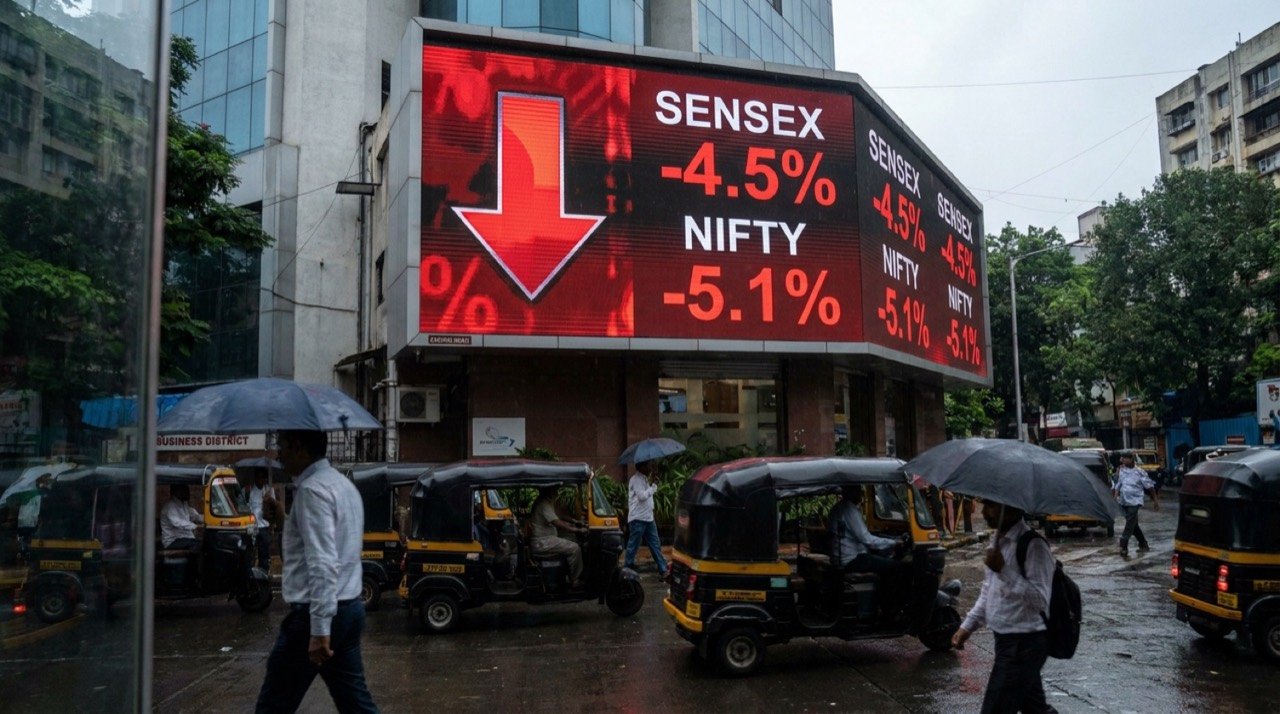
Sensex Sheds 893 Points as Global Risk and West Asia Tensions Weigh on Indian Equities
Indian benchmark indices closed sharply lower on June 23 as weak global cues and West Asian uncertainty dragged the Sensex below 76,300 and the Nifty under 23,850.
Union Bank Shares Fall After Q1 Update and Management Changes
Union Bank of India stock slipped after its June-quarter business update showed slower deposit growth alongside stronger advances, with senior management changes adding to investor caution.

Sensex Climbs Around 291 Points, Nifty Closes Above 24,100 as IT and Pharma Shares Lift Market
Indian equities rebounded on June 22, 2026, with the Sensex gaining about 291 points and the Nifty closing above 24,100, led by IT and pharmaceutical stocks despite lingering Middle East tensions.
More from this section
More
Adani Case: US DOJ Pushes for Permanent Dismissal of Charges
The US Department of Justice has urged a judge to permanently dismiss charges against Gautam Adani, calling the case legally flawed — a reversal with consequences for markets, diplomacy and cross-border enforcement.

Akasa Air Inducts 40th Aircraft in Indian Aviation Scale-Up
Akasa Air's 40th aircraft, ferried to Bengaluru via Seattle, Reykjavik and Cairo, marks a fleet milestone for the young carrier and a fresh signal that India's aviation market remains firmly in expansion mode.
BARC Ratings Suspension Leaves Indian TV Industry Flying Blind
BARC's pause on television ratings has put India's broadcast measurement system under fresh scrutiny, leaving broadcasters, advertisers and media planners without the weekly audience data that anchors the TV economy.