Sensex, Nifty Week Ahead: Trade Deal Hopes and Q1 Earnings in Focus
Indian equities enter a news-heavy week with trade-deal expectations, quarterly earnings, foreign flows and global cues all converging to set the direction for the Sensex and Nifty.
Commentary & Analysis ·
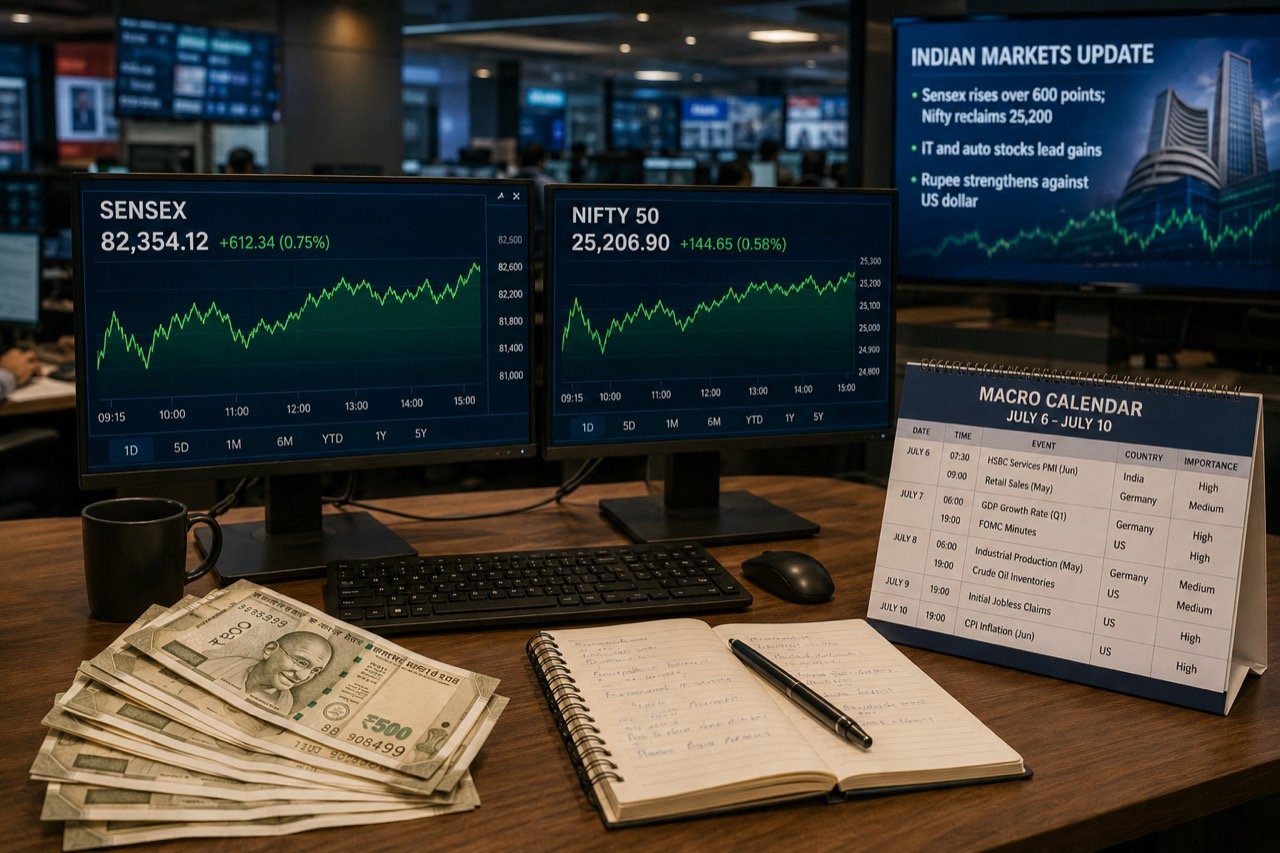
Indian equities head into the new week with an unusually crowded calendar of catalysts. Market reports point to trade-deal expectations, the start of the quarterly earnings season, global risk appetite and sector-specific momentum as the forces most likely to steer the Sensex and Nifty over the coming sessions. That such a wide range of drivers is converging at once is itself notable: it means the market's next move is unlikely to be decided by any single headline, but by how several storylines resolve together over the course of the week.
What is supporting the mood
The immediate tone has been lifted by hopes of clearer external trade arrangements and by resilient domestic flows, which have repeatedly cushioned Indian markets against global wobbles. This is a pattern that has recurred often enough in recent years to become something of a working assumption among traders: when global sentiment turns choppy, steady buying from domestic institutions and retail-linked flows tends to absorb the shock, at least in the short run. Search interest around the market's weekly outlook and trade-deal headlines suggests both retail and institutional investors are hunting for practical signals rather than broad narratives. In other words, participants are not simply content to hear that talks are progressing; they want to know what a prospective trade arrangement would actually mean for specific sectors, tariff lines and company earnings, because that is what ultimately gets priced into a share.
This appetite for specificity over sentiment is itself a useful signal about where the market currently sits. When investors are searching for granular detail rather than reacting to broad optimism, it usually indicates that a good part of the easy, sentiment-driven rally has already happened, and that the market is now looking for confirmation before it is willing to extend gains further. That shift from narrative to detail is exactly the dynamic that tends to precede a more discerning, stock-by-stock phase of trading rather than a broad, indiscriminate rally.
The variables that could change sentiment
Markets rarely move on one story alone. Earnings guidance from early reporters, foreign portfolio flows, the rupee's trajectory, crude oil prices and commentary from global central banks can each shift sentiment quickly, particularly when valuations already price in good news. Each of these variables carries its own logic. Earnings guidance from the first companies to report in the Q1 season effectively sets the tone for how the broader results calendar will be read; if early numbers disappoint, investors tend to mark down expectations for the sectors that follow, even before those companies have reported. Foreign portfolio flows matter because they are typically the most reactive component of market liquidity, capable of reversing quickly if global risk appetite sours, and their direction over the coming days will say a great deal about how international investors are reading India relative to other emerging markets.
The rupee's trajectory and crude oil prices are linked in ways that are easy to underestimate. India remains a large net importer of oil, so a rise in crude prices tends to pressure the currency, and a weaker rupee in turn raises input costs for companies that import materials or service foreign-currency debt. Commentary from global central banks adds a further layer, since shifts in the expected path of interest rates elsewhere in the world influence how much capital flows into or out of emerging markets such as India. That makes confirmation the theme of the week: do results match the optimism, do global cues stay supportive, and do policy headlines harden into concrete agreements? None of these questions can be answered by sentiment alone; each requires evidence that accumulates only as the week's data and disclosures actually arrive.
Why the earnings season carries extra weight this time
The start of the quarterly earnings season matters more than usual precisely because so much optimism has already been built into current prices. When a market rallies ahead of results on the strength of expectation, the earnings season stops being a routine check-in and becomes the mechanism by which that expectation is tested against reality. Companies that merely meet forecasts may not be rewarded if the market had quietly priced in something better, while companies that fall short risk sharper-than-usual reactions precisely because there was little room built in for disappointment. This asymmetry is a normal feature of markets that have run ahead of confirmed news, and it is one reason traders tend to watch the first wave of results so closely rather than waiting for the full season to unfold.
Traders will track momentum day to day, while long-term investors will be watching whether fundamentals genuinely justify it. This difference in time horizon is worth dwelling on, because it explains why the same set of headlines can produce very different reactions depending on who is reading them. A short-term trader may treat a positive trade-deal headline as an immediate buying signal, since price momentum itself can be profitable regardless of whether the underlying story is fully confirmed. A long-term investor, by contrast, is less interested in the headline than in whether it eventually shows up in order books, revenue guidance and margin performance over subsequent quarters. Both groups are watching the same market, but they are effectively asking different questions of it.
The stakeholders with the most at stake
Retail investors, who have become an increasingly influential force in Indian equity flows in recent years, are perhaps the group most exposed to the gap between headline optimism and delivered results. Because retail participation has grown substantially, the collective behaviour of individual investors now has a more visible effect on daily market direction than it once did, which means their reaction to early earnings and trade-deal developments this week could itself become a market-moving factor. Domestic institutional investors, whose steady flows have often been credited with cushioning the market against global volatility, will be watching whether that role needs to continue or whether foreign portfolio investors return as net buyers. Exporters and import-dependent companies have a direct stake in how the rupee and crude oil move, since currency and input-cost shifts flow straight through to their margins. Policymakers, for their part, have an interest in seeing trade-deal talk translate into an actual agreement, both for the economic benefits it would bring and for the credibility of the optimism that markets have already extended to them.
What to watch as the week unfolds
Given how many variables are in play, the most useful approach for investors is likely to be sequential rather than trying to form a single view upfront. The earliest and most concrete data points will be the first wave of Q1 earnings and guidance commentary, which should offer the first hard test of whether current valuations are justified. Alongside that, daily movements in foreign portfolio flows, the rupee and crude oil prices will offer a running commentary on whether the external environment remains supportive. Finally, any shift from trade-deal talk to an actual, detailed agreement would represent the clearest possible upgrade in the quality of the news driving the market, moving it from expectation to fact. Until that shift happens, headlines about progress in trade talks should be treated as directional rather than decisive.
The NE Times View
The setup entering this week is classic late-cycle optimism: prices moving on promises before proof. For Indian retail investors, who now anchor market flows, the discipline that matters is separating headline hope from delivered earnings, a trade deal that remains a headline is not yet cash flow. We would treat any rally built purely on expectation as fragile and watch the first wave of Q1 numbers as the real referendum on valuations. India's macro story remains strong, but strong stories bought at high expectations still need results to keep paying. Investors would do well to resist treating optimistic headlines as a substitute for evidence, and instead use the coming days of earnings and flow data as the real test of whether the market's current mood is warranted.
Key takeaways
- The Sensex and Nifty face a crowded week of catalysts, including trade-deal hopes, the start of Q1 earnings, foreign portfolio flows, the rupee and crude oil prices, and global central bank commentary.
- Investor search behaviour suggests a shift from broad optimism toward demand for specific, verifiable signals, a sign that markets are entering a more discerning phase.
- Early Q1 earnings will carry outsized weight this week because current valuations already price in a degree of optimism that now needs to be confirmed by results.
- Retail investors, domestic institutions, exporters and policymakers each have distinct stakes in how the week's trade-deal and earnings news develops.
- The NE Times View: treat rallies built on expectation as fragile until a trade deal moves from headline to concrete agreement and Q1 results validate current valuations.
You may also like to read
Sensex Jumps 1,695 Points as Oil Slides on Peace-Deal Hopes
Indian equities staged one of their strongest sessions of the year after crude prices fell on reports of a possible US-Iran agreement, easing pressure on the oil-importing economy.

Sensex Drops 372 Points, Nifty Slips Below 24,000 On IT, Auto Drag
Indian benchmarks closed lower on June 29 as the Sensex fell 372 points to 76,728 and the Nifty ended at 23,946, with IT, auto and oil and gas stocks dragging while pharma outperformed.

Sensex Climbs Around 291 Points, Nifty Closes Above 24,100 as IT and Pharma Shares Lift Market
Indian equities rebounded on June 22, 2026, with the Sensex gaining about 291 points and the Nifty closing above 24,100, led by IT and pharmaceutical stocks despite lingering Middle East tensions.
Sensex and Nifty Slide as Global Tech Selloff Hits Indian Market Sentiment
Indian equities fell on Tuesday as weak global cues, including a sharp slide in South Korean technology shares, dragged the Sensex down nearly 900 points and pulled the Nifty lower.
More from this section
More
Adani Case: US DOJ Pushes for Permanent Dismissal of Charges
The US Department of Justice has urged a judge to permanently dismiss charges against Gautam Adani, calling the case legally flawed — a reversal with consequences for markets, diplomacy and cross-border enforcement.

Akasa Air Inducts 40th Aircraft in Indian Aviation Scale-Up
Akasa Air's 40th aircraft, ferried to Bengaluru via Seattle, Reykjavik and Cairo, marks a fleet milestone for the young carrier and a fresh signal that India's aviation market remains firmly in expansion mode.
BARC Ratings Suspension Leaves Indian TV Industry Flying Blind
BARC's pause on television ratings has put India's broadcast measurement system under fresh scrutiny, leaving broadcasters, advertisers and media planners without the weekly audience data that anchors the TV economy.