Sensex and Nifty Slide as Global Tech Selloff Hits Indian Market Sentiment
Indian equities fell on Tuesday as weak global cues, including a sharp slide in South Korean technology shares, dragged the Sensex down nearly 900 points and pulled the Nifty lower.
Commentary & Analysis ·
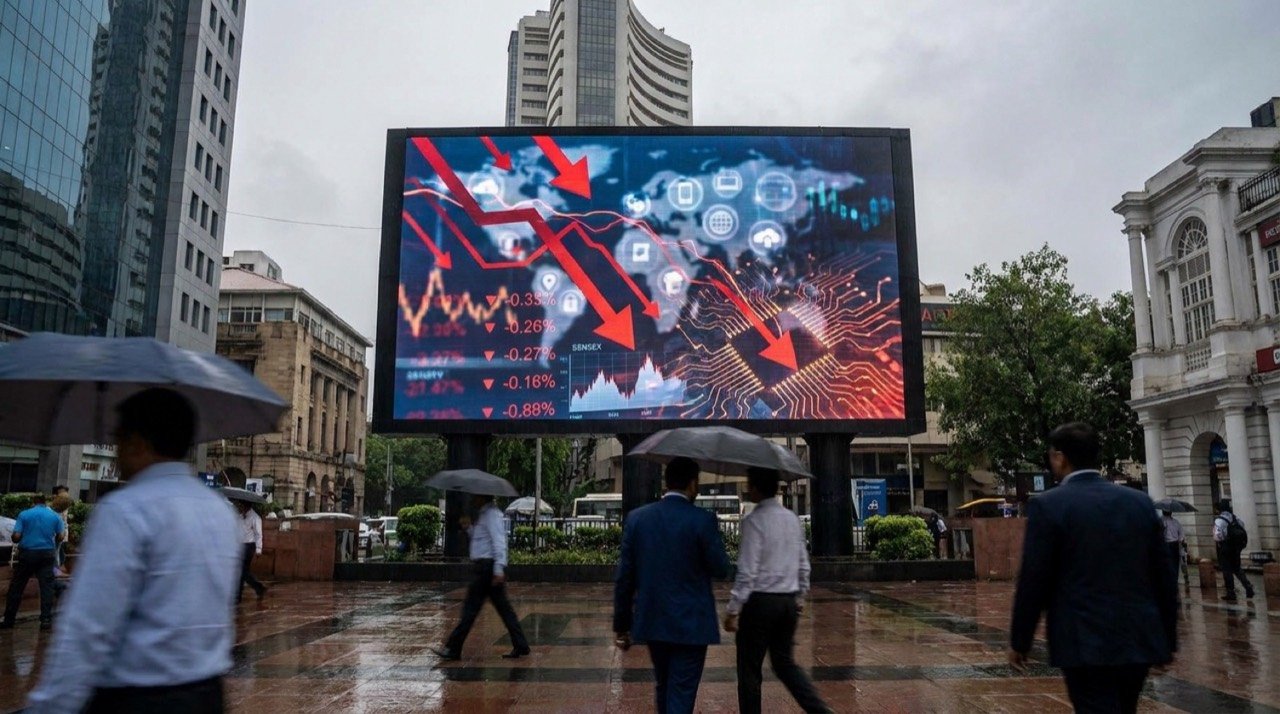
Indian equities came under pressure on Tuesday as weak global cues rattled investor sentiment, with a sharp fall in South Korean technology shares setting the tone for a risk-off session across Asia. The BSE Sensex closed almost 900 points lower while the Nifty also slipped, mirroring broader caution across regional markets as traders pulled back from risk in a single, fast-moving trading day. For a market that has spent much of the recent period drawing strength from a resilient domestic growth narrative, the session was a sharp reminder of how quickly sentiment can turn when the trigger originates far outside India's own borders.
What drove the fall
The trigger lay overseas. A slump in South Korean technology stocks, where an AI-fuelled rally had run hot enough to prompt a trading halt, spilled into regional sentiment and weighed on Indian benchmarks within a short window of trading. This is a familiar pattern in modern equity markets: a shock in one node of a tightly networked global system does not stay contained for long, particularly when that node sits at the centre of a theme, artificial intelligence, that investors everywhere have been chasing with similar enthusiasm and similar assumptions about future earnings.
Analysts pointed to a familiar mix of valuation concerns, profit booking and shifting overseas flows as investors reassessed how much risk they were willing to carry. After a strong run, stretched technology and AI-linked names looked vulnerable to even a modest change in mood. This is worth dwelling on. When valuations run ahead of near-term earnings, the market effectively prices in a benign, uninterrupted future. Any single data point, a halted trade, a disappointing print, a stray comment from a policymaker, can force a rapid recalibration, and because so many investors are positioned similarly, the unwind tends to be abrupt rather than gradual.
How exposed are Indian markets
The session was a reminder that domestic benchmarks remain tethered to international shocks, even when India's own growth story stays intact. Foreign portfolio flows and global sentiment can override local fundamentals over short horizons, transmitting volatility from one market to another almost mechanically. A fund manager based in Seoul or New York rebalancing a global technology allocation does not pause to consider whether Indian corporate earnings, consumption trends or policy settings have changed; the sell order in Mumbai follows the sell order in Seoul within minutes, driven by portfolio-level risk management rather than any reassessment of India-specific fundamentals.
That sensitivity is especially pronounced around technology and AI-linked themes, where global and Indian investors increasingly chase the same narratives and unwind them in tandem when sentiment sours. This is a structural feature of how capital moves in an interconnected world, not a one-off quirk of Tuesday's session. Indian technology and new-age listed names, along with broader benchmarks that carry meaningful weight in these sectors, are unlikely to be fully insulated from swings in global technology sentiment for as long as international capital treats "tech" and "AI" as a single, globally traded theme rather than a set of distinct, country-specific businesses.
Why this matters beyond one trading session
For ordinary savers and investors, a 900-point fall in the Sensex is a headline number, but the more important question is what it signals about the durability of the rally that preceded it. Markets that rise on narrative and momentum, rather than on steadily improving fundamentals, tend to be more prone to these sharp, sentiment-driven corrections. The fact that the proximate cause sat in South Korea rather than in any domestic development underscores that Indian equities, however strong the underlying economy, are priced in a global market for capital, and that market currently has a low tolerance for disappointment in the AI and technology space specifically.
There is also a policy dimension worth noting, even though this episode does not appear to have originated from any domestic regulatory or monetary trigger. Regulators and exchanges globally, including in South Korea, have mechanisms such as trading halts precisely because rapid, narrative-driven rallies can just as rapidly reverse, and the speed of that reversal can itself become a source of instability. When such a halt occurs in a market as significant to the AI trade as South Korea's, it functions as a signal to investors everywhere to reassess risk, and Indian markets, connected as they are to the same global flows, absorbed part of that signal on Tuesday.
What investors are watching
With the selloff concentrated in high-valuation segments, market participants will be watching whether the pullback is a one-session reset or the start of a broader repricing. Stability in global tech and a steadying of overseas flows would help calm nerves, while further weakness abroad could keep Indian indices on the back foot for longer than a single session. The distinction matters enormously for how investors should respond: a one-day reset driven by a specific overseas event is very different, in both cause and appropriate response, from the beginning of a sustained repricing of AI and technology valuations globally.
The outlook depends heavily on cues from abroad. If global technology stabilises, domestic sentiment could recover quickly given India's underlying growth narrative, which has not itself changed as a result of Tuesday's session. If the overseas selloff deepens, however, investors should brace for continued swings in the days ahead, since the transmission mechanism that produced Tuesday's fall, correlated global positioning in AI and technology themes, remains fully in place and will keep operating for as long as those themes dominate global portfolio flows.
The NE Times View
A 900-point fall driven by Seoul's tech rout is a useful reminder that India's markets remain hostage to global sentiment, however strong the domestic growth story. The contagion through technology shares shows how tightly Asian equities now move together, and how little insulation even a large, relatively self-contained economy like India's can expect when a shared global narrative unravels. For retail investors riding the SIP boom, the lesson is sober: diversification and patience matter more than the headline index on any single Tuesday. Chasing the same momentum that drove valuations up in the first place, without regard for how quickly that momentum can reverse, is precisely the behaviour that turns an overseas correction into a painful domestic one.
Key takeaways
- The Sensex closed nearly 900 points lower on Tuesday and the Nifty also fell, amid broad risk aversion triggered by a slump in South Korean technology shares.
- The South Korean selloff followed an AI-driven rally hot enough to prompt a trading halt, and the shock spread quickly across Asian markets, including India.
- Analysts cited stretched valuations, profit booking and shifting overseas flows as the key forces behind the pullback in high-valuation, technology and AI-linked segments.
- Foreign portfolio flows and global sentiment can override domestic fundamentals over short horizons, meaning Indian benchmarks remain exposed to shocks that originate entirely overseas.
- The path ahead hinges on whether global technology stabilises or the overseas selloff deepens; retail investors are best served by diversification and patience rather than reacting to a single session's move.
You may also like to read
Sensex Crashes Nearly 900 Points as Global Risk-Off Mood Hits Indian Markets
Indian equities tumbled on Tuesday as the Sensex shed about 893 points and the Nifty slipped below 23,900, dragged by weak global cues, IT and metal selling and foreign outflow fears.
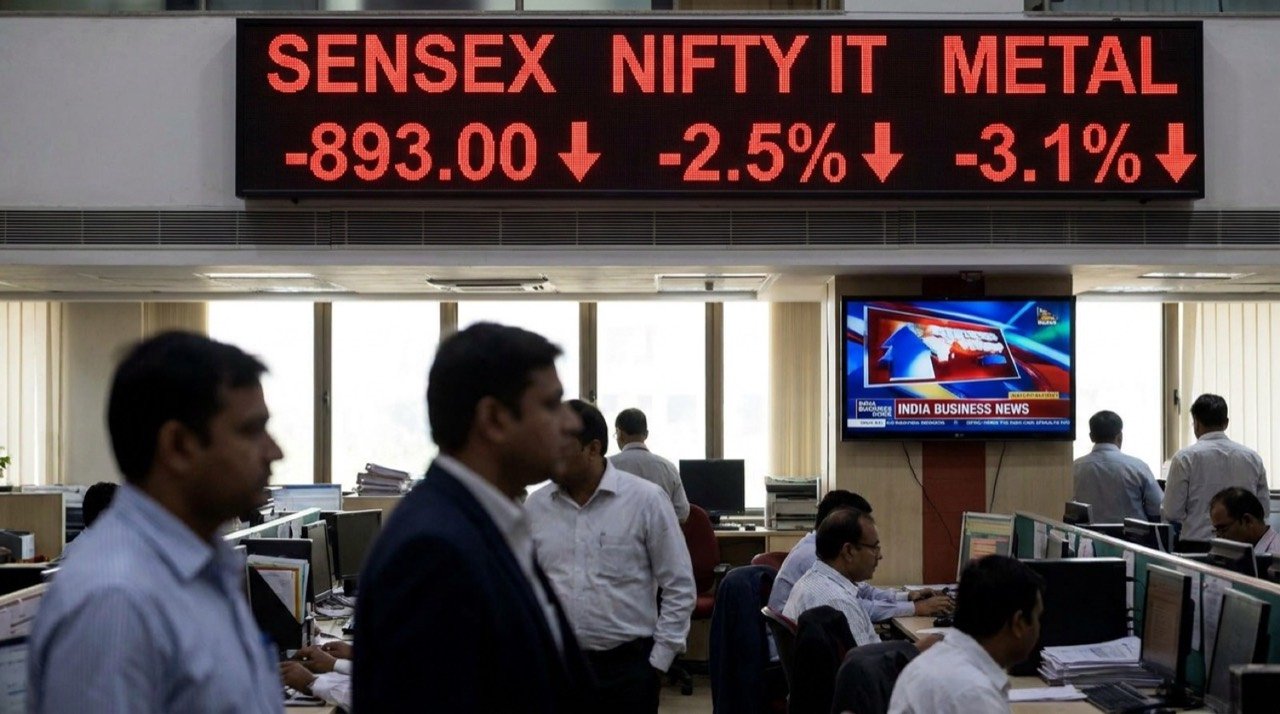
Sensex Tumbles 893 Points as IT and Metal Stocks Lead Broad Market Selloff
Indian equities slid sharply on 23 June, with the Sensex down 893 points and the Nifty closing at 23,824, as IT, metals and PSU banks led a broad-based selloff driven by weak global cues.

Sensex Climbs Around 291 Points, Nifty Closes Above 24,100 as IT and Pharma Shares Lift Market
Indian equities rebounded on June 22, 2026, with the Sensex gaining about 291 points and the Nifty closing above 24,100, led by IT and pharmaceutical stocks despite lingering Middle East tensions.
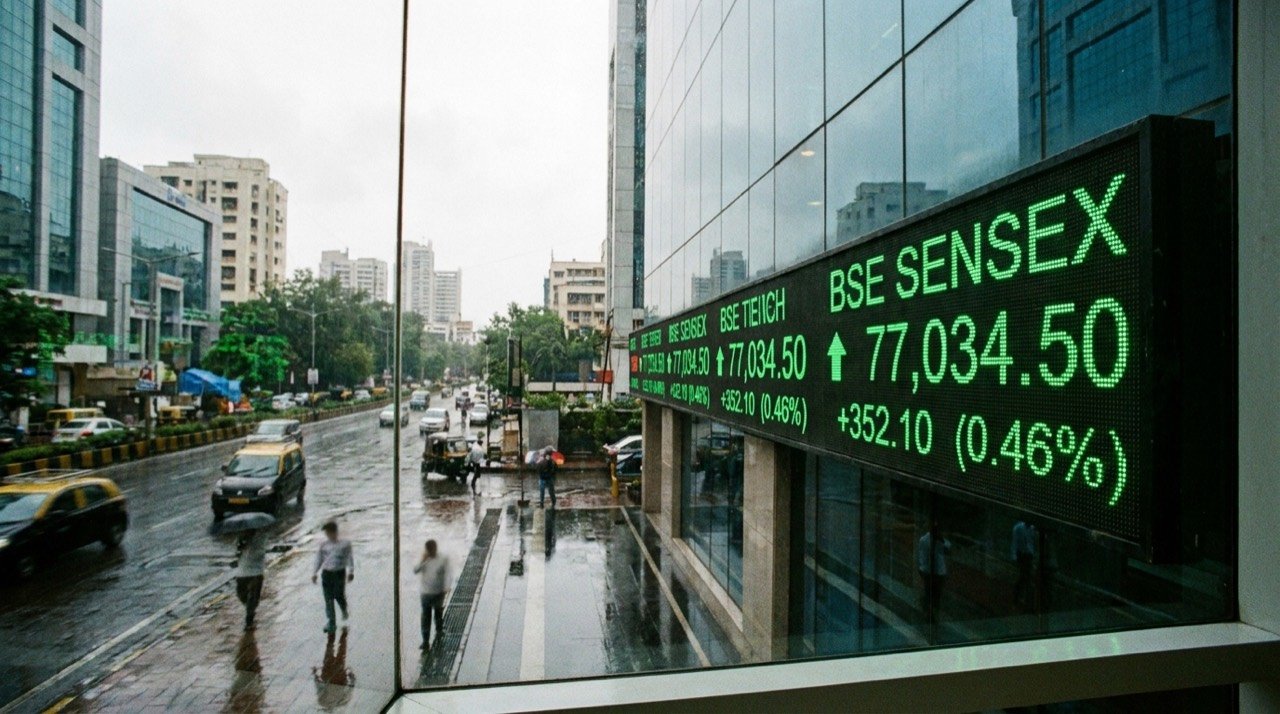
Sensex Holds Above 77,000 As Crude Pullback And RBI Liquidity Push Lift Indian Markets
Indian benchmarks extended gains around 24 June 2026 as easing crude prices, calmer West Asia tensions and fresh RBI liquidity support kept financial and auto stocks firmly in demand.
More from this section
More
Adani Case: US DOJ Pushes for Permanent Dismissal of Charges
The US Department of Justice has urged a judge to permanently dismiss charges against Gautam Adani, calling the case legally flawed — a reversal with consequences for markets, diplomacy and cross-border enforcement.

Akasa Air Inducts 40th Aircraft in Indian Aviation Scale-Up
Akasa Air's 40th aircraft, ferried to Bengaluru via Seattle, Reykjavik and Cairo, marks a fleet milestone for the young carrier and a fresh signal that India's aviation market remains firmly in expansion mode.
BARC Ratings Suspension Leaves Indian TV Industry Flying Blind
BARC's pause on television ratings has put India's broadcast measurement system under fresh scrutiny, leaving broadcasters, advertisers and media planners without the weekly audience data that anchors the TV economy.