Sensex Tumbles 893 Points as IT and Metal Stocks Lead Broad Market Selloff
Indian equities slid sharply on 23 June, with the Sensex down 893 points and the Nifty closing at 23,824, as IT, metals and PSU banks led a broad-based selloff driven by weak global cues.
Commentary & Analysis ·
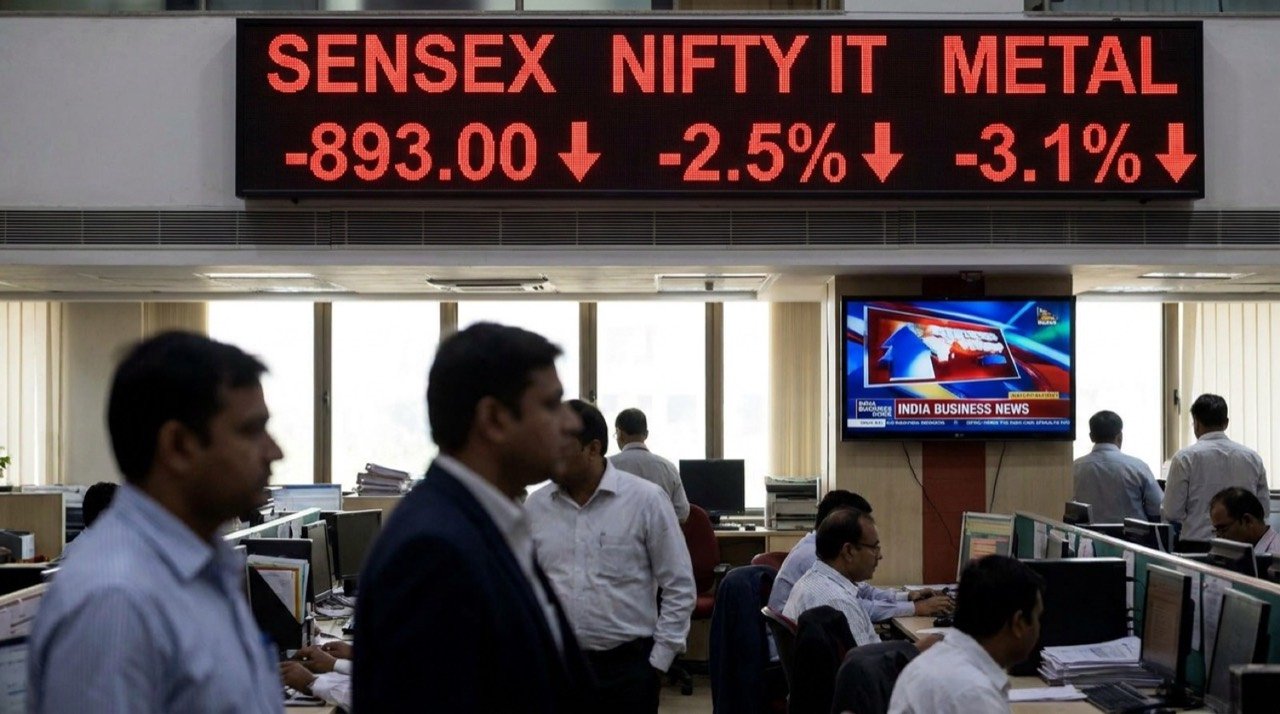
Indian equities ended sharply lower on 23 June, snapping a recent upward run and underscoring how quickly global risk sentiment can reach into domestic sectors. The Sensex fell 893.39 points, or 1.16 percent, to close at 76,200.68, while the Nifty shed 278.80 points to finish at 23,824.10. The decline was broad rather than confined to a single corner of the market, and it arrived after weeks in which the benchmarks had been drifting higher, lulling many participants into treating the uptrend as the default state of affairs rather than one condition among several that markets can occupy.
Where the selling was concentrated
Market commentary described broad-based selling led by IT, metals, telecom, public-sector banks and realty. Technology stocks bore the brunt of the pressure, mirroring weakness in their global peers, while metal shares slid alongside softer sentiment in cyclical sectors. Among the major Nifty losers were Infosys, TCS and Wipro from the IT pack, with Adani Enterprises and JSW Steel also among the prominent decliners. The presence of heavyweight index constituents on the losers' list helped drag the benchmarks lower through the session, since a handful of large-weight names moving in the same direction can shift the index materially even when other counters are comparatively steady.
That the damage clustered in IT, metals, telecom, PSU banks and realty is itself informative. These are sectors with quite different underlying businesses, yet they share a common vulnerability: each is disproportionately exposed to swings in global capital flows, commodity cycles, or borrowing costs, rather than to purely domestic demand conditions. When such a disparate group falls in step, the more plausible explanation is a shift in the overall appetite for risk among investors, domestic and foreign alike, rather than any single sector-specific setback.
What triggered the fall
Analysts pointed to weak global cues and pressure on technology stocks abroad as the principal triggers. With Indian IT firms deriving a large share of revenue from overseas clients, sentiment in international technology markets tends to transmit rapidly to Mumbai-listed names. This transmission mechanism is well understood by market participants but is nonetheless easy to underestimate during calmer periods: a company's fundamentals in India can be perfectly sound, yet its share price will still move in sympathy with a sell-off thousands of kilometres away if the revenue linkage is strong enough.
The episode matters because it interrupted a recent upward trend, reminding investors that gains built over weeks can be tested in a single session when external conditions turn. It also highlighted the sensitivity of specific Indian sectors to developments far beyond the country's borders. For an economy that has spent the past several years positioning itself as a relatively insulated, domestically driven growth story, days like this are a useful corrective. India's markets are not hermetically sealed from the rest of the world, and the channels of contagion, be they IT export revenue, metal commodity pricing, or capital flows into banking and realty, remain very much intact.
Breadth and the bright spots
Market breadth was notably weak, with declining shares far outnumbering those that advanced, a sign that the selling was widespread rather than isolated. Weak breadth of this kind tends to unsettle market participants more than an index number in isolation, because it suggests the move was not merely a function of one or two large stocks skewing the average, but rather reflected a broad retreat by investors across the board, including in mid- and small-cap names that do not always make the headlines.
Not every sector retreated in step, however. Pharma and healthcare stocks held up comparatively well, offering a measure of cushion against the wider decline. This relative resilience is consistent with the defensive characteristics often attributed to healthcare-linked equities: demand for medicines and healthcare services tends to be less sensitive to swings in global risk appetite than demand for, say, steel or IT outsourcing contracts, and this may explain why investors rotated toward the sector even as they exited more cyclically exposed names.
To summarise the session's key figures: the Sensex was down 893.39 points, or 1.16 percent, to 76,200.68, while the Nifty was down 278.80 points to close at 23,824.10. The fall was led by IT, metals, telecom, PSU banks and realty, with Infosys, TCS, Wipro, Adani Enterprises and JSW Steel among the key losers, while pharma and healthcare emerged as relative outperformers. As market analysts summarised it, weak global cues and pressure on technology stocks abroad were the key triggers for the selloff.
What this means for investors
Looking ahead, traders will watch whether global sentiment stabilises or whether the weakness extends, with the durability of the earlier uptrend now in question. A single session of losses does not, by itself, establish a new direction for the market, but it does raise the question of whether the preceding rally had priced in an unrealistically benign set of global conditions. If technology weakness abroad persists, or if metal prices continue to soften on demand concerns, Indian markets may find it difficult to reclaim the highs seen just before this decline.
For long-term investors, the session served as a reminder that diversification and a steady horizon matter most when external shocks ripple through the market. Portfolios concentrated in a narrow set of export-oriented or commodity-linked sectors are, by construction, more exposed to exactly the kind of global sentiment shift that appears to have driven this fall. Conversely, exposure to sectors with more domestically anchored demand, such as pharmaceuticals and healthcare, can provide some ballast during episodes of this kind, even if it does not eliminate volatility altogether.
The NE Times View
A single bruising session is not a verdict on India's growth story, but the breadth of this selloff is the warning. When IT, metals and PSU banks fall together, it signals global risk-off sentiment rather than a domestic shock, and it is worth distinguishing carefully between the two when assessing what, if anything, needs to change in an investment approach. A domestic shock would call for a reassessment of India-specific assumptions; a global risk-off move calls instead for a reassessment of how exposed a portfolio is to international sentiment swings, regardless of how sound the underlying domestic businesses may be.
The NE Times View: retail investors should read this as a reminder that valuations had run ahead of earnings; watch foreign outflows and dollar strength, not the daily points tally. The temptation after a sharp single-day fall is to fixate on the headline number, the points lost, the percentage decline, but these figures are ultimately backward-looking. The more useful indicators for gauging whether this is a passing episode or the start of a more sustained correction are the underlying flows: whether foreign institutional investors continue to pull capital out of Indian equities, and whether the dollar continues to strengthen against the rupee and other emerging-market currencies, both of which tend to presage further pressure on the very sectors that led Monday's decline.
Key takeaways
- The Sensex fell 893.39 points (1.16 percent) to 76,200.68 and the Nifty fell 278.80 points to 23,824.10 on 23 June, driven by broad-based selling.
- IT, metals, telecom, PSU banks and realty led the decline, with Infosys, TCS, Wipro, Adani Enterprises and JSW Steel among the prominent losers.
- Weak global cues and pressure on technology stocks abroad were cited by analysts as the principal triggers, reflecting India's IT sector's heavy reliance on overseas revenue.
- Pharma and healthcare stocks were relative outperformers, underscoring the defensive value of sectors less tied to global risk sentiment.
- Investors should track foreign outflows and dollar strength as more meaningful signals than the day's points tally, and maintain diversified, long-horizon portfolios to weather such shocks.
You may also like to read

Sensex Climbs Around 291 Points, Nifty Closes Above 24,100 as IT and Pharma Shares Lift Market
Indian equities rebounded on June 22, 2026, with the Sensex gaining about 291 points and the Nifty closing above 24,100, led by IT and pharmaceutical stocks despite lingering Middle East tensions.

Sensex Drops 372 Points, Nifty Slips Below 24,000 On IT, Auto Drag
Indian benchmarks closed lower on June 29 as the Sensex fell 372 points to 76,728 and the Nifty ended at 23,946, with IT, auto and oil and gas stocks dragging while pharma outperformed.
Sensex Crashes Nearly 900 Points as Global Risk-Off Mood Hits Indian Markets
Indian equities tumbled on Tuesday as the Sensex shed about 893 points and the Nifty slipped below 23,900, dragged by weak global cues, IT and metal selling and foreign outflow fears.
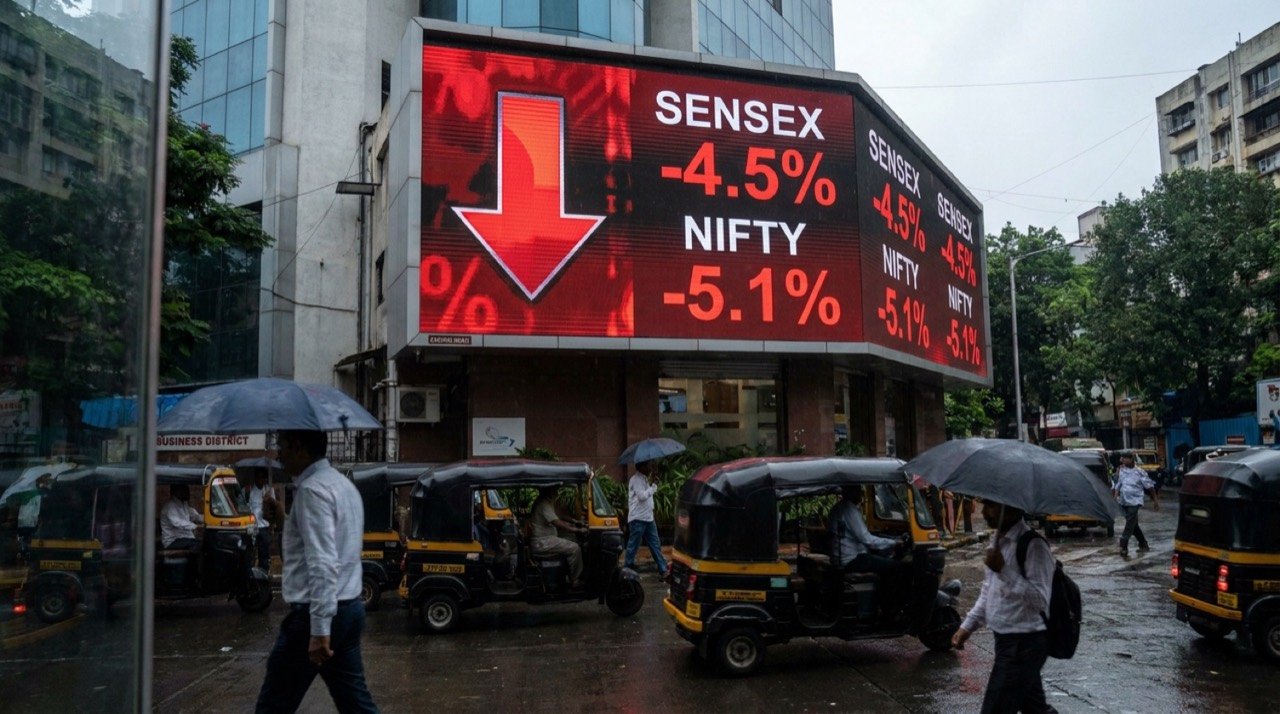
Sensex Sheds 893 Points as Global Risk and West Asia Tensions Weigh on Indian Equities
Indian benchmark indices closed sharply lower on June 23 as weak global cues and West Asian uncertainty dragged the Sensex below 76,300 and the Nifty under 23,850.
More from this section
More
Adani Case: US DOJ Pushes for Permanent Dismissal of Charges
The US Department of Justice has urged a judge to permanently dismiss charges against Gautam Adani, calling the case legally flawed — a reversal with consequences for markets, diplomacy and cross-border enforcement.

Akasa Air Inducts 40th Aircraft in Indian Aviation Scale-Up
Akasa Air's 40th aircraft, ferried to Bengaluru via Seattle, Reykjavik and Cairo, marks a fleet milestone for the young carrier and a fresh signal that India's aviation market remains firmly in expansion mode.
BARC Ratings Suspension Leaves Indian TV Industry Flying Blind
BARC's pause on television ratings has put India's broadcast measurement system under fresh scrutiny, leaving broadcasters, advertisers and media planners without the weekly audience data that anchors the TV economy.