Gold Prices Ease Across Indian Cities: What the July 4 Dip Means
Gold rates for 24-karat and 22-karat metal edged lower across Delhi, Mumbai, Bengaluru, Chennai and Hyderabad on July 4, offering a window for buyers weighing jewellery and investment purchases.
Commentary & Analysis ·
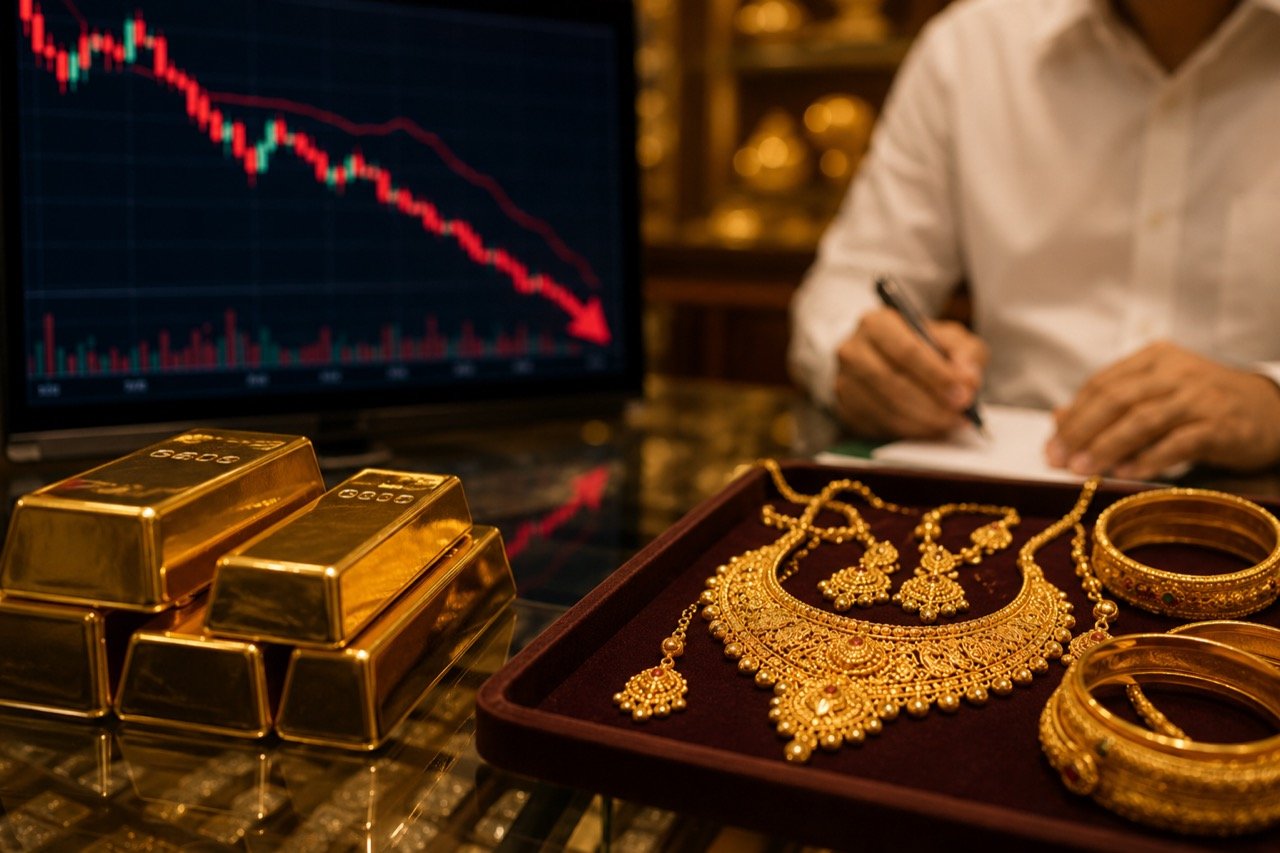
Gold prices eased across India's major cities on July 4, with rates for both 24-karat and 22-karat metal moving lower in Delhi, Mumbai, Bengaluru, Chennai and Hyderabad, according to daily price tracking reported by the Economic Times. It was a modest, single-day movement, the kind that rarely makes front-page news in most economies but reliably draws attention in India, where gold occupies a peculiar dual role. It is at once a financial asset that investors watch for returns and a cultural fixture bound up with weddings, festivals and the quiet arithmetic of household savings. That duality is precisely why even small day-to-day shifts in the quoted rate ripple through conversations far beyond trading desks, reaching kitchen tables where families are weighing whether now is the moment to buy for an upcoming wedding season or festival.
Why a single day's move gets noticed
In most commodity markets, a small daily dip would pass unremarked, absorbed into the noise of routine trading. Gold in India works differently because the price is not just a number on a screen; it is a reference point that households use to plan real purchases. A family preparing for a wedding, or setting aside gold ahead of a festival such as Diwali or Akshaya Tritiya, does not experience the market abstractly. They experience it as a concrete decision: buy this week, or wait. That is why even a routine easing in rates, of the kind seen on July 4 in Delhi, Mumbai, Bengaluru, Chennai and Hyderabad, becomes a talking point rather than a footnote. It also explains why financial media in India maintains daily city-by-city gold price tracking in the first place, a level of granular, near-real-time consumer reporting that few other commodities receive.
The forces behind the price
City-level gold rates in India are shaped by a layered set of factors, both global and domestic. On the global side, international bullion trends set the broad direction, reflecting worldwide investor sentiment, central bank activity and the general appetite for safe-haven assets. Layered on top of that is the rupee-dollar exchange rate, since gold is priced internationally in dollars but sold domestically in rupees; a weaker rupee can push up the local price even when the dollar-denominated bullion price is flat, and vice versa. Import duties and taxes add another layer specific to India, given that the country imports the overwhelming majority of the gold it consumes. Finally, local demand conditions, including seasonal buying patterns tied to weddings and festivals, and city-specific dynamics, account for the small variations that make Delhi's rate differ slightly from Mumbai's or Chennai's on any given day. Because so many variables feed into the final number, a single day's dip is rarely a clean signal of any one cause. It could reflect a shift in global sentiment, a currency movement, a change in local demand, or some combination of all three, and separating these strands from a single data point is close to impossible.
Different signals for different buyers
This layered structure means that gold's daily price carries different meanings depending on who is reading it. For investors, the more meaningful cues lie in global interest-rate expectations and the strength of the dollar, both of which shape bullion's direction over months rather than days. A trader or portfolio manager watching gold as an asset class is, in effect, watching the same signals that move every other safe-haven instrument, and a one-day easing in the Indian retail price tells them little that a broader trend chart would not. For jewellery buyers, however, the calculus is almost entirely different. Their timing tends to be driven less by charts and more by family occasions, a wedding date already fixed months in advance, a festival on the calendar, or simply the accumulated habit of buying gold when a milestone approaches. For this group, a day's dip is welcome, but it is not the primary driver of the decision to buy; the occasion is.
What buyers actually pay at the counter
It is worth underscoring that the headline rate reported each day is only the starting point of what a buyer actually pays. Purity affects the base calculation, since 24-karat and 22-karat gold carry different valuations reflecting their different metal content. On top of that, making charges, the fee jewellers levy for crafting raw metal into finished ornaments, can add meaningfully to the final bill, and these charges vary considerably from one jeweller to another and one design to another. Taxes are layered on further still. The cumulative effect is that a small dip in the quoted city rate does not always translate into a proportionate saving at the counter. A buyer who fixates solely on the daily headline number risks missing the larger and more controllable levers, purity verification, making-charge comparison and tax transparency, that actually determine value for money on a gold purchase.
The NE Times View
A one-day easing in gold prices is useful information, not a signal to rush. Indian households buy gold for reasons that outlast market cycles: family milestones, cultural obligations and long-term saving habits that are not, and should not be, dictated by the ticker on any single morning. The sensible approach is to separate daily volatility from genuine trend shifts, recognising that the two are easily conflated but serve very different purposes for a buyer. Someone purchasing gold for a wedding in a few months' time gains little by reacting to a single day's dip and more by comparing effective costs across jewellers, factoring in making charges and taxes rather than the quoted rate alone, and matching purchases to their own timelines rather than the market's daily rhythm. For investors, the calculus is different but the discipline required is similar: staggered, systematic buying over time remains a sounder strategy than attempting to chase short-term dips, particularly given how many overlapping global and domestic factors feed into any single day's price. In both cases, patience and a clear sense of one's own purpose in buying gold, whether as adornment, tradition or portfolio diversification, serve buyers better than reacting to daily headlines.
What to watch next
Looking ahead, the same set of forces that produced the July 4 easing will continue to determine where gold rates head next. Global interest-rate expectations remain the dominant long-run driver for bullion, since expectations of higher or lower rates shape the opportunity cost of holding a non-yielding asset like gold. The rupee-dollar exchange rate will continue to add a domestic overlay to whatever direction international prices take, meaning Indian buyers should watch currency movements alongside bullion trends rather than either in isolation. Seasonal demand, tied to the wedding and festival calendar, will also continue to exert its own pull on local prices independent of global markets. None of these factors resolves neatly into a single forecast, which is itself the point: gold's price is a composite signal, and reading too much into any one day's movement, whether up or down, risks mistaking noise for a trend.
Key takeaways
- Gold rates eased across Delhi, Mumbai, Bengaluru, Chennai and Hyderabad on July 4 for both 24-karat and 22-karat metal, per daily tracking reported by the Economic Times.
- City-level prices reflect a mix of global bullion trends, the rupee-dollar rate, import duties and taxes, and local demand, which is why a single day's move rarely tells the full story.
- Investors should focus on global interest-rate expectations and dollar strength, which drive bullion over months, rather than daily fluctuations.
- Jewellery buyers should compare effective costs, including making charges and taxes, rather than relying on the headline rate alone.
- Staggered, disciplined buying remains a sounder approach than chasing short-term dips, for both households and investors.
You may also like to read
Gold Blazes To Record Highs As Safe-Haven Demand Grips Indian Buyers
Gold scaled fresh records in mid-June 2026, with domestic prices near Rs 1.69 lakh per 10 grams as geopolitical tension, a weak rupee and resilient investment demand fuelled a relentless rally.
Tata Motors Lifts Prices From July, Doubles Down On EV And Hydrogen
Tata Motors will raise passenger vehicle prices by up to 1.5 percent from July 1 to offset input-cost pressure, even as chairman N. Chandrasekaran reaffirms heavy investment in electric and hydrogen mobility.

OPEC+ Agrees Bigger August Output Hike: What It Means for Oil Prices
OPEC Plus members have signed off on a larger production increase for August, a supply-side shift that puts crude benchmarks, India's import bill and fuel-linked costs firmly back in the market spotlight.

India's Gold Loan Defaults Ease Even as Sanctions Double
India's gold-loan market is expanding fast, with loan sanctions reportedly doubling even as default ratios shrink, pointing to stronger repayment behaviour and rising demand for secured credit.
More from this section
More
Adani Case: US DOJ Pushes for Permanent Dismissal of Charges
The US Department of Justice has urged a judge to permanently dismiss charges against Gautam Adani, calling the case legally flawed — a reversal with consequences for markets, diplomacy and cross-border enforcement.

Akasa Air Inducts 40th Aircraft in Indian Aviation Scale-Up
Akasa Air's 40th aircraft, ferried to Bengaluru via Seattle, Reykjavik and Cairo, marks a fleet milestone for the young carrier and a fresh signal that India's aviation market remains firmly in expansion mode.
BARC Ratings Suspension Leaves Indian TV Industry Flying Blind
BARC's pause on television ratings has put India's broadcast measurement system under fresh scrutiny, leaving broadcasters, advertisers and media planners without the weekly audience data that anchors the TV economy.