Modi Greets Trump on US 250th Independence Day, Hails Partnership
Prime Minister Narendra Modi marked America's 250th Independence Day with a message to President Trump, saying the next 250 years should lift the India-US partnership to new heights.
Commentary & Analysis ·
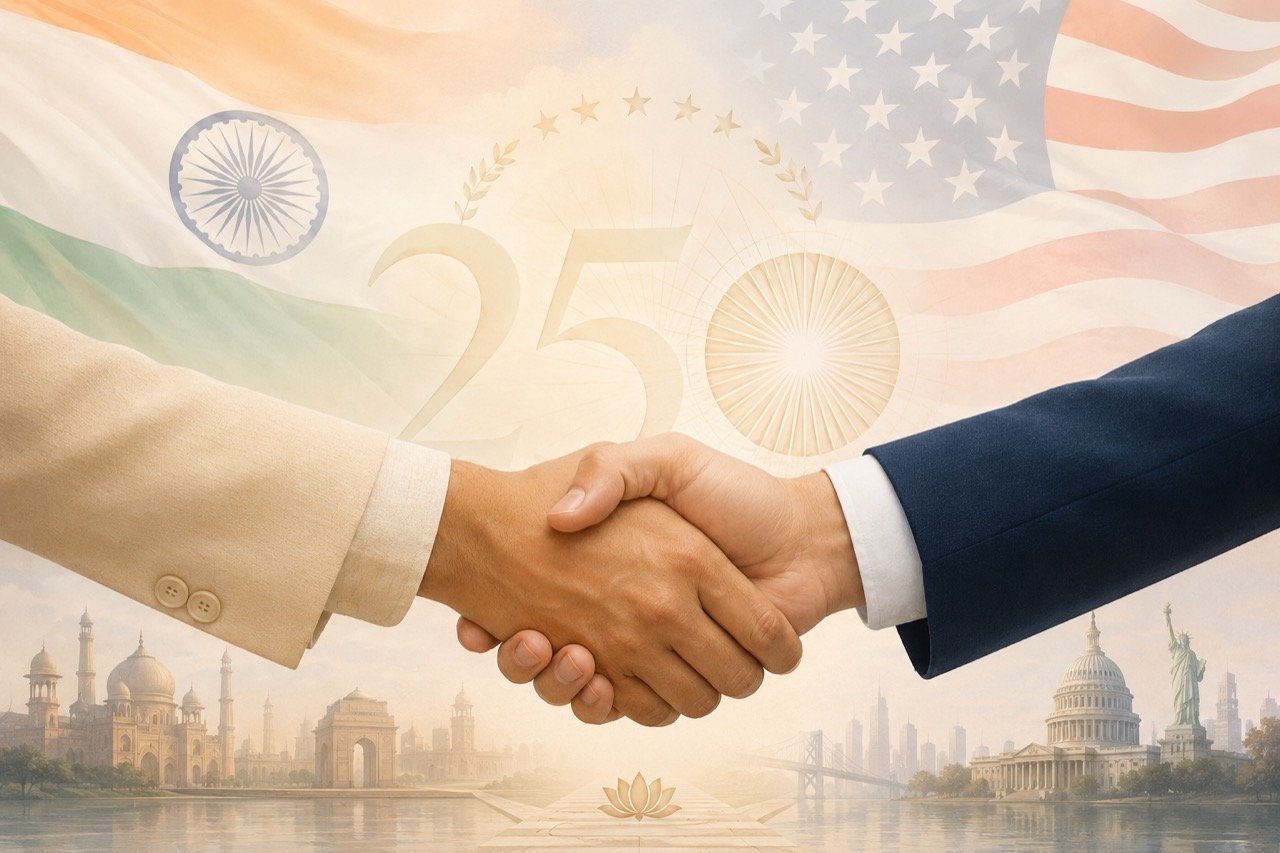
Prime Minister Narendra Modi has greeted President Donald Trump and the American people on the United States' 250th Independence Day, saying that the next 250 years should take the India-US partnership to new heights. The message, reported by The Indian Express, drew on the familiar vocabulary of shared democratic values and strategic cooperation. On its face, this is diplomatic ritual — the kind of goodwill statement that accompanies any major national anniversary. But in international relations, ritual is rarely empty. National days give leaders a public stage on which to reaffirm, or quietly recalibrate, the tenor of a relationship, and that stage carries particular weight when the two countries involved are as deeply entangled as India and the United States are today, across trade, technology, defence, education and diaspora ties.
Why anniversary diplomacy matters
It would be easy to dismiss a 250th-anniversary greeting as boilerplate. Leaders send these messages routinely, and the language of friendship is a diplomatic constant regardless of the state of underlying ties. Yet the choice of framing is never accidental. By invoking the "next 250 years," Modi's message reaches well beyond the immediate news cycle and situates the India-US relationship inside a multi-generational horizon. That is a deliberate rhetorical move. It signals that New Delhi views Washington not as a partner of convenience tied to a particular administration or a particular set of negotiations, but as a long-term strategic anchor. For a relationship that has expanded rapidly in scope over the past two decades, this kind of framing serves a purpose: it tells both domestic and international audiences that the partnership is expected to outlast whatever frictions currently exist.
The language of continuity amid real friction
The most striking feature of the greeting is precisely this emphasis on continuity. The India-US relationship has grown into one of the broadest bilateral engagements either country maintains, spanning trade, defence cooperation, technology transfer, education and people-to-people exchange. Yet breadth does not mean ease. The relationship demands constant, active management, and genuine differences persist beneath the surface — on trade terms and tariffs, on immigration and visa policy, on India's insistence on strategic autonomy in its foreign policy choices, and on how the two countries respond to global crises where their interests do not always align. A message built around the idea of "the next 250 years" is constructed, whether consciously or not, to look past these frictions rather than address them directly. That is a common technique in diplomatic communication: celebrate the durability of a relationship in the abstract precisely when its concrete details are under strain.
Speaking to two domestic audiences at once
Greetings of this kind are rarely aimed solely at the foreign counterpart being addressed. They are also calibrated for domestic consumption on both sides. The Indian diaspora in the United States is one of the most significant bridges between the two societies, active in business, academia, politics and culture, and public affirmations of partnership from India's own prime minister reinforce those people-to-people ties and give the diaspora a sense of being seen and valued by the home country. On the American side, a warm message from a major partner ahead of a landmark national celebration is a low-cost, high-visibility gesture that requires no policy concession. At the same time, it is worth being clear-eyed about what ceremonial warmth can and cannot do. It does not resolve policy disagreements. What it does is set a constructive tone within which harder, more consequential negotiations can continue without being derailed by public acrimony.
What the greeting does and does not commit either side to
It is important to separate symbolism from substance here. Nothing in this greeting commits India or the United States to any specific outcome on trade, tariffs, visas or technology transfer — the issues that actually determine how the relationship functions day to day. What the greeting does is protect the atmosphere in which those issues are negotiated. Diplomatic relationships, like any long-running negotiation, benefit from a baseline of public goodwill that prevents disputes over specific issues from curdling into broader distrust. By publicly committing to the idea of a centuries-long partnership, Modi's message effectively raises the reputational cost of either side allowing a narrow dispute to spiral into a larger rupture. This is a subtle but real form of diplomatic insurance, even if it does not show up in any communiqué or trade figure.
What this means for ordinary Indians
For readers in India, the anniversary message itself is not the story that matters most. The story that matters is what happens next: whether the goodwill expressed in this greeting translates into tangible movement on the issues that affect ordinary Indians directly. Trade terms shape the cost and availability of goods and the fortunes of Indian exporters. Visa and immigration policy shape the ability of Indian students, professionals and families to work, study and reunite in the United States. Technology transfer arrangements shape India's access to advanced manufacturing, defence and digital capabilities. None of these are settled by a Independence Day greeting, however warmly worded. They are settled in negotiating rooms, trade talks and bureaucratic processes that unfold over months and years, largely out of public view. The greeting is best understood as a marker of intent rather than a marker of achievement.
The NE Times View
Read this greeting as a signal, not a settlement. New Delhi is investing in the optics of permanence with Washington precisely because the substance of the relationship — tariffs, visas, technology transfer — remains contested. That is smart diplomacy: it costs nothing and keeps the strategic conversation anchored in goodwill rather than grievance. Framing the relationship in terms of the next 250 years is a way of insuring the partnership against short-term turbulence, whether that turbulence comes from trade disputes, election cycles, or disagreements over specific foreign policy questions. For Indian readers, the real test is not the anniversary message but whether the coming months convert this tone into movement on trade and mobility, the issues that touch ordinary Indians most directly. Warm words are cheap and useful; they are not, however, a substitute for negotiated outcomes, and it is those outcomes that will ultimately determine whether this anniversary greeting is remembered as a genuine turning point or simply as one more instance of routine diplomatic courtesy.
Key takeaways
- Modi's message to Trump on the US 250th Independence Day frames the India-US partnership in multi-generational terms, aiming to project durability beyond current-day frictions.
- Real points of tension persist beneath the ceremonial warmth, including trade terms, immigration policy, India's strategic autonomy, and responses to global crises.
- The greeting serves domestic audiences on both sides, particularly reinforcing ties with the Indian diaspora in America, without resolving any specific policy dispute.
- Symbolic gestures like this function as diplomatic insurance, preserving goodwill so it can absorb friction from harder negotiations without triggering broader rupture.
- The genuine test for Indian readers lies ahead: whether trade and mobility issues see real movement in the months following this anniversary messaging.
You may also like to read
Modi And Trump Hold G7 Bilateral In Evian As Trade And West Asia Crisis Dominate Agenda
On the sidelines of the G7 summit in France, Prime Minister Narendra Modi and US President Donald Trump met to advance the trade deal and coordinate on a deepening crisis in West Asia.
Modi Joins G7 Leaders in Evian as Critical Minerals and AI Top Agenda
India's prime minister attends his seventh consecutive G7 summit, with a much-watched Modi-Trump bilateral and supply-chain security dominating talks in the French Alps.
Fragile Israel-Iran Ceasefire Holds As Trump Pushes Towards Signed Peace Deal
After months of missile exchanges, Israel and Iran have suspended attacks under a conditional truce, with Washington claiming a formal peace agreement is now within reach.
Modi's Expected July Travel Puts India's Indo-Pacific Diplomacy on Watch
Reports that Prime Minister Modi may visit Indonesia, Australia and New Zealand in July have spotlighted India's Indo-Pacific calendar, raising the question of what concrete agreements the trip could deliver.
More from this section
More
India-New Zealand Ties: Visit Plans Put FTA and Diplomacy in Focus
Reports of a planned high-level India-New Zealand engagement have revived attention on free trade talks, professional mobility and Indo-Pacific cooperation between two partners with clear room to grow.
India Watches Dhaka's China-Backed Teesta Plan as Stakes Rise
New Delhi is closely tracking Bangladesh's proposal to develop the Teesta river with Chinese assistance, a move that revives one of South Asia's most sensitive water-sharing disputes and tests regional strategic trust.
India-Japan Summit Widens Ties Across AI, Defence and Chips
At their annual summit in New Delhi, Prime Ministers Modi and Takaichi unveiled a roadmap deepening cooperation on maritime security, artificial intelligence, semiconductors, shipbuilding and critical technologies.