India-Japan Summit Widens Ties Across AI, Defence and Chips
At their annual summit in New Delhi, Prime Ministers Modi and Takaichi unveiled a roadmap deepening cooperation on maritime security, artificial intelligence, semiconductors, shipbuilding and critical technologies.
Commentary & Analysis ·
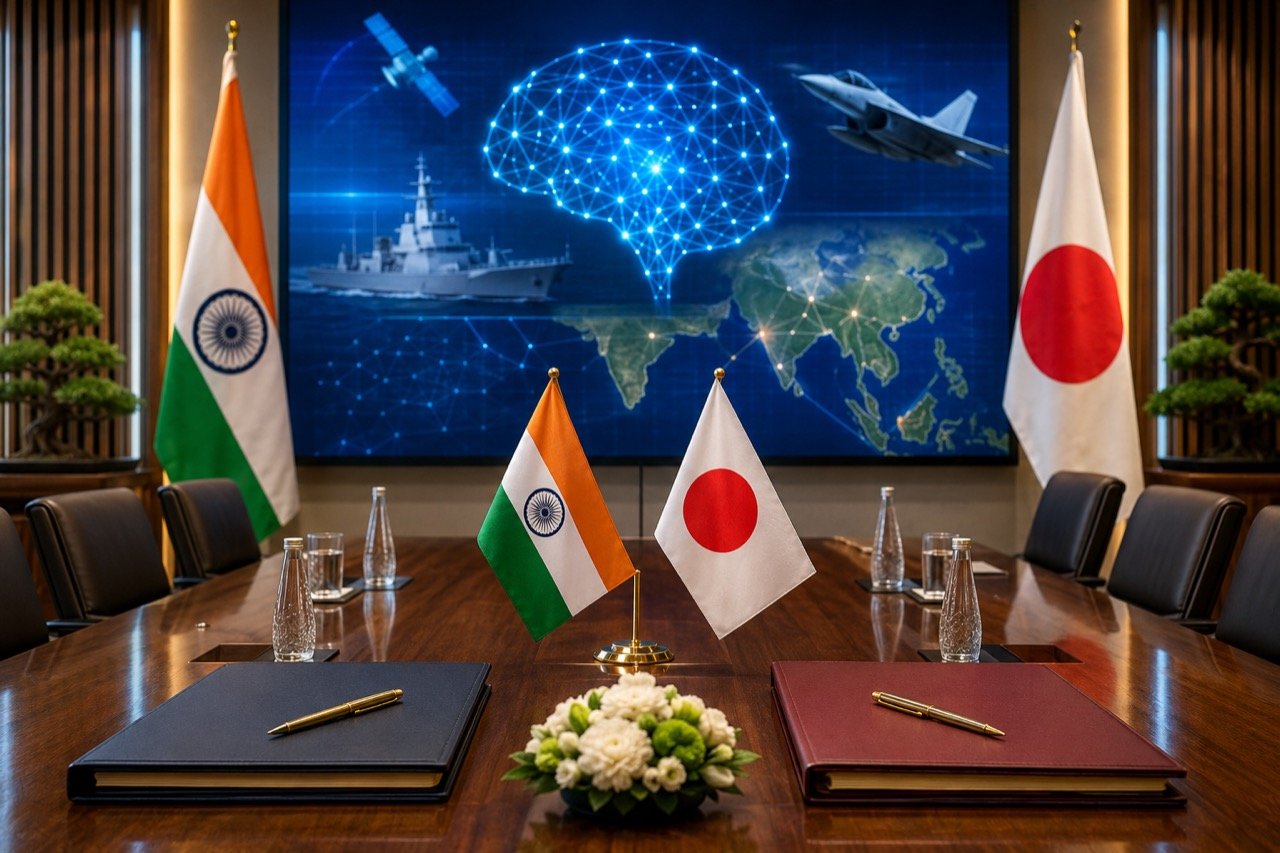
India and Japan have moved to deepen their strategic and economic partnership through a set of agreements unveiled at the annual summit in New Delhi. Prime Minister Narendra Modi and Japanese Prime Minister Sanae Takaichi announced cooperation spanning defence, economic security and maritime priorities — including naval radio antenna systems — under a broader bilateral roadmap, AP reported. What stands out is the mix of sectors covered. Defence and maritime security reflect the two countries' shared Indo-Pacific concerns, while artificial intelligence, semiconductors, shipbuilding and critical technologies speak to a different, more contemporary preoccupation: economic security, or the business of building resilient supply chains and reducing strategic dependence in sensitive industries.
A summit that reads differently from those before it
Annual India-Japan summits are not new, and neither is the language of "comprehensive strategic partnership" that typically accompanies them. What distinguishes this iteration is the breadth of the roadmap and the deliberate pairing of hard security cooperation with technology and industrial policy. Naval radio antenna systems sit alongside semiconductors and AI in the same document, which is itself a signal. It suggests that both governments now view defence capability and technological capability as two expressions of the same underlying concern: reducing vulnerability in a region where supply chains, chip fabrication and maritime access have all become contested terrain. For a relationship long associated with infrastructure financing and people-to-people exchange, this is a notable widening of scope.
From investment partner to strategic builder
The relationship already rests on a strong investment base. Japan remains one of India's largest investors, and earlier commitments aimed to more than double Japanese investment over a decade. That history matters here because it establishes the baseline against which this roadmap should be judged. The framing has now shifted: economic ties are being presented not merely as trade flows or capital commitments but as joint strategic capacity-building. In practice, this means Japanese firms and capital are being invited into sectors — semiconductors, AI infrastructure, shipbuilding — that India has identified as central to its own manufacturing and self-reliance ambitions. It is less a matter of Japan investing in India and more a matter of the two states co-building industrial capacity that neither wants to be solely dependent on China or other single-source suppliers for.
Why AI, chips and shipbuilding are being bundled with defence
The inclusion of artificial intelligence and semiconductors in a summit roadmap alongside naval hardware may seem like an odd juxtaposition, but it reflects a broader global trend of treating technology policy as a component of national security rather than a purely commercial matter. Semiconductors underpin everything from consumer electronics to missile guidance systems; AI has applications across logistics, surveillance and autonomous systems; shipbuilding capacity determines naval reach and merchant marine resilience alike. By bundling these strands together, India and Japan are effectively acknowledging that economic security and defence security have become inseparable. For India, this dovetails with its push to build domestic semiconductor fabrication and expand AI infrastructure. For Japan, it offers a way to diversify its own technology and manufacturing partnerships beyond a region increasingly shaped by China's assertiveness and by shifting American trade policy.
The implementation question
The hard part, as with any such roadmap, will be implementation. Agreements announced at a summit are, by their nature, statements of intent rather than binding commitments with fixed timelines. Roadmaps are only as strong as the projects, funding and timelines behind them, and both capitals will need sustained follow-through to convert summit language into factories, ships and chips. This is not a hypothetical concern — the two countries have a track record of ambitious pledges that outpaced actual delivery, including on the investment-doubling target referenced above. Bureaucratic friction on the Indian side, and a more risk-averse, deliberate corporate culture on the Japanese side, have both historically slowed the translation of high-level agreements into operational projects on the ground. Observers will be watching for concrete markers: specific investment figures, named companies, project sites and delivery dates, rather than further joint statements.
What this means for stakeholders
For Indian policymakers, the roadmap offers an opportunity to anchor semiconductor and AI ambitions to a partner with deep technological expertise and a demonstrated willingness to invest in Indian infrastructure over decades. For Japanese companies, India represents scale — a large domestic market, an expanding talent pool in engineering and software, and a geopolitical alignment that reduces the risks associated with over-concentration in China. For the wider Indo-Pacific region, deeper India-Japan cooperation in defence and maritime security, including naval systems, reinforces an informal network of partnerships — alongside groupings such as the Quad — aimed at preserving open sea lanes and balancing an increasingly assertive regional environment. None of the stakeholders involved are likely to state this in blunt terms, but the subtext of the roadmap is difficult to miss.
The NE Times View
This summit confirms that India-Japan ties have outgrown the bullet-train era and entered the age of economic security. For India, Japanese capital and technology in semiconductors, AI and shipbuilding align neatly with its manufacturing ambitions; for Japan, India offers scale, talent and a democratic partner in an increasingly contested Asia. The real test lies in execution — Delhi's regulatory friction and Tokyo's cautious corporate culture have slowed past promises. If even half this roadmap materialises on schedule, it would meaningfully rewire Asia's technology supply chains away from single-country dependence. Indian policymakers should treat delivery, not announcement, as the metric of success. The coming months, rather than the summit itself, will determine whether this roadmap becomes a genuine inflection point in the relationship or another entry in a long list of ambitious but only partially realised bilateral pledges.
Key takeaways
- India and Japan unveiled a bilateral roadmap covering defence, maritime security, AI, semiconductors and shipbuilding at the New Delhi summit between Narendra Modi and Sanae Takaichi.
- The pairing of naval systems with technology cooperation signals that both governments now treat economic security and defence security as interlinked priorities.
- Japan's existing status as one of India's largest investors provides a foundation, but past pledges — including the goal to double investment over a decade — have not always been fully realised.
- Execution risk is significant: Indian regulatory friction and Japanese corporate caution have historically slowed delivery on similar agreements.
- The roadmap's real significance will be measured by concrete projects, funding and timelines in the months ahead, not by the summit announcements themselves.
You may also like to read
India-New Zealand Ties: Visit Plans Put FTA and Diplomacy in Focus
Reports of a planned high-level India-New Zealand engagement have revived attention on free trade talks, professional mobility and Indo-Pacific cooperation between two partners with clear room to grow.
BRICS Security Meet in Delhi Targets Terrorism, Cyber and AI Threats
India is hosting a BRICS National Security Advisers meeting in New Delhi, with cross-border terrorism, cyber threats, AI misuse and transnational crime set to dominate a fast-broadening security agenda.

Modi's Expected July Travel Puts India's Indo-Pacific Diplomacy on Watch
Reports that Prime Minister Modi may visit Indonesia, Australia and New Zealand in July have spotlighted India's Indo-Pacific calendar, raising the question of what concrete agreements the trip could deliver.
India-US AI Chips Roundtable Puts Critical Minerals in the Spotlight
Discussions between India and the United States on AI, semiconductors and critical minerals underline how technology cooperation is fast becoming a supply-chain and resource-security story, not just a software one.
More from this section
MoreIndia-New Zealand Ties: Visit Plans Put FTA and Diplomacy in Focus
Reports of a planned high-level India-New Zealand engagement have revived attention on free trade talks, professional mobility and Indo-Pacific cooperation between two partners with clear room to grow.
Modi Greets Trump on US 250th Independence Day, Hails Partnership
Prime Minister Narendra Modi marked America's 250th Independence Day with a message to President Trump, saying the next 250 years should lift the India-US partnership to new heights.
India Watches Dhaka's China-Backed Teesta Plan as Stakes Rise
New Delhi is closely tracking Bangladesh's proposal to develop the Teesta river with Chinese assistance, a move that revives one of South Asia's most sensitive water-sharing disputes and tests regional strategic trust.