Modi's Expected July Travel Puts India's Indo-Pacific Diplomacy on Watch
Reports that Prime Minister Modi may visit Indonesia, Australia and New Zealand in July have spotlighted India's Indo-Pacific calendar, raising the question of what concrete agreements the trip could deliver.
Commentary & Analysis ·
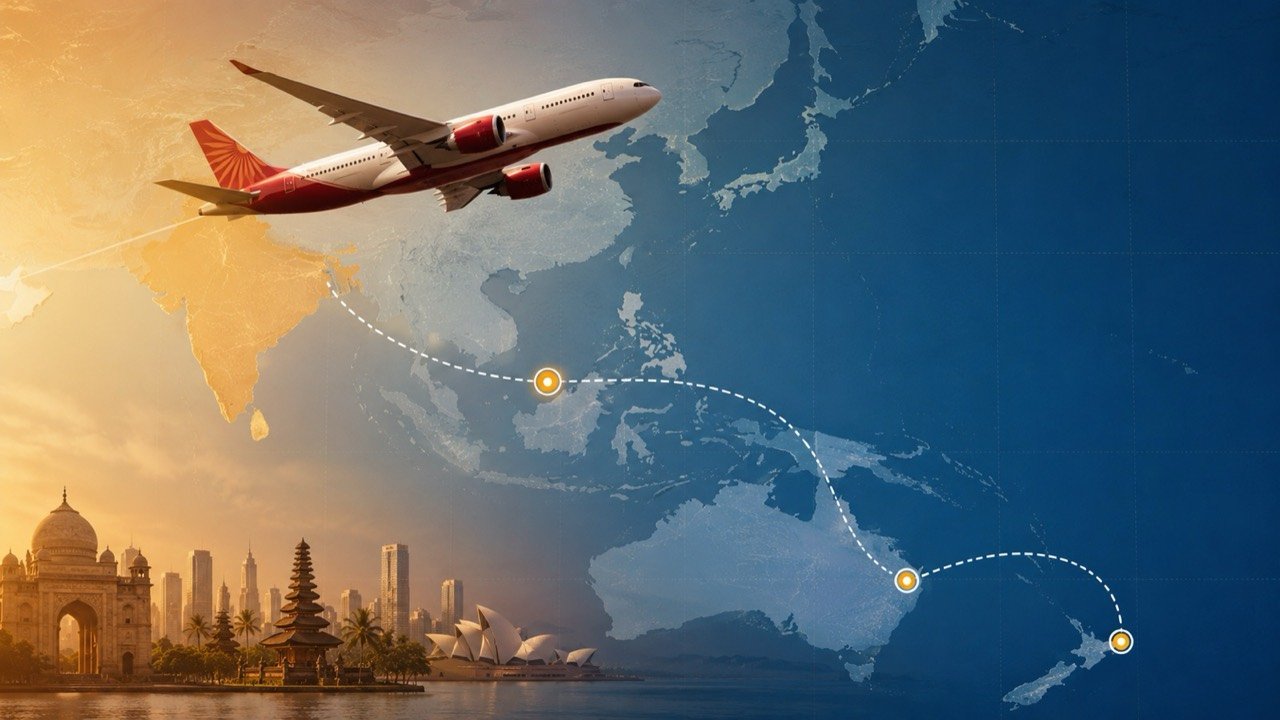
Reports that Prime Minister Narendra Modi may travel to Indonesia, Australia and New Zealand in July have drawn fresh attention to India's Indo-Pacific calendar. If confirmed, the visits would come at a moment when New Delhi is trying to balance trade, security, diaspora outreach and a thickening web of strategic partnerships across the region. The itinerary, while still reported rather than officially confirmed, has already prompted the kind of scrutiny that reveals how much weight is now placed on India's regional conduct, not merely its intentions.
That scrutiny is itself instructive. A decade ago, a prospective prime ministerial tour of this kind might have been read chiefly through the lens of optics and diaspora sentiment. Today, the same itinerary is parsed for what it says about India's capacity to sustain a coherent Indo-Pacific strategy under pressure from multiple directions at once. The shift in how such trips are read is a marker of how central the Indo-Pacific has become to India's foreign policy identity.
A region of overlapping priorities
The three proposed destinations map onto distinct strands of India's regional strategy, and it is worth taking each in turn to understand why this particular combination matters. Indonesia is central to engagement with ASEAN, the bloc through which India has long sought to anchor its Act East policy and secure a voice in Southeast Asian economic and security architecture. Australia is a key partner within the Quad framework, the informal grouping that has become one of the more consequential vehicles for Indo-Pacific security cooperation in recent years. New Zealand, meanwhile, offers space to build economic and community ties that have long lagged behind their potential, notwithstanding a sizeable and engaged Indian diaspora there.
Taken together, the itinerary would let India present a coherent Indo-Pacific posture rather than a series of one-off bilaterals, reinforcing its claim to be a steady regional actor. This is not a trivial distinction. Individual bilateral visits can be dismissed as opportunistic or reactive; a deliberately sequenced tour spanning Southeast Asia, the South Pacific's largest economy and a smaller but strategically located South Pacific state signals design rather than improvisation. For partners assessing India's seriousness as a regional power, that distinction between reactive diplomacy and designed strategy carries real weight.
Continuity amid global uncertainty
Beyond the specifics of trade deals or defence memoranda, the trip would allow India to signal continuity in foreign policy during a period of global flux. Maintaining a predictable rhythm of high-level engagement is itself a message to partners weighing how reliable New Delhi will be on trade and security commitments over the medium term. In an environment where great-power attention can swing rapidly between crises, the mere act of keeping to a calendar of regional visits communicates something about institutional discipline.
That signalling matters most to smaller and mid-sized partners, who often look for assurance that India's attention will not be diverted by crises elsewhere, whether on its own borders or in theatres further afield. New Zealand, in particular, occupies this category: it is not a great power in the Indo-Pacific balance, but its willingness to deepen ties with India depends partly on confidence that New Delhi sees the relationship as more than an afterthought. The same logic applies, in a different register, to ASEAN members watching whether India's Act East policy remains a living priority or has quietly become rhetorical furniture.
The test is in the deliverables
The central question, as with any high-profile diplomatic tour, is how much of the agenda turns into agreements rather than statements of intent. Diaspora events and warm optics are a given; the harder measure is progress on the issues that shape long-term ties. Five areas stand out as the practical benchmarks against which this trip, if it proceeds, ought to be judged: trade, meaning tangible movement on market access and economic frameworks rather than reaffirmed aspirations; mobility, meaning easier pathways for students and skilled workers seeking to study or work in these countries; defence cooperation, meaning practical steps taken with Quad partner Australia rather than further joint statements of shared values; education, meaning deeper university and research links that translate into actual programmes and exchanges; and supply chains, meaning resilience measures and critical-minerals cooperation that reduce shared vulnerabilities.
Each of these categories carries a different constituency and a different test of success. Trade negotiators will be watching for movement on market access; students and professionals will be watching for visa and mobility reforms; strategic planners will be watching the defence file with Australia in particular, given its place in the Quad; and industry will be watching the critical-minerals conversation, an area where India's ambitions to diversify supply chains away from overexposure to any single source have become increasingly pressing. A commentator summarised the stakes succinctly: the optics of a regional tour are easy, but the real test is whether it converts goodwill into trade, mobility and supply-chain commitments.
Why the details matter more than the itinerary
It is worth pausing on why this granular list of deliverables matters more than the fact of the trip itself. Indo-Pacific diplomacy, almost by definition, involves a crowded calendar of summits, dialogues and bilateral visits among a similar set of leaders and officials. The marginal value of any single visit is therefore not in its occurrence but in what it produces. A trip that yields renewed rhetorical commitments to a "free and open Indo-Pacific" without corresponding movement on market access, mobility or defence cooperation adds little beyond diplomatic choreography.
This is particularly true given how crowded the regional diplomatic calendar has become. Partners across ASEAN, the Quad and the wider Indo-Pacific are accustomed to a steady stream of joint statements and framework agreements; distinguishing substantive progress from restated ambition has become its own skill for observers and stakeholders alike. For India, the incentive to produce something concrete is correspondingly higher, precisely because the region is not short of goodwill gestures.
What to watch as the calendar firms up
For now the itinerary remains reported rather than official, and dates could still shift, as is common with prime ministerial travel plans at this stage. But the attention it has generated underlines how much weight India's partners place on the substance, not just the symbolism, of its Indo-Pacific outreach in the months ahead. As the visit, if confirmed, draws closer, the relevant markers to watch will be whether joint statements from Jakarta, Canberra and Wellington contain specific commitments with timelines attached, or whether they remain couched in the language of shared values and future intent.
Equally worth watching is how each host government frames the visit domestically. Australia's engagement with India sits within its own broader recalibration of regional partnerships; Indonesia's ASEAN chairmanship considerations and its balancing act among larger powers shape how it will present any outcomes; and New Zealand's smaller but no less real domestic constituencies, including its Indian diaspora, will be watching for signs that the relationship is finally receiving sustained attention rather than periodic gestures.
The NE Times View
Travel itineraries are not foreign policy; agreements are. The expected July tour usefully signals India's Indo-Pacific seriousness, but the region is crowded with summits long on photographs and short on follow-through. The question worth holding ministers to is concrete: market access, defence cooperation, supply-chain resilience. If the visits yield only joint statements, they confirm ambition without advancing it, and the strategic moment will have been spent on optics. India has genuine strategic reasons to deepen ties with Indonesia, Australia and New Zealand, and the logic of the itinerary is sound. But logic is not the same as delivery, and the only fair verdict on this trip will be one rendered after the fact, based on what is actually signed, agreed or committed, rather than what is merely announced.
Key takeaways
- Reports suggest Prime Minister Modi may visit Indonesia, Australia and New Zealand in July, spanning ASEAN, Quad and South Pacific engagement in a single coordinated tour.
- The itinerary's value lies less in its occurrence than in whether it produces concrete outcomes on trade, mobility, defence cooperation, education and supply-chain resilience.
- Continuity of high-level engagement signals reliability to smaller and mid-sized Indo-Pacific partners wary of India's attention being diverted elsewhere.
- Australia's defence file, given its Quad role, and critical-minerals cooperation are likely to be closely watched substantive benchmarks.
- Dates and details remain unconfirmed, and the tour's ultimate significance will depend on deliverables rather than joint statements or diaspora optics.
You may also like to read
India-New Zealand Ties: Visit Plans Put FTA and Diplomacy in Focus
Reports of a planned high-level India-New Zealand engagement have revived attention on free trade talks, professional mobility and Indo-Pacific cooperation between two partners with clear room to grow.
PM Modi Begins Three-Nation Indo-Pacific Tour on July 6
Prime Minister Narendra Modi travels to Indonesia, Australia and New Zealand from July 6 to 11 in a trip New Delhi frames as a concerted push to deepen India's strategic footprint across the Indo-Pacific.

Modi Joins G7 Leaders in Evian as Critical Minerals and AI Top Agenda
India's prime minister attends his seventh consecutive G7 summit, with a much-watched Modi-Trump bilateral and supply-chain security dominating talks in the French Alps.

Modi Greets Trump on US 250th Independence Day, Hails Partnership
Prime Minister Narendra Modi marked America's 250th Independence Day with a message to President Trump, saying the next 250 years should lift the India-US partnership to new heights.
More from this section
MoreIndia-New Zealand Ties: Visit Plans Put FTA and Diplomacy in Focus
Reports of a planned high-level India-New Zealand engagement have revived attention on free trade talks, professional mobility and Indo-Pacific cooperation between two partners with clear room to grow.
Modi Greets Trump on US 250th Independence Day, Hails Partnership
Prime Minister Narendra Modi marked America's 250th Independence Day with a message to President Trump, saying the next 250 years should lift the India-US partnership to new heights.
India Watches Dhaka's China-Backed Teesta Plan as Stakes Rise
New Delhi is closely tracking Bangladesh's proposal to develop the Teesta river with Chinese assistance, a move that revives one of South Asia's most sensitive water-sharing disputes and tests regional strategic trust.