Karnataka Daycare Rules: Child Panel Pushes Reform After Abuse Case
Karnataka's child rights panel has proposed uniform daycare regulations, including mandatory registration and CCTV access, after an alleged child abuse case at a Capgemini campus daycare facility.
Commentary & Analysis ·
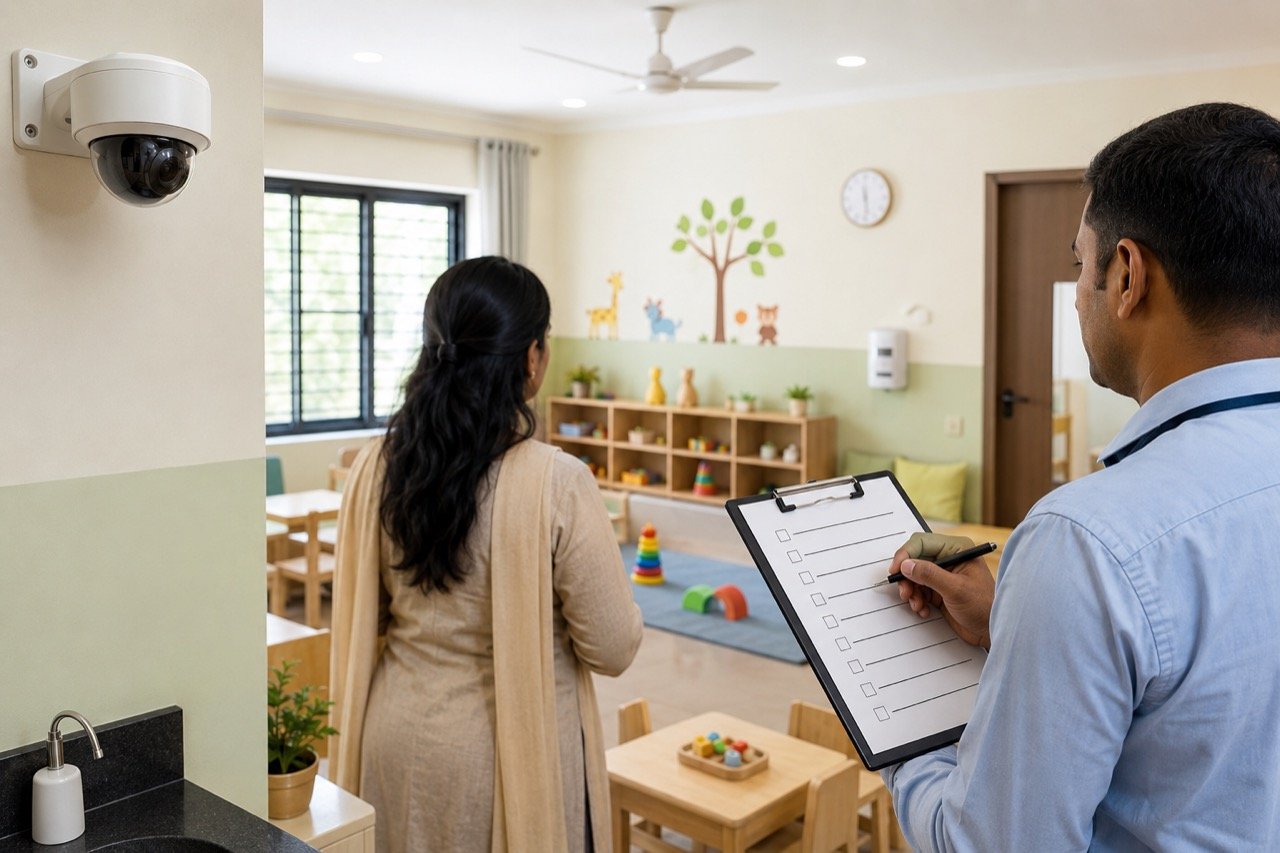
Karnataka's child rights panel is pressing for uniform, enforceable rules covering daycare centres across the state, a move that follows the alleged abuse of a child at a daycare facility on a Capgemini campus. The proposals, reported by The Indian Express, include mandatory registration of all centres, parental access to CCTV footage and a stronger overall regulatory framework. Taken together, the recommendations mark an attempt to move Karnataka away from a patchwork of informal, self-policed arrangements towards something closer to a proper regulatory regime for an industry that has, until now, largely escaped sustained scrutiny.
What the panel has proposed
At the heart of the recommendations is a shift from scattered, uneven standards to a single statewide regime. Every daycare centre would need to be formally registered, creating an official record of who is operating and where. This alone is a significant change in a sector where centres can currently open with minimal formal declaration to any state authority, leaving parents to rely largely on word of mouth, employer endorsement or a facility's own marketing when deciding where to leave their children.
CCTV access is intended to give parents and inspectors a window into daily operations, while clearer inspection norms would make enforcement routine rather than reactive. The logic here is straightforward: surveillance that only exists for internal security purposes, viewable solely by the centre's own management, does little to reassure parents or deter misconduct. Extending viewing rights to parents, and building a structured inspection calendar rather than ad hoc visits triggered only by complaints, would convert monitoring from a passive record-keeping exercise into an active safeguard.
Why the case has struck a nerve
Daycare centres sit at a sensitive intersection of family trust, employer responsibility and state oversight. Working parents hand over their children for hours at a time, often to facilities attached to or endorsed by their employers. An abuse allegation at a corporate campus daycare therefore raises urgent questions about staffing checks, monitoring, grievance channels and who is ultimately accountable when safeguards fail. It is worth dwelling on why the corporate setting sharpens these questions rather than softens them: many parents choose an employer-linked facility precisely because they assume that a large, reputable company has already vetted the arrangement on their behalf. When that assumption is shown to be misplaced, the breach of trust extends beyond the daycare operator to the employer that hosted or facilitated the arrangement.
The significance of the panel's intervention is that authorities are treating the incident as a symptom of a systemic gap rather than a one-off failure. That framing matters. Treating an individual allegation as evidence of a structural weakness, rather than an isolated aberration, is what justifies statewide rule-making rather than a narrow, facility-specific response. Registration, transparency and regular inspection are designed to make safety a default condition of operating, not an improvised response after harm has occurred. In other words, the goal is to shift the burden of proof: instead of parents having to discover after the fact that a centre was unsafe, centres would have to demonstrate in advance that they meet a baseline standard before they are allowed to operate at all.
The stakeholders who must be reconciled
The challenge will be balance: children need safety and dignity, staff need fair procedures, parents need credible communication, and centres need rules that are strict but workable. Each of these constituencies pulls policy in a slightly different direction. Child safety advocates will want the broadest possible transparency and the most rigorous vetting standards, with little tolerance for delay in implementation. Daycare operators, particularly smaller and mid-sized ones without the resources of a large corporate-linked chain, will worry about compliance costs, the administrative burden of registration, and the practicalities of installing and maintaining CCTV infrastructure that parents can access remotely.
Staff working in these centres have their own legitimate interest in the process. Surveillance access for parents raises questions about how footage is stored, who can view it, and whether staff have any recourse if footage is misused or taken out of context. A framework that gives parents blanket access without corresponding privacy safeguards for employees risks trading one set of problems for another. Employers who host or subsidise daycare facilities on their campuses, meanwhile, will need to decide how much responsibility they are willing to accept for vetting and monitoring arrangements that, until now, many have treated as an amenity rather than a liability.
From incident to institution: the harder part of reform
Proposing a framework is the easier half of this process; building the institutional capacity to enforce it is the harder half. Mandatory registration only has teeth if there is a functioning authority to process applications, verify submissions, and act against centres that operate without registering. Inspection norms only matter if inspectors are adequately trained, sufficiently resourced, and insulated from the kind of local pressure that can blunt enforcement in practice. Karnataka will need to answer these operational questions well before any new rules take effect, because a framework that exists only on paper offers no more protection than the status quo it replaces.
There is also a question of scale and reach. Karnataka's daycare sector spans everything from large, corporate-linked facilities with professional management to small neighbourhood setups run informally. A single statewide regime will have to be calibrated so that it is rigorous enough to matter at the corporate end of the sector while remaining realistic enough that smaller operators are not simply pushed underground, avoiding registration altogether and leaving children even less protected than before.
The NE Times View
Karnataka's response will be a test case for how India regulates the fast-growing childcare sector that its urban workforce now depends on. Corporate-linked daycares have expanded far faster than the rules governing them, and this case exposes how thin the oversight layer really is. Mandatory registration and CCTV access are sensible starting points, but they must be paired with staff vetting, privacy safeguards and genuinely independent inspections. If the state converts this moment into a durable framework rather than a headline-driven circular, working parents across India will have a model worth demanding from their own governments.
The broader stakes extend well beyond Karnataka. As dual-income households become the norm in India's major cities, reliance on institutional childcare, whether employer-linked or independent, is only going to grow. A state that gets this regulatory framework right now, while the sector is still young enough to be shaped, will spare itself the far harder task of retrofitting safety standards onto an entrenched and sprawling industry later. Conversely, a framework that is announced with fanfare but never properly implemented will leave parents with a false sense of security that is arguably worse than no regulation at all, since it discourages the vigilance that currently substitutes for formal oversight.
Key takeaways
- Karnataka's child rights panel wants mandatory statewide registration of daycare centres, parental access to CCTV footage and stronger inspection norms, prompted by an alleged abuse case at a Capgemini campus daycare.
- The proposals aim to make safety a default, upfront condition for operating a centre rather than a reactive response after harm occurs.
- Corporate-linked daycares raise particular concerns because parents often assume an employer has already vetted the arrangement, deepening the breach of trust when safeguards fail.
- Effective reform will depend on enforcement capacity, staff privacy safeguards around CCTV access, and rules calibrated to work for both large corporate facilities and smaller neighbourhood centres.
- Karnataka's handling of this moment could set a template, for better or worse, for how other Indian states regulate a childcare sector that has expanded faster than its oversight.
You may also like to read
Karnataka CID Arrests Former JD(S) MLA in Rs 750-Crore Hassan Land Case
Karnataka's CID has arrested former JD(S) MLA K S Lingesh over the alleged illegal regularisation of about 2,750 acres of government land in Hassan, with losses estimated near Rs 750 crore.

Arrest in Bengaluru Daycare Case Deepens Child Safety Questions
Bengaluru police have arrested a woman connected to the daycare case at a Capgemini campus facility, sharpening scrutiny of caregiver vetting, oversight and accountability at workplace-linked childcare centres.

Bidadi Township Protest Becomes First Major Test for Karnataka CM DK Shivakumar
Farmers and the opposition are pressing Karnataka Chief Minister DK Shivakumar over the 9,000-acre Greater Bengaluru township near Bidadi, as final land-acquisition orders reignite a long-running land-rights dispute.
Karnataka's Computer Science Seat-Cap Debate Tests Higher-Education Demand
Karnataka's standoff over expanding computer science engineering seats has intensified as universities push for capacity while the state guards quality, with CM Shivakumar moving cautiously.
More from this section
More
AICTE Industry Fellowship 2026: Rs 1.5 Lakh Scheme Closes July 5
The AICTE Industry Fellowship Programme 2026, which places technical-education faculty inside leading companies on a Rs 1.5 lakh monthly stipend, reached its application deadline on July 5.

Bay of Bengal Low Pressure System Revives Monsoon Over Western India
A low-pressure system over the Bay of Bengal has pushed the monsoon back into an active phase, bringing steady heavy rain to Kerala, coastal Karnataka and Maharashtra, and putting Mumbai and Pune on preparedness watch.
Bishnoi Gang Suspects Injured in Haryana Encounter as Police Tighten Net
A joint Haryana-Delhi Police operation in Bahadurgarh left two suspected Lawrence Bishnoi gang members injured, spotlighting the multi-state coordination now central to India's fight against organised crime networks.