Karnataka CID Arrests Former JD(S) MLA in Rs 750-Crore Hassan Land Case
Karnataka's CID has arrested former JD(S) MLA K S Lingesh over the alleged illegal regularisation of about 2,750 acres of government land in Hassan, with losses estimated near Rs 750 crore.
Commentary & Analysis ·
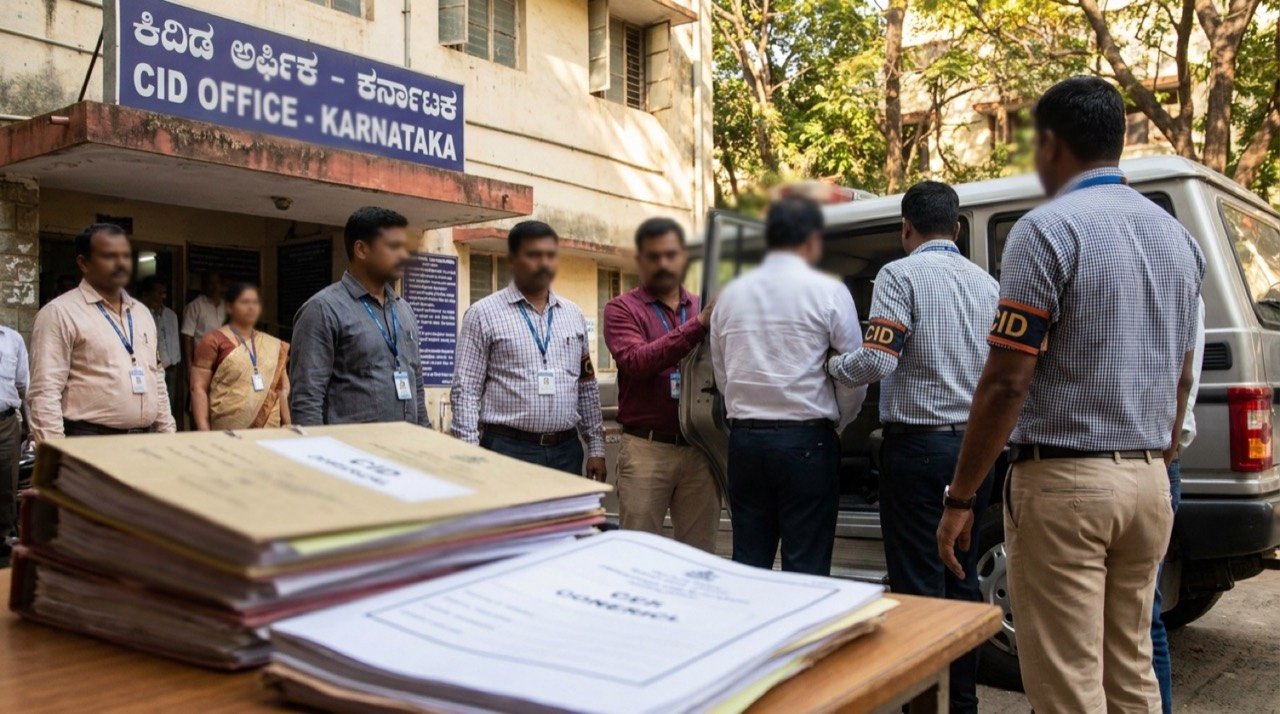
The Karnataka Criminal Investigation Department (CID) has arrested former JD(S) MLA K S Lingesh and others in connection with a major land case in Hassan district, marking a significant escalation in an investigation that has been building through the courts for some time. Investigators allege the irregularities involve about 2,750 acres of government land and a notional loss estimated at around Rs 750 crore. The scale of the figures alone places this among the more consequential land-related cases to surface in Karnataka in recent years, and the fact that a former elected representative is now in custody, rather than merely facing proceedings on paper, signals that the state's investigators intend to press the matter with some seriousness.
What the CID alleges
According to the CID, land was granted in the names of bogus beneficiaries through the Bagair Hukum process, a mechanism originally intended to regularise the holdings of genuine cultivators who had farmed government land, often for years or decades, without formal title. The scheme exists precisely because land records in much of rural Karnataka, as in many parts of India, are imperfect, and because there is a recognised social case for giving long-standing occupants of government land a legal pathway to ownership. Investigators allege that this legitimate purpose was subverted: rather than regularising the claims of genuine cultivators, the process was allegedly used to channel large tracts of public land to ineligible recipients. The charges filed in the case include forgery, cheating, criminal breach of trust and conspiracy, a combination that points to a deliberate and coordinated effort rather than isolated administrative error.
It is worth pausing on why a welfare-oriented land regularisation scheme is so vulnerable to this kind of misuse in the first place. Bagair Hukum applications typically require verification of long-term cultivation, revenue records and local enquiry, all of which depend on the integrity of officials at the taluk and district level. Where that verification is weak, or where it can be influenced, the scheme becomes a vehicle for exactly the kind of fraud alleged here: land that was never under genuine cultivation by the applicant is nonetheless certified as such, and titles are issued on that false basis. A scam of this size, spanning thousands of acres, is difficult to imagine as the work of a single actor. It ordinarily requires the cooperation, or at least the calculated inaction, of officials responsible for surveying, verifying and approving these claims.
A case with a long legal history
The latest arrests do not arise out of nowhere. The case had already moved through the courts, with the High Court earlier upholding proceedings against the former legislator over the alleged illegal land grant. That judicial affirmation is significant: it means the allegations have already withstood at least one round of legal scrutiny before reaching the point of custodial arrest. The progression from a judicially sanctioned proceeding to an actual arrest represents a marked escalation, and suggests that the CID believes it now has sufficient material, or sufficient concern about evidence tampering or flight risk, to justify taking Lingesh and others into custody rather than allowing the case to proceed solely through summons and hearings.
This trajectory also matters for how the case is likely to be perceived publicly. Cases involving politicians can sometimes stall for years in preliminary hearings without any visible consequence, feeding public cynicism about whether the powerful are ever truly held to account. Here, by contrast, there is a documented sequence of escalating action: allegations, a case in court, an appellate court upholding the proceedings, and now arrest. Each step reduces the plausibility of the claim that the case is merely politically motivated harassment, though that claim will almost certainly still be made in public discourse given Lingesh's status as a former MLA.
Why this is politically sensitive
Because the case involves a former elected representative, it carries clear political sensitivity, and is likely to feature in the wider debate over accountability in land administration. Karnataka's politics, like that of many Indian states, involves shifting coalitions and rivalries between parties, and cases against politicians are routinely read through a partisan lens, regardless of the underlying facts. The JD(S), as a party that has moved in and out of governing coalitions in Karnataka, will inevitably face questions about what it knew, if anything, about how land was being allotted during the relevant period, and rival parties will be equally tempted to use the case as a talking point about governance failures under previous arrangements.
None of this changes the substance of the allegations, but it does shape how the case will be covered, debated and possibly politicised in the weeks ahead. It is important, in that context, to keep the focus on the specific and documented elements of the case, the acreage involved, the estimated loss, the mechanism allegedly abused and the charges filed, rather than allowing it to be reduced to a purely partisan storyline.
The deeper problem: land governance
Beyond the individuals named, the case raises broader concerns about land governance in Karnataka and elsewhere. It highlights weaknesses in rural land records, beneficiary verification and the safeguards meant to prevent the misuse of welfare-linked land grant systems. India's land records infrastructure has long been recognised as a weak point in governance: overlapping claims, outdated surveys, and inconsistent digitisation mean that verifying who is actually entitled to a parcel of government land is often harder than it should be. Schemes such as Bagair Hukum, designed with a genuine social purpose, become correspondingly easier to exploit when the underlying records are not robust enough to catch fraudulent claims at the point of application.
This is not a problem unique to Hassan district or to Karnataka. Similar patterns, land meant for the landless or for genuine cultivators ending up in the hands of well-connected intermediaries, have surfaced in various forms across Indian states over the years. What distinguishes this case is the scale now alleged, nearly 2,750 acres and Rs 750 crore in notional loss, which is large enough to suggest either a very long period of accumulated abuse or a concentrated and organised effort, or both. As the investigation advances, attention will turn to whether the arrests lead to a wider reckoning over how government land is documented and distributed, and whether the safeguards built into schemes like Bagair Hukum can be strengthened against systematic abuse.
What to watch next
Several threads will determine how significant this case turns out to be. First, whether the investigation expands beyond Lingesh and the other individuals already arrested to implicate officials in the revenue and survey departments who would have been responsible for verifying the disputed claims. Second, whether the courts move swiftly given the High Court's earlier involvement, or whether the case settles into the kind of prolonged litigation that has characterised many land-fraud prosecutions in India. Third, whether the Karnataka government uses this case as an occasion to review and tighten the Bagair Hukum process itself, given how central it is alleged to have been to the fraud. And fourth, how political parties respond, whether this becomes a genuine bipartisan push for land record reform or is reduced to point-scoring ahead of future elections.
The NE Times View
An arrest over 2,750 acres and Rs 750 crore is welcome, but land regularisation rackets thrive on the collusion of officials, surveyors and politicians across party lines. Karnataka's CID must follow the paper trail upward rather than settle for one ex-MLA as a convenient face. The scale of the alleged fraud, spanning thousands of acres and requiring the falsification of beneficiary records, is simply not achievable by a lone former legislator acting without institutional cooperation. Until the bureaucratic enablers, the officials who verified false claims, the surveyors who signed off on fraudulent measurements, and any political patrons who shielded the arrangement, are named and prosecuted, such scams will simply find new sponsors. Genuine reform requires not just punishing individuals but re-examining the verification architecture of schemes like Bagair Hukum itself, so that a mechanism meant to protect vulnerable cultivators cannot again be turned into a vehicle for large-scale land grabbing.
Key takeaways
- Karnataka CID has arrested former JD(S) MLA K S Lingesh and others in a land case involving about 2,750 acres of government land in Hassan district and an estimated notional loss of around Rs 750 crore.
- Investigators allege land was granted to bogus beneficiaries through the Bagair Hukum process, a scheme originally meant to regularise holdings of genuine cultivators.
- Charges include forgery, cheating, criminal breach of trust and conspiracy, reflecting the scale and seriousness of the alleged fraud.
- The case had already been upheld by the High Court before escalating to custodial arrest, distinguishing it from cases that stall indefinitely in preliminary proceedings.
- The episode exposes broader weaknesses in rural land records and beneficiary verification that go well beyond this single case, raising questions about whether official complicity will also be investigated.
You may also like to read
CBI Arrests Haryana IAS Officer Dhirendra Khadgata in Rs 60-Crore IDFC First Bank Fund Case
The CBI has arrested Haryana IAS officer Dhirendra Khadgata over alleged diversion of around Rs 60 crore in government funds linked to an IDFC First Bank branch, reviving questions of governance and banking oversight.

Karnataka Daycare Rules: Child Panel Pushes Reform After Abuse Case
Karnataka's child rights panel has proposed uniform daycare regulations, including mandatory registration and CCTV access, after an alleged child abuse case at a Capgemini campus daycare facility.
Yusuf Pathan's Vadodara Land Case Returns With Rs 20.5 Crore Question
The Vadodara land dispute linked to TMC MP and former cricketer Yusuf Pathan is back in focus as the disputed Tandalja public plot is now valued at about Rs 20.5 crore, reviving questions on allotment and accountability.

Bidadi Township Protest Becomes First Major Test for Karnataka CM DK Shivakumar
Farmers and the opposition are pressing Karnataka Chief Minister DK Shivakumar over the 9,000-acre Greater Bengaluru township near Bidadi, as final land-acquisition orders reignite a long-running land-rights dispute.
More from this section
More
AICTE Industry Fellowship 2026: Rs 1.5 Lakh Scheme Closes July 5
The AICTE Industry Fellowship Programme 2026, which places technical-education faculty inside leading companies on a Rs 1.5 lakh monthly stipend, reached its application deadline on July 5.

Bay of Bengal Low Pressure System Revives Monsoon Over Western India
A low-pressure system over the Bay of Bengal has pushed the monsoon back into an active phase, bringing steady heavy rain to Kerala, coastal Karnataka and Maharashtra, and putting Mumbai and Pune on preparedness watch.
Bishnoi Gang Suspects Injured in Haryana Encounter as Police Tighten Net
A joint Haryana-Delhi Police operation in Bahadurgarh left two suspected Lawrence Bishnoi gang members injured, spotlighting the multi-state coordination now central to India's fight against organised crime networks.