Government to Sell Up to 2% IRFC Stake Through Offer for Sale
The Centre will sell up to 2% in Indian Railway Finance Corporation via an offer for sale, opening to non-retail investors on Wednesday and retail bidders the next day, under its disinvestment programme.
Commentary & Analysis ·
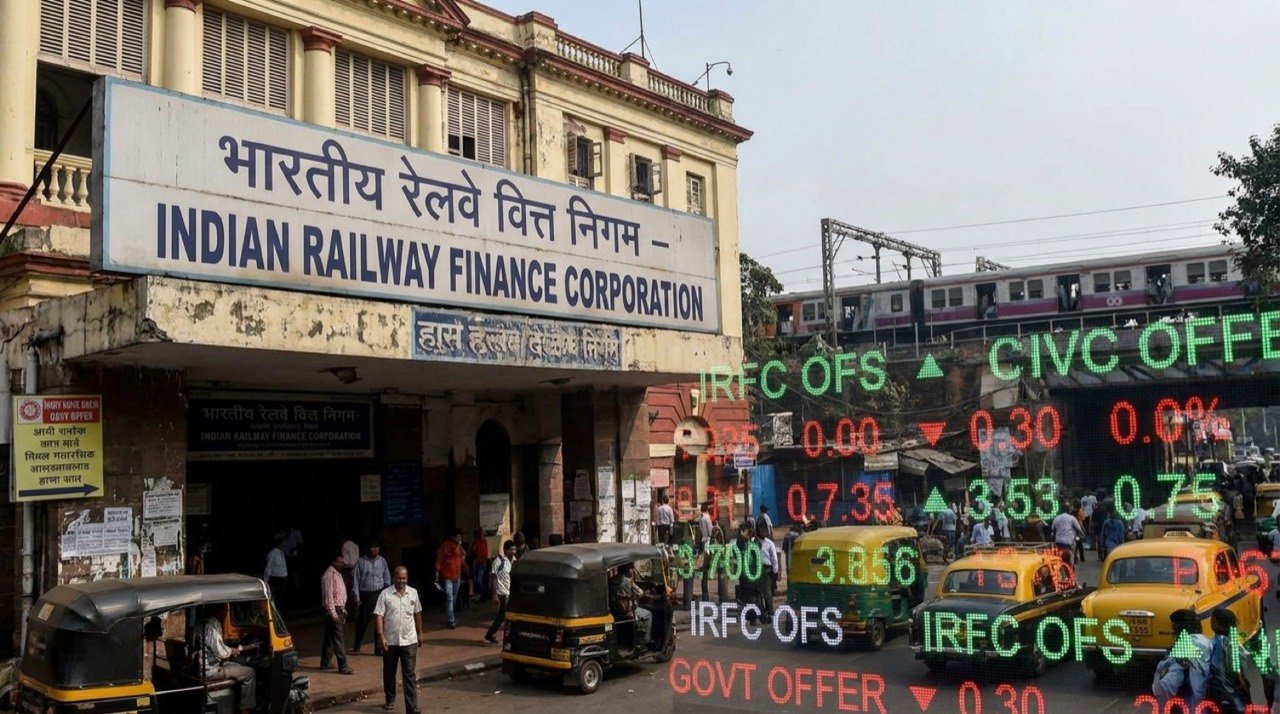
The Indian government will sell up to 2 percent of its holding in Indian Railway Finance Corporation (IRFC) through an offer for sale (OFS), with the issue opening to non-retail investors on Wednesday and retail investors able to bid the following day. On the surface, this is a routine entry in the long ledger of the Centre's disinvestment programme. But the structure of the sale, the identity of the company involved, and the timing all make it worth a closer look than the modest headline number might suggest.
How the offer is structured
According to reports, the base sale is set at 1 percent of equity, with an additional 1 percent greenshoe option that allows the government to expand the offer if demand is strong. This is a familiar template: start conservative, then use the greenshoe to capture upside if institutional appetite proves robust. The two-day window follows the standard OFS format, opening first to institutional and other non-retail bidders before retail investors get their turn. This sequencing exists for a reason. Institutional bids on day one help establish a credible floor price and demand signal, which in turn gives retail investors on day two more confidence — or, in a weak scenario, more caution — about where to pitch their own bids.
Market attention in the coming days will centre on three things: the floor price the government sets, the level of oversubscription the base tranche attracts, and how aggressively institutional investors such as mutual funds, insurers and foreign portfolio investors compete for allotment. Together, these will determine whether the government exercises the full greenshoe or settles for the smaller 1 percent base sale. A thin institutional book would likely mean the Centre banks the smaller amount and waits for a better window; a strong one would let it lean on the greenshoe and extract the full 2 percent while pricing remains favourable.
Why IRFC matters
IRFC is not an ordinary public-sector unit up for sale. It is the dedicated financing arm closely tied to funding Indian Railways and related infrastructure, meaning its balance sheet is, in effect, the capital-raising machinery behind the country's rail modernisation push. As the railways pursue large-scale modernisation and capacity expansion — new rolling stock, track upgrades, electrification, station redevelopment and more — the company's role in mobilising capital for these projects gives this stake sale a significance that goes well beyond a routine divestment line item in the budget.
This is precisely why the government is trimming its holding by a modest 2 percent rather than stepping back further. IRFC remains strategically important to the railways' financing architecture, and the Centre has no evident interest in diluting its control. What it does have an interest in is nudging the company towards a healthier free float. A wider base of publicly held shares generally supports better price discovery, deeper liquidity, and a broader universe of investors able to participate in the stock — all of which are useful outcomes for a company that will likely need to keep tapping markets to fund the railways' capital expenditure appetite in the years ahead.
A signal for future PSU sales
Beyond the immediate proceeds this sale will generate, the offer is being read across the market as a barometer of current appetite for public-sector undertakings more broadly. Government-linked stocks have had a mixed run in various market cycles, and how investors respond to a well-regarded, railway-linked financier like IRFC will tell the Centre something about the mood for its wider PSU stable.
Strong demand here could embolden the government to line up further PSU stake sales in the months ahead, treating this OFS as a live test case that de-risks subsequent launches. A tepid response, on the other hand, might prompt a more cautious calendar, with the disinvestment department choosing to wait for calmer or more bullish market conditions rather than pushing paper into a soft market. In that sense, this IRFC sale carries weight far beyond its own two percentage points; it is also an early data point for how the rest of the government's divestment pipeline might be timed and sized.
What it means for investors and the exchequer
For investors, the OFS offers a fresh entry point into a stock that is effectively leveraged to India's railway capital expenditure cycle. Anyone with a constructive view on the pace of railway modernisation, and on the government's continued willingness to back IRFC's balance sheet, will see this as an opportunity to build or add to a position at a price discovered through competitive bidding rather than the secondary market alone.
For the government, the outcome will help calibrate the pace and ambition of its broader disinvestment push in the months ahead. Proceeds from the sale feed directly into the fiscal arithmetic, offsetting borrowing needs or supporting spending commitments elsewhere. But the more instructive outcome, arguably, is qualitative rather than monetary: how institutions and retail investors price a strategically important, railway-linked PSU today tells the finance ministry a great deal about what it can expect to raise, and how quickly, if it decides to widen the disinvestment net later this year.
The NE Times View
A modest 2 percent trim in IRFC is routine disinvestment that nets the exchequer cash without ceding control of a strategic railway financier. There is nothing wrong, in principle, with monetising a fraction of a market favourite in an orderly, well-telegraphed process such as this one. The base-plus-greenshoe structure is sensible, the two-day retail-institutional sequencing is standard practice, and IRFC's underlying business case — financing the railways' expansion — remains intact regardless of who holds the extra 2 percent of equity.
But selling small slices of profitable PSUs, however cleanly executed, is not by itself a disinvestment strategy. It is, more accurately, a recurring patch for the fiscal arithmetic — a way to book non-tax receipts without committing to the harder work of genuine strategic divestment, privatisation, or a clearly sequenced multi-year PSU sale calendar. The market will watch this OFS closely for signal value, and rightly so; but policymakers should be wary of reading strong demand for a two percent stake in a well-run company as validation of the broader disinvestment approach. The two are not the same test.
Key takeaways
- The government will sell up to 2 percent of IRFC via an OFS, comprising a 1 percent base sale and a 1 percent greenshoe option.
- Non-retail investors bid first on Wednesday, with retail investors following the next day, in line with the standard OFS format.
- IRFC's central role in financing Indian Railways' modernisation gives the sale importance beyond a routine divestment, while the Centre retains firm control.
- Pricing, oversubscription levels and institutional demand will determine whether the greenshoe is exercised, and will be watched as a signal for the pace of future PSU stake sales.
- The NE Times View holds that while the sale itself is sound, small routine PSU trims should not be mistaken for a coherent disinvestment strategy.
You may also like to read
Fairfax India's $1 Billion Government Bond Purchase Puts IDBI Stake Bid in Focus
Fairfax India has reportedly bought nearly $1 billion in Indian government bonds, a capital move widely read as positioning ahead of a possible bid for a stake in IDBI Bank.

TCS Earnings, Crude Oil and Global Cues Set to Steer Dalal Street
Indian equities head into a cue-heavy week as the June-quarter earnings season opens with TCS, while crude oil prices and global risk signals shape how investors position across sectors.

FIIs Offload Rs 1,350 Crore As DIIs Step In To Steady Markets
Foreign institutional investors sold Indian equities worth Rs 1,350 crore on June 29 while domestic institutions bought Rs 2,801 crore, cushioning benchmarks on a volatile day that ended in the red.

Netweb Shares Slide 11% Before Board Meets On Fundraise Plan
Netweb Technologies India stock logged its steepest single-day fall since January 2025, dropping as much as 11 percent after the company said its board would meet to consider raising fresh capital.
More from this section
More
Adani Case: US DOJ Pushes for Permanent Dismissal of Charges
The US Department of Justice has urged a judge to permanently dismiss charges against Gautam Adani, calling the case legally flawed — a reversal with consequences for markets, diplomacy and cross-border enforcement.

Akasa Air Inducts 40th Aircraft in Indian Aviation Scale-Up
Akasa Air's 40th aircraft, ferried to Bengaluru via Seattle, Reykjavik and Cairo, marks a fleet milestone for the young carrier and a fresh signal that India's aviation market remains firmly in expansion mode.
BARC Ratings Suspension Leaves Indian TV Industry Flying Blind
BARC's pause on television ratings has put India's broadcast measurement system under fresh scrutiny, leaving broadcasters, advertisers and media planners without the weekly audience data that anchors the TV economy.