FMCG Demand Outlook Brightens on Rural Recovery and Stable Prices
Consumer goods companies are turning more upbeat as rural demand recovers, input costs hold steady and everyday purchases pick up, offering a telling read on the health of Indian household spending.
Commentary & Analysis ·

India's fast-moving consumer goods companies are sounding noticeably more confident, with a recovering rural market, stable input costs and firmer everyday demand lifting the sector's mood. According to Business Standard, firms are tracking volume growth and price stability as the key signals for the months ahead. The shift in tone is worth pausing over, because FMCG executives have spent the better part of the last two years hedging their commentary with caveats about muted rural offtake and cost pressure. A more upbeat read from an industry that touches nearly every household in the country deserves scrutiny rather than a quick nod of approval.
Why FMCG is the economy's pulse check
Sales of soaps, snacks, shampoos and staples are one of the most honest indicators of household confidence. When families buy more packaged foods and daily-use products, or trade back up to preferred brands rather than settling for cheaper local substitutes, it usually means budgets are loosening across both urban and rural India. Unlike big-ticket purchases such as cars or property, which can be deferred or financed and therefore say as much about credit conditions as about sentiment, FMCG spending is immediate and repeated. People buy soap and shampoo whether or not they feel optimistic about the future; what changes with confidence is which brand, which pack size, and how often they restock. That makes FMCG commentary a proxy for the wider consumer economy, not just one sector's earnings story, and it is why economists and policymakers watch these numbers as closely as investors do.
This is also why a single quarter of upbeat commentary from FMCG firms tends to move well beyond the sector's own share prices. When packaged goods companies talk of volume recovery, it feeds into broader assumptions about GDP composition, about how much of India's growth is being driven by consumption as opposed to investment or government spending, and about whether the benefits of that growth are reaching households outside the metros.
The rural engine matters most
Rural markets account for a large share of the industry's volume growth, and they were the first to trade down when inflation squeezed budgets. That trading down was itself a telling signal of stress: rural consumers did not necessarily buy less, but many shifted to smaller sachets, cheaper brands or local alternatives to protect their spending on essentials. It is a coping mechanism, not a collapse in demand, but it depresses both volumes and margins for the larger listed players who depend on rural India for scale.
Better monsoon distribution, improving farm incomes and steadier prices can now unlock purchases that had been delayed or downgraded. If rural households that spent the last couple of years economising begin trading back up to their preferred brands and larger pack sizes, the effect compounds: it lifts volumes, it lifts realisations per unit, and it validates the distribution investments that FMCG companies have made in smaller towns and villages over the past decade. If that recovery holds, it broadens the demand base well beyond metro shelves, which matters because urban consumption alone has rarely been enough to sustain the kind of volume growth the sector's investors have come to expect.
Optimism still has to be executed
The caution is that optimism still has to be executed. Distribution reach, pricing discipline and the resilience of consumer budgets will determine whether upbeat commentary converts into sustained volume growth rather than a single good quarter. Distribution reach is not a given even for large companies; reaching the last mile of rural India requires sustained investment in wholesalers, retailers and logistics that can be scaled back the moment demand disappoints, which in turn can undo years of groundwork.
Pricing discipline is the other side of that coin. Companies that raised prices sharply during the input-cost spike of recent years now face a delicate balancing act: cutting prices or offering larger grammage to win back volume, without triggering a price war that erodes margins across the sector. Firms that navigate this well will likely be rewarded with market share; those that either overprice out of habit or discount too aggressively risk squandering the goodwill that a genuine recovery could offer.
What could go wrong
Consumer budgets, particularly in rural India, remain more exposed to shocks than urban ones. A poor spread of monsoon rainfall in any single season, a spike in fuel or fertiliser costs, or a slowdown in agricultural prices can quickly reverse the improvement in farm incomes that is underpinning this optimism. Because rural demand is so closely tied to the agricultural cycle, FMCG recovery narratives have a habit of appearing prematurely, only to be deferred by a season of erratic weather or a commodity price shock. That history is a reason for measured optimism rather than either dismissal or excitement.
The NE Times View
A genuine rural recovery would be one of the most meaningful economic stories of the year, because it signals that growth is reaching beyond India's cities. FMCG optimism is an early tell, but it is also fragile: one erratic monsoon stretch or a fresh commodity-cost spike could reverse the mood quickly. The companies that win from here will be those that kept price points honest during the inflationary squeeze and invested in rural distribution when it was unfashionable, rather than those simply riding a favourable narrative into the next earnings call. For readers, the takeaway is simple: watch volumes, not just company commentary, because volumes are where household reality shows up. Commentary can be shaped for investor calls; the actual movement of soap bars and snack packets off rural shelves cannot.
It is also worth watching how long the current stability in input costs lasts, since much of the sector's improved mood rests on that stability rather than on a dramatic surge in demand. Should raw material costs turn volatile again, the same companies now sounding confident could just as quickly return to the cautious, hedged language that has characterised recent years. For now, the more encouraging signal is that firms are explicitly framing volume growth and price stability as the metrics to watch, which suggests a degree of self-awareness about what actually matters to households, as distinct from what looks good in a results presentation.
Key takeaways
- FMCG companies are turning more confident amid a recovering rural market, stable input costs and firmer everyday demand.
- Rural markets, a major share of industry volumes, were the first to trade down during the inflationary squeeze and are now central to any recovery story.
- Distribution reach and pricing discipline will decide whether this optimism becomes sustained volume growth or fades after one good quarter.
- Consumer budgets, especially in rural India, remain vulnerable to monsoon variability and renewed commodity-cost pressure.
- Readers and investors alike should track actual volumes rather than company commentary, since volumes reflect real household behaviour.
You may also like to read
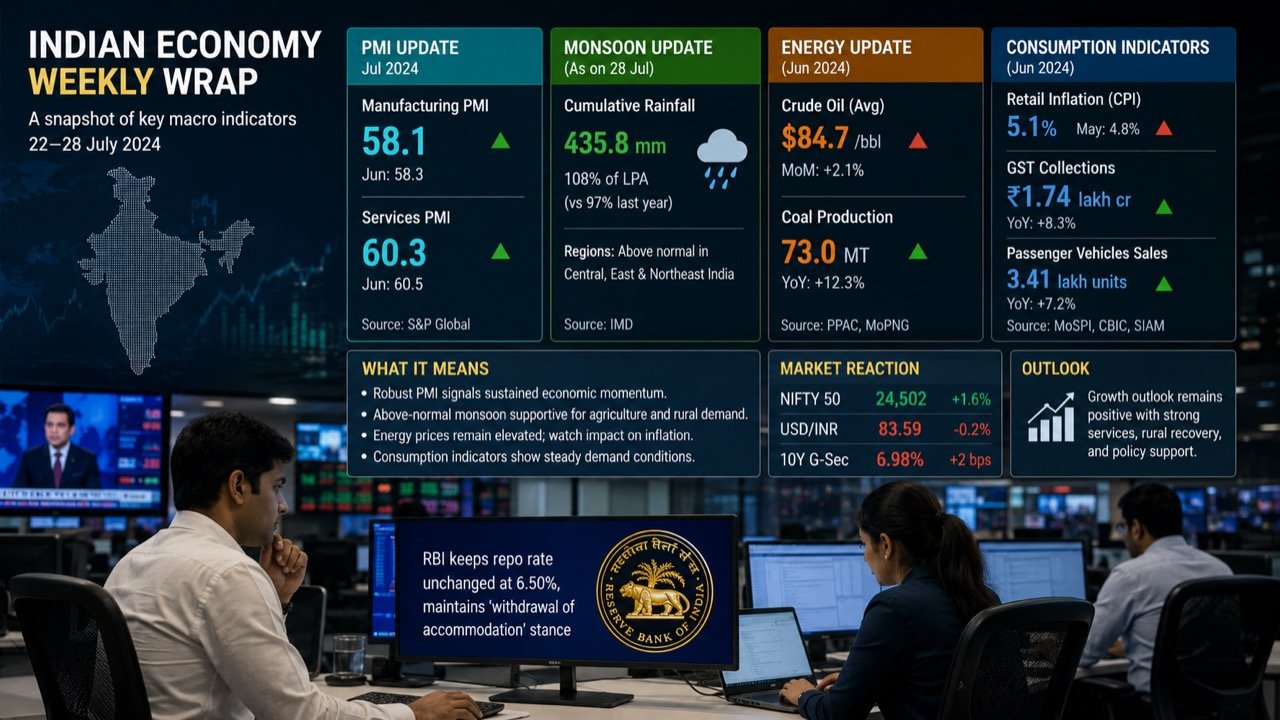
India Economy This Week: Energy Relief, PMI and Monsoon Demand
India's near-term growth picture is being read through a dashboard of indicators this week, with energy costs, PMI activity readings and monsoon-linked rural demand each pulling the conversation in different directions.

OPEC+ Agrees Bigger August Output Hike: What It Means for Oil Prices
OPEC Plus members have signed off on a larger production increase for August, a supply-side shift that puts crude benchmarks, India's import bill and fuel-linked costs firmly back in the market spotlight.

Radico Khaitan Bets on Premium Spirits as India Trades Up
Radico Khaitan's plan to earn a larger share of revenue from premium products spotlights a wider premiumisation wave reshaping India's spirits market, where higher-margin brands are chasing rising disposable incomes.

Moody's Flags India's Fragmented Water Management as a Growing Fiscal and Credit Risk
Moody's warns that India's dispersed water governance, subsidised pricing and unclear investment pathways could turn rising water stress into a fiscal and credit liability as demand surges.
More from this section
More
Adani Case: US DOJ Pushes for Permanent Dismissal of Charges
The US Department of Justice has urged a judge to permanently dismiss charges against Gautam Adani, calling the case legally flawed — a reversal with consequences for markets, diplomacy and cross-border enforcement.

Akasa Air Inducts 40th Aircraft in Indian Aviation Scale-Up
Akasa Air's 40th aircraft, ferried to Bengaluru via Seattle, Reykjavik and Cairo, marks a fleet milestone for the young carrier and a fresh signal that India's aviation market remains firmly in expansion mode.

BARC Ratings Suspension Leaves Indian TV Industry Flying Blind
BARC's pause on television ratings has put India's broadcast measurement system under fresh scrutiny, leaving broadcasters, advertisers and media planners without the weekly audience data that anchors the TV economy.