E20 Petrol: Why India's Ethanol Blending Push Divides Motorists
India's rollout of E20 ethanol-blended petrol has become a live public-policy debate, with vehicle owners raising questions about mileage, engine compatibility and consumer choice even as the government defends its energy-security goals.
Commentary & Analysis ·
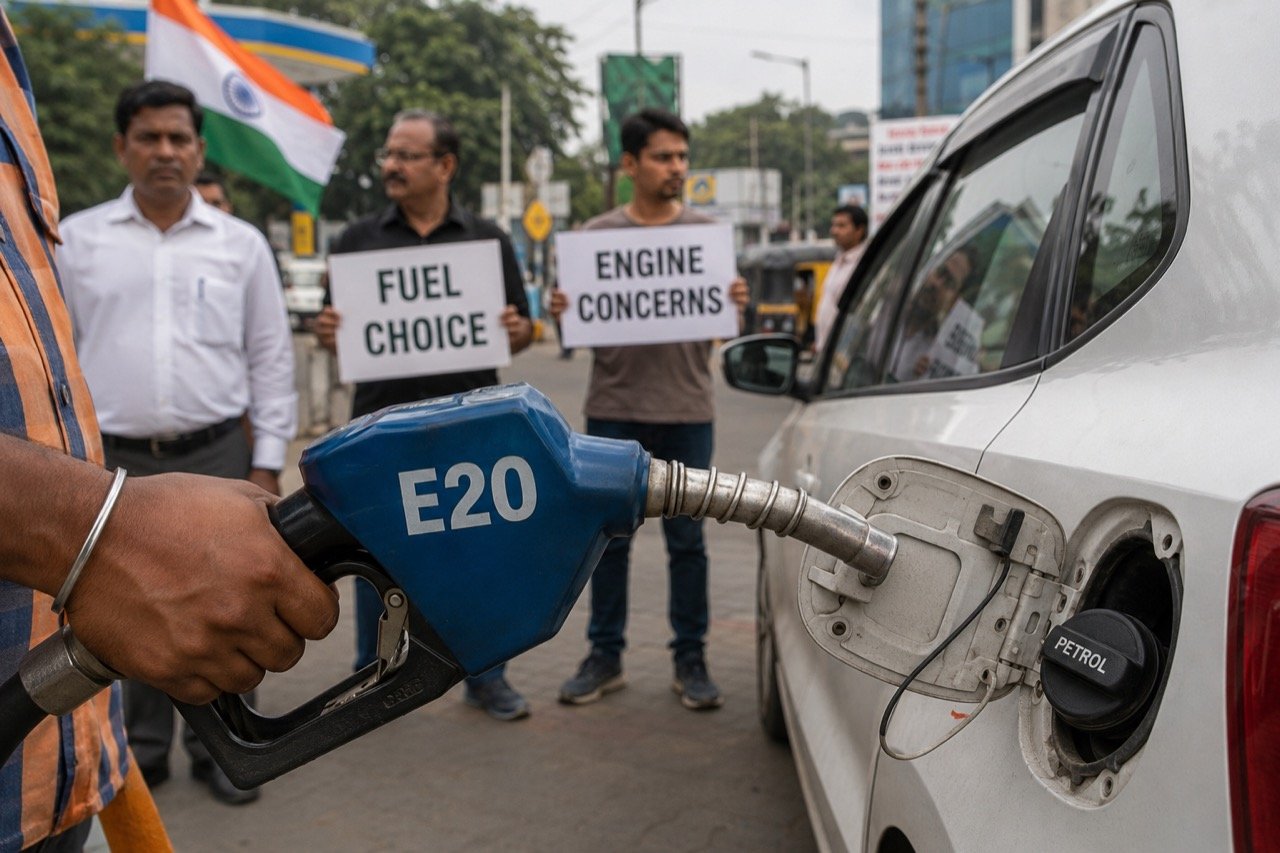
Few policy debates reach the average Indian as directly as the one now playing out at petrol pumps. The rollout of E20 fuel — petrol blended with 20 per cent ethanol — has moved from technical circles into everyday conversation, as motorists question what the ethanol mandate means for their mileage, their engines and their wallets. Search interest around E20 petrol, engine compatibility and fuel economy has surged as criticism of the blending programme gathers momentum. Unlike most policy arguments, this one is experienced by consumers every time they refuel, which is precisely why it has become so charged.
That everyday, unavoidable quality is worth dwelling on. Tax changes, trade policy, even fuel-price movements are usually absorbed gradually or explained through a single, comprehensible number. Ethanol blending is different: it changes the composition of what goes into the tank, it cannot easily be opted out of at most stations, and its effects — on mileage, on engine parts, on long-term reliability — are diffuse and hard for an individual driver to verify. That combination of universality and ambiguity is a natural breeding ground for suspicion, regardless of how sound the underlying policy rationale might be.
What the government wants from ethanol blending
The ethanol-blending programme is a pillar of India's energy strategy. By substituting a fifth of every litre of petrol with domestically produced ethanol, the government aims to cut its enormous oil import bill, create a steady market for sugarcane and grain feedstocks, and trim some tailpipe emissions. The strategic logic — less dependence on volatile global crude markets — is widely accepted.
Each of these three objectives serves a distinct constituency, and together they explain why the programme has moved with such policy momentum. Reducing the oil import bill speaks to macroeconomic stability: crude purchases are a major drain on foreign exchange, and any credible substitute at scale has an obvious appeal to planners worried about the rupee and the current account. A guaranteed market for sugarcane and grain feedstocks speaks to rural incomes and to the perennial problem of sugar surplus and cane-arrears disputes in producing states. And the emissions angle, while more modest in its impact than the other two, allows the programme to be framed as compatible with India's broader climate commitments. None of these rationales is manufactured; they are the standard justifications offered by energy economists for blending mandates in general, and they explain why the policy has proceeded with such evident conviction at the executive level.
Why motorists are pushing back
Critics focus on the consumer side of the ledger. Ethanol carries less energy than petrol, so many drivers report a drop in mileage. Owners of older vehicles worry about long-term compatibility of engine components and fuel systems, and about whether warranties will cover blend-related wear. Perhaps the sharpest complaint is the lack of choice: at many stations, E20 is effectively the only petrol on offer, leaving owners of legacy vehicles with no practical alternative.
Each of these grievances has a distinct texture. The mileage complaint is the most immediately felt: a driver who fills a tank and watches the trip computer report fewer kilometres per litre experiences that as a direct, personal cost, even if the pump price per litre has not moved. It does not matter, from the driver's vantage point, whether the shortfall is a well-understood consequence of ethanol's lower energy density — what registers is simply that the same rupee amount now buys less distance.
The compatibility concern is slower-burning but potentially more consequential. Vehicles designed and sold before blending ratios rose face genuine uncertainty about whether seals, gaskets, fuel lines and injectors were engineered with higher ethanol content in mind. For owners of such vehicles, the anxiety is compounded by not knowing whether a manufacturer would attribute a future fuel-system failure to the fuel itself, and whether that would affect warranty claims. In the absence of clear technical guidance, this uncertainty tends to harden into distrust rather than dissipate over time.
The absence-of-choice complaint is, in some ways, the most politically potent of the three, because it removes agency from the consumer. A driver who dislikes E20 but has no alternative fuel available at the pump is not merely inconvenienced; they are being asked to accept a change to their vehicle's operating conditions without consent. That sense of being cornered, rather than persuaded, is often what turns a technical grievance into a public controversy.
A policy that is sound but poorly explained
The path forward likely depends less on chemistry than on communication. Clear pump labelling, published fuel-economy data, unambiguous warranty guidance from automakers and technical advisories for older vehicles would go a long way towards rebuilding trust. If owners feel forced into uncertainty instead, the pressure could migrate from social media to courts and regulators.
It is worth noting how much of this friction is avoidable. None of the measures described above requires reversing the blending target or slowing the transition; they simply require the state and the automotive industry to treat information as part of the policy deliverable rather than a footnote to it. Pump labelling that states the actual ethanol content clearly, rather than assuming drivers already know, costs little and removes ambiguity at the point of sale. Published, standardised fuel-economy comparisons — rather than anecdotal reports circulating informally — would let owners judge for themselves whether the mileage difference they are experiencing is expected or exceptional. And explicit warranty language from vehicle manufacturers, stating precisely what is and is not covered under E20 use, would settle one of the most anxiety-inducing unknowns in the entire debate.
The risk of inaction is that a policy debate which is currently confined to comment threads and fuel-pump conversations escalates into something more adversarial. Consumer forums, owners' associations and eventually litigation are the predictable next steps when a grievance festers without an authoritative, consistent response. Regulators and courts are poor venues for resolving what is fundamentally a communication failure, but they are exactly where such disputes tend to land once informal channels are exhausted.
The NE Times View
The E20 controversy is a case study in how sound strategic policy can stumble on weak consumer engagement. India's reasons for blending ethanol are legitimate — energy security, farm incomes and emissions all matter. But a transition that touches every fuel tank in the country cannot be run as a supply-side project alone. The government and oil marketers should treat mileage transparency and vehicle-compatibility guidance as core deliverables, not afterthoughts, and preserving some consumer choice at the pump would defuse much of the anger. Trust, once lost at the fuel station, is expensive to refill.
What makes this case instructive beyond the fuel-pump context is the general lesson it offers about large infrastructural transitions. Whenever a policy is implemented uniformly and without an opt-out — whether it concerns fuel composition, digital payments infrastructure, or utility standards — the burden of proof shifts onto the state to demonstrate, continuously and transparently, that the change is safe, fair and well understood by those affected. A policy can be economically sound and still generate political cost if the human experience of it feels opaque or involuntary. The ethanol programme need not be diluted to fix this; it needs to be explained.
Key takeaways
- India's E20 ethanol-blending mandate aims to cut oil import costs, support sugarcane and grain producers, and reduce tailpipe emissions.
- Motorists' objections centre on reduced mileage, uncertainty over long-term engine and fuel-system compatibility, and warranty concerns.
- The lack of alternative fuel options at many pumps has intensified frustration among owners of older vehicles.
- Clearer pump labelling, published fuel-economy data and explicit manufacturer warranty guidance could substantially reduce consumer distrust.
- Left unaddressed, the grievance risks escalating from informal criticism into regulatory or legal disputes.
You may also like to read
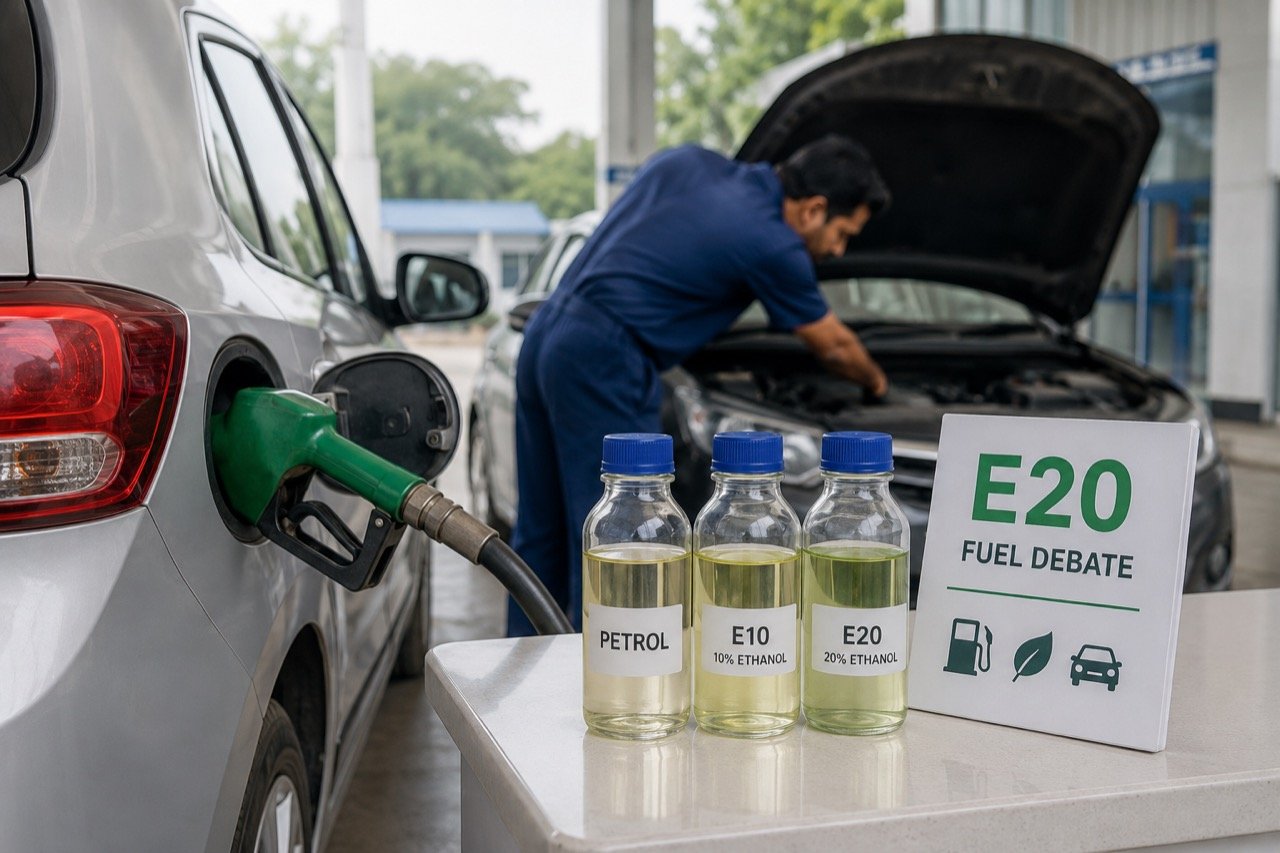
E20 Fuel in India: Mileage and Engine Worries Reach the Petrol Pump
India's push for 20 percent ethanol-blended petrol has moved from policy circles to everyday consumers, who are now asking hard questions about mileage loss, engine compatibility and what older vehicles should do.
E20 Petrol: Carmakers Say No Engine Damage, But Mileage Dips
Carmakers have clarified that E20 petrol does not damage engines, but an acknowledged drop in fuel efficiency keeps ethanol-blended fuel at the centre of a consumer debate touching every Indian driver.

India Lifts Natural Gas Curbs as Middle East Tensions Ease
The Centre has rolled back emergency natural gas restrictions imposed in March to shield priority sectors, signalling that policymakers judge the immediate supply risk from West Asian instability to have receded.

Nitin Gadkari Backs Isobutanol-Blended Diesel in New Biofuel Push
Union Minister Nitin Gadkari is reportedly pushing for up to 15 percent isobutanol blending in diesel, extending India's biofuel drive beyond E20 petrol into the fuel that powers freight and farming.
More from this section
More
AICTE Industry Fellowship 2026: Rs 1.5 Lakh Scheme Closes July 5
The AICTE Industry Fellowship Programme 2026, which places technical-education faculty inside leading companies on a Rs 1.5 lakh monthly stipend, reached its application deadline on July 5.
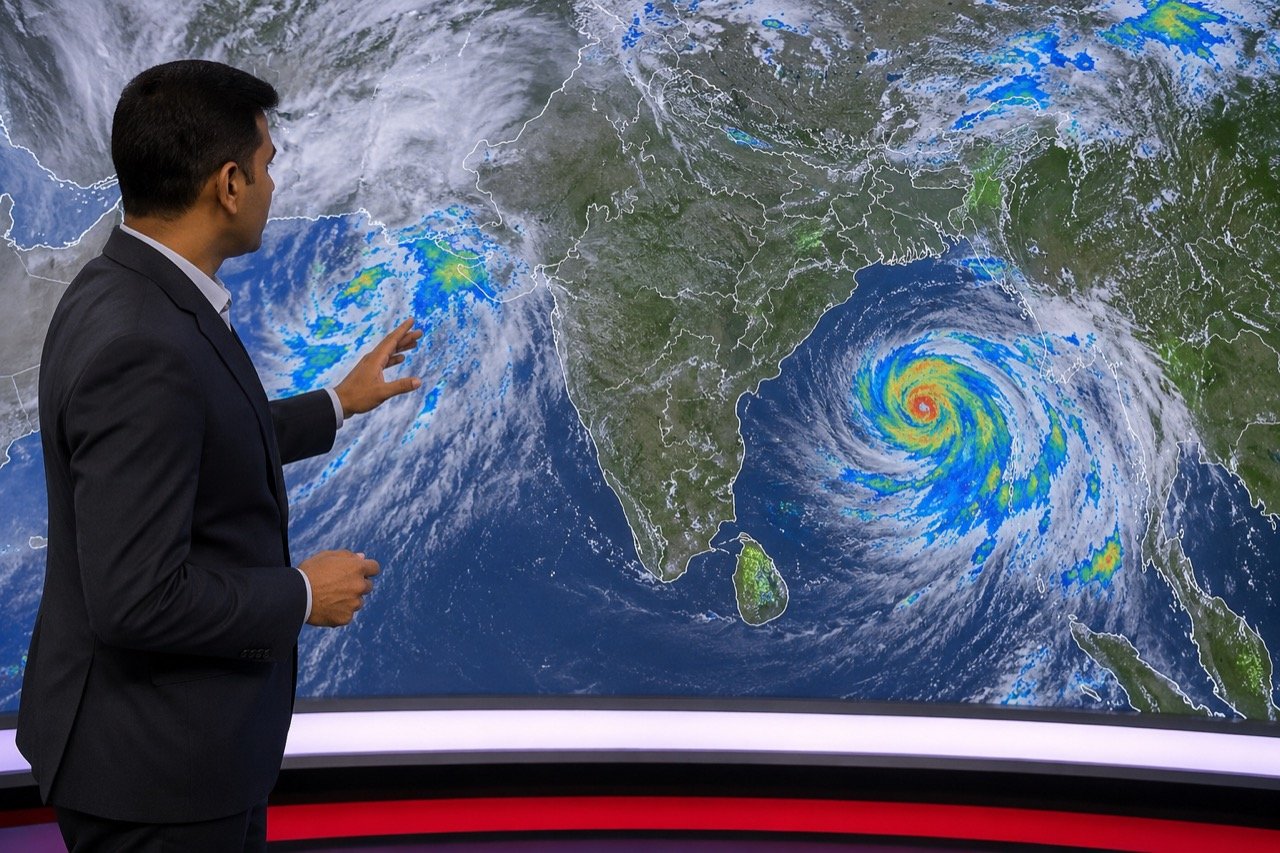
Bay of Bengal Low Pressure System Revives Monsoon Over Western India
A low-pressure system over the Bay of Bengal has pushed the monsoon back into an active phase, bringing steady heavy rain to Kerala, coastal Karnataka and Maharashtra, and putting Mumbai and Pune on preparedness watch.
Bishnoi Gang Suspects Injured in Haryana Encounter as Police Tighten Net
A joint Haryana-Delhi Police operation in Bahadurgarh left two suspected Lawrence Bishnoi gang members injured, spotlighting the multi-state coordination now central to India's fight against organised crime networks.