Defence Ministry Plans Seven Manufacturing Clusters to Boost Military Production
India's Ministry of Defence is reported to be planning seven manufacturing clusters to deepen supply chains, cut import dependence and draw private industry into higher-value military production.
Commentary & Analysis ·
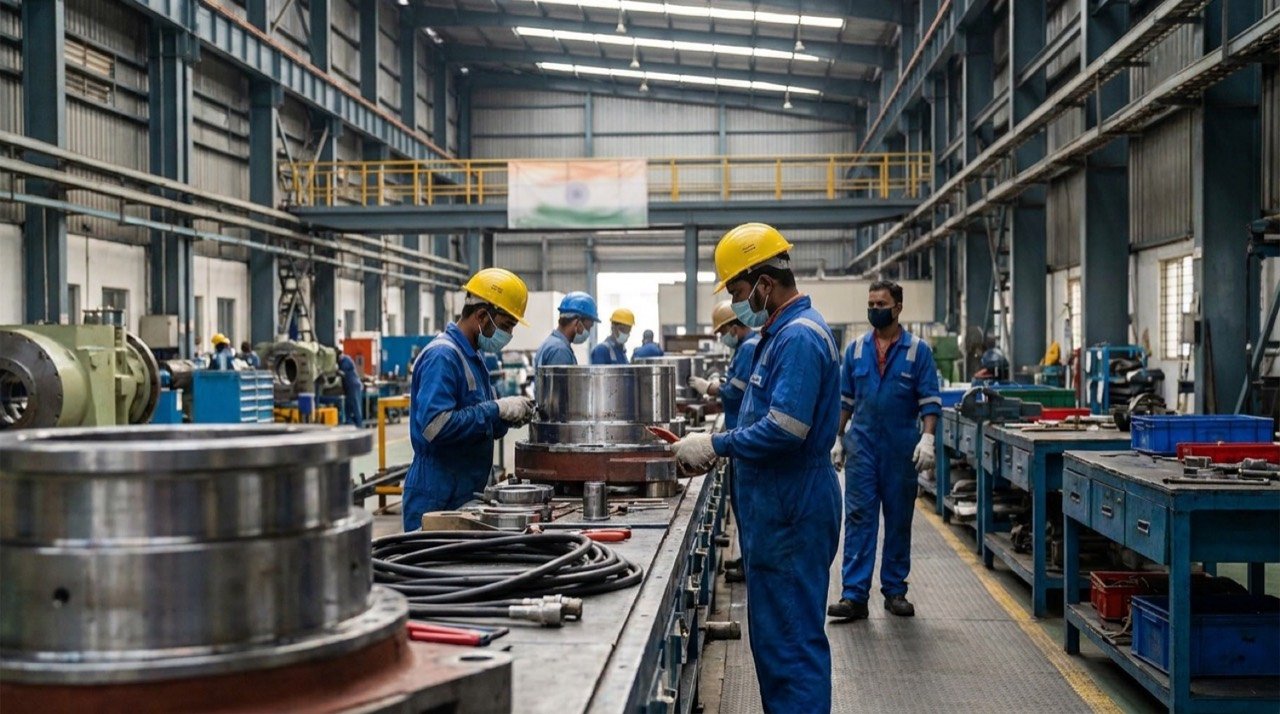
India's Ministry of Defence is reported to be examining a plan for seven manufacturing clusters aimed at strengthening military production, deepening domestic supply chains and drawing greater private-sector participation into a field long dominated by state-owned units. The idea, still at the proposal stage, is nonetheless significant enough to warrant close attention, because it speaks to a question that has hung over India's defence-industrial policy for years: can the country move beyond assembling imported kits and become a genuine originator of military hardware.
Part of a self-reliance push
The proposal fits a broader, multi-year effort to reduce India's heavy dependence on imported defence equipment while expanding indigenous design, component manufacturing and maintenance capacity. Cutting reliance on foreign suppliers has become both a strategic and an economic priority for New Delhi. Strategically, a defence establishment that cannot produce or repair its own equipment at scale is vulnerable in precisely the moments when it matters most, during a prolonged conflict, a supply embargo, or a geopolitical rupture with a key supplier nation. Economically, every rupee spent on imported systems is a rupee that does not circulate through domestic factories, does not create domestic engineering jobs, and does not build the kind of technical know-how that compounds over decades. Concentrating capability in clusters is a deliberate model rather than an incidental choice. By co-locating manufacturers, testing facilities and suppliers, the ministry hopes to create ecosystems where smaller firms can plug into larger programmes rather than operate in isolation, each hunting for its own customers, financiers and testing slots.
Why clusters matter
Modern military manufacturing is not a single-factory affair. It depends on a web of skilled vendors, specialised testing infrastructure, access to finance, dependable logistics and, above all, a predictable flow of orders to justify long-term investment. A single prime contractor assembling a fighter jet, an armoured vehicle or a naval sensor system typically draws on hundreds of smaller firms supplying forgings, castings, electronics, software and precision-machined parts. When those firms are scattered across the country with no shared infrastructure, each one must independently solve the same problems of certification, quality testing and access to specialised machinery. A cluster model tries to collapse those redundant costs by putting suppliers physically near one another and near the testing and certification bodies they depend on. If implemented well, clusters can help small and mid-sized suppliers graduate into higher-value work, building components and subsystems rather than merely supplying raw inputs such as steel, aluminium or basic castings. That shift, from raw-material supplier to subsystem manufacturer, is exactly the kind of industrial upgrading that has powered manufacturing success stories elsewhere, and it is the crux of what India's defence planners appear to be chasing. In turn, deeper domestic subsystem capability can give the armed forces faster and cheaper access to upgrades and replacements, reducing the lag between a battlefield requirement being identified and a solution reaching the front line.
The conditions for success
The gap between policy intent and industrial reality is where such initiatives are often won or lost, and India's own recent history offers ample evidence of that gap. Several ingredients will determine whether these seven clusters deliver on their promise rather than becoming another well-intentioned scheme that fails to achieve scale. A steady pipeline of firm orders is needed to anchor private investment, since no private manufacturer will sink capital into specialised tooling on the strength of a single announced cluster; they need confidence that the ministry and the armed forces will actually place orders over a sustained horizon. Genuine technology transfer, rather than assembly-only work, is equally important, because clusters that merely bolt together imported components under a domestic label do little to build the design and engineering competence that self-reliance is supposed to deliver. Access to affordable finance for small and mid-sized vendors matters because defence manufacturing typically demands long gestation periods and capital-intensive certification processes that many smaller Indian firms cannot finance on commercial terms alone. Shared testing and certification infrastructure within each cluster would remove one of the most persistent bottlenecks in Indian defence manufacturing, where a lack of accredited testing facilities has historically slowed even capable firms. And skilled local jobs and training are needed to sustain the workforce that these clusters would require, since precision manufacturing for military use demands a different calibre of technical skill than general engineering work. Without sustained demand, even well-designed clusters risk becoming under-used industrial parks, dotted with half-empty sheds and idle machine tools rather than humming with subcontractors. Predictable procurement is the lever that turns intent into capacity, and it is arguably the single hardest thing for any government procurement system to guarantee, given the competing pressures of budget cycles, shifting strategic priorities and the political attractiveness of new announcements over the unglamorous work of honouring existing commitments.
Industry analysts have summed up the essential tension neatly: the central issue is whether policy intent turns into sustained orders, technology transfer and local jobs. That formulation is worth dwelling on, because it implicitly warns against judging this scheme by its announcement alone. A ministry press release describing seven clusters is not the same thing as seven clusters filled with functioning, profitable, technically capable firms a decade from now. The distance between the two depends entirely on the follow-through that rarely makes headlines: contract terms, payment timelines, intellectual property arrangements and the mundane bureaucratic machinery of certification and quality assurance.
What private industry will be watching
For private manufacturers considering whether to commit capital to these clusters, the calculus will not be about patriotism or policy alignment alone; it will be about risk-adjusted returns. Firms that have previously been drawn into defence-adjacent manufacturing only to find orders delayed, cancelled or replaced by imports will be watching closely for signals that this scheme differs from past ones. Larger private conglomerates with balance sheets robust enough to absorb years of uncertain returns may be willing to make an early move, but the deeper prize, and the harder one to secure, is drawing in the small and mid-sized enterprises that would supply the second and third tiers of the chain. Those are the firms with the least capacity to absorb delayed payments or shifting specifications, and they are also, not coincidentally, the firms whose participation would most clearly indicate that the cluster model is achieving its stated aim of deepening the supply base rather than simply relocating a handful of large contractors.
Geography, politics and the risk of dispersion
One further consideration, not addressed in detail in the ministry's reported plan but implicit in any multi-cluster scheme, is where these seven clusters will actually be sited. Industrial clusters work best when they follow logistics, existing engineering talent pools, proximity to ports or rail links, and pre-existing pockets of manufacturing expertise. They work far less well when their locations are chosen to distribute political benefit evenly across states or constituencies. India has, in other contexts, seen well-funded industrial schemes underperform precisely because site selection prioritised political optics over logistical logic. If the seven clusters are located with an eye to genuine industrial fit rather than balanced political representation, the odds of building durable supplier ecosystems improve considerably; if not, the risk is a set of geographically scattered, thinly populated zones that never achieve the density of suppliers needed to function as true clusters at all.
The NE Times View
Clustering defence manufacturing is the right instinct: it builds the supplier depth and shared infrastructure that one-off orders never create. The harder part is what has tripped up earlier schemes: predictable order books, faster certification and private firms willing to invest against demand that historically arrives late. Geography also matters; clusters built for political balance rather than logistics will underperform. Self-reliance lives in the second-tier supply chain, which is exactly what this should nurture. The test of this plan will not be visible in the coming months, when announcements and inaugurations are likely to generate favourable coverage, but over the coming years, in whether small and mid-sized suppliers within these clusters are winning repeat orders, upgrading their technical capabilities, and building the kind of institutional trust with prime contractors and the ministry that allows them to invest for the long term. That is a slower, less photogenic story than a ribbon-cutting, but it is the only one that will determine whether India moves meaningfully closer to being a producer, rather than an assembler, of its own defence equipment.
Key takeaways
- The Ministry of Defence is reportedly examining a plan for seven manufacturing clusters to strengthen domestic military production and deepen supply chains.
- The scheme is part of a broader self-reliance push aimed at reducing dependence on imported defence equipment and expanding indigenous design and component manufacturing.
- Success will hinge on a steady pipeline of firm orders, genuine technology transfer, affordable finance for smaller vendors, shared testing and certification infrastructure, and skilled local jobs.
- Without sustained demand, clusters risk becoming under-used industrial parks rather than functioning supplier ecosystems.
- The real measure of this plan's success will be the depth of second-tier supply chains and the quality of jobs created over the coming years, not the number of clusters announced.
You may also like to read
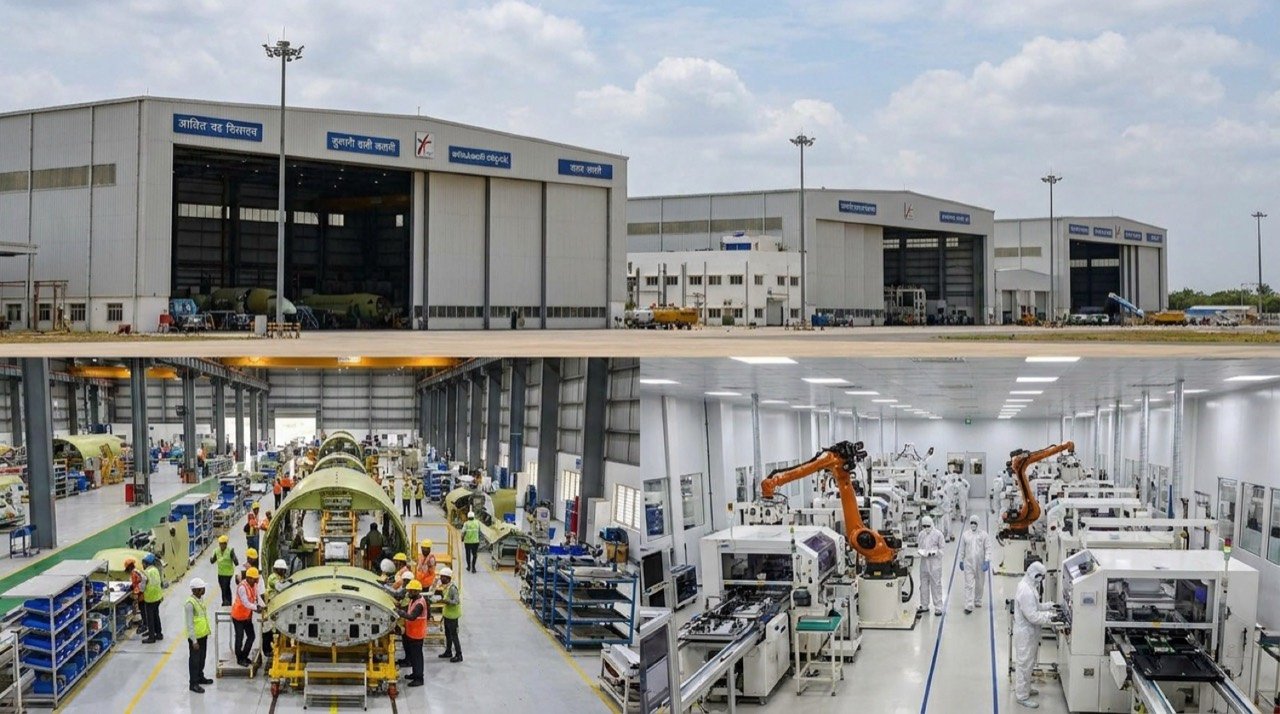
Seven Defence Manufacturing Clusters Put India's Self-Reliance Push in Focus
India is reportedly planning seven defence manufacturing clusters to deepen domestic capability, cut import dependence and strengthen supply chains across aerospace, electronics and land systems.
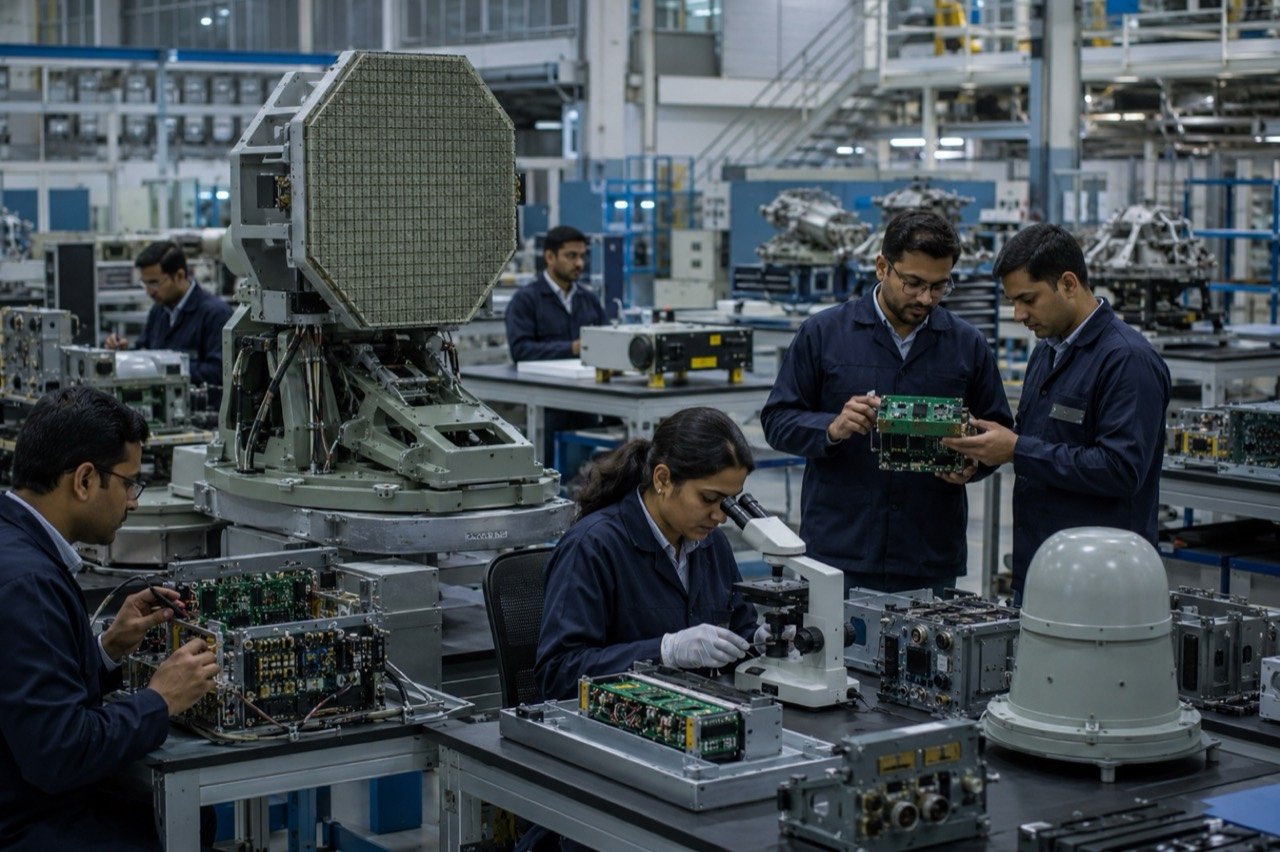
BEL Secures Rs 1,081 Crore in Fresh Defence Electronics Orders
Navratna PSU Bharat Electronics has booked Rs 1,081 crore in new orders since May, spanning radars, communication gear, CBRN protection and avionics, keeping its shares and order book firmly in focus.

Sanand Semiconductor Plant: What CG Semi's Launch Means for India
Commercial production at CG Semi's chip assembly and test facility in Sanand, marked by remarks from Prime Minister Modi, has renewed focus on how far India's semiconductor manufacturing push has actually come.

Maersk Orders 1,000 India-Made Containers From DCM Shriram
Maersk has unveiled its first India-made EXIM shipping container and placed an order for 1,000 more with DCM Shriram, a commercial vote of confidence in India's push to manufacture the hardware of global trade.
More from this section
More
Adani Case: US DOJ Pushes for Permanent Dismissal of Charges
The US Department of Justice has urged a judge to permanently dismiss charges against Gautam Adani, calling the case legally flawed — a reversal with consequences for markets, diplomacy and cross-border enforcement.

Akasa Air Inducts 40th Aircraft in Indian Aviation Scale-Up
Akasa Air's 40th aircraft, ferried to Bengaluru via Seattle, Reykjavik and Cairo, marks a fleet milestone for the young carrier and a fresh signal that India's aviation market remains firmly in expansion mode.

BARC Ratings Suspension Leaves Indian TV Industry Flying Blind
BARC's pause on television ratings has put India's broadcast measurement system under fresh scrutiny, leaving broadcasters, advertisers and media planners without the weekly audience data that anchors the TV economy.