CG Semi Sanand Plant Opens, Boosting India's Semiconductor Drive
Prime Minister Narendra Modi inaugurated CG Semi's chip assembly and test facility in Sanand, Gujarat, giving India's semiconductor mission a working manufacturing milestone rather than another policy promise.
Commentary & Analysis ·
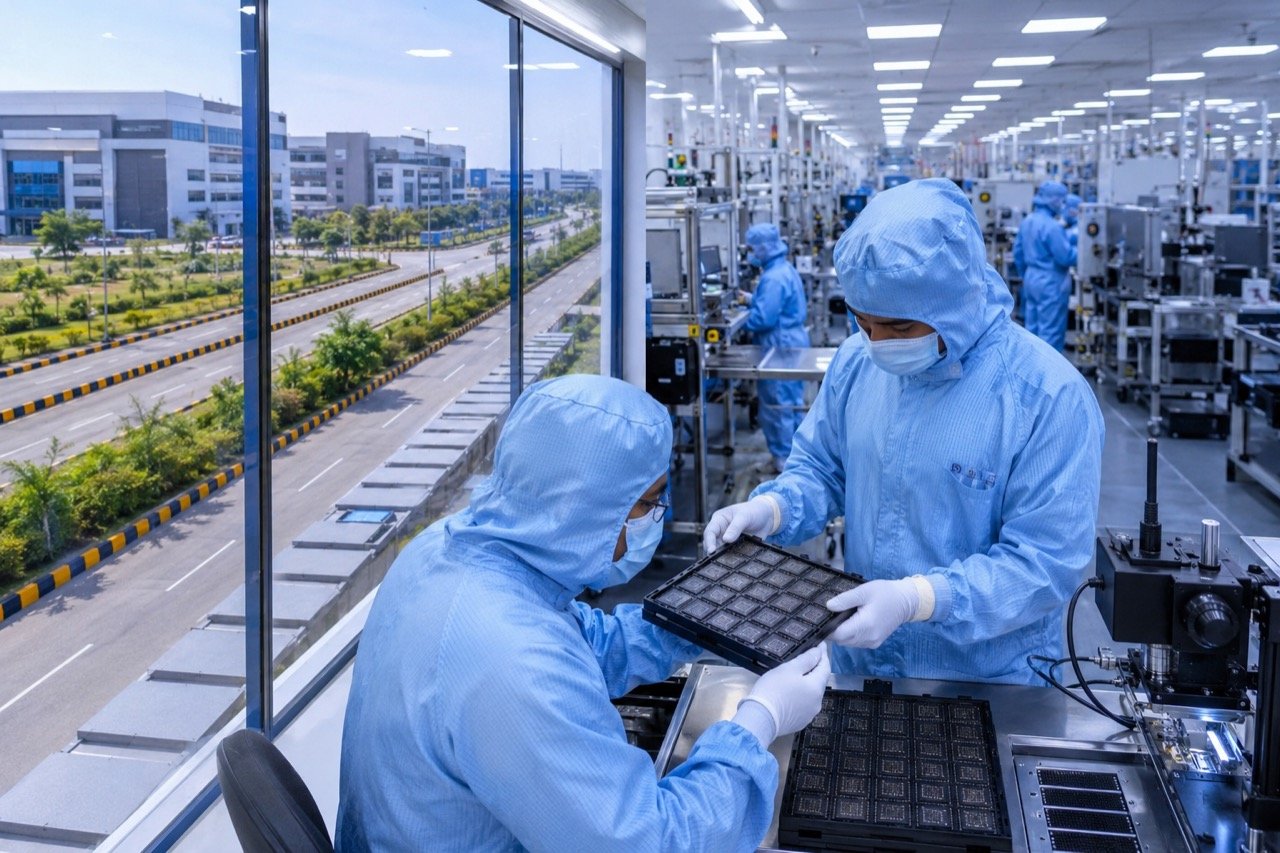
Prime Minister Narendra Modi inaugurated CG Semi's Outsourced Semiconductor Assembly and Test (OSAT) facility in Sanand, Gujarat, marking the start of commercial activity at a plant positioned as a key step in India's semiconductor ambitions. The launch adds working industrial capacity to a national strategy that spans chip design, packaging, testing, logistics and skilled manufacturing. Coming as it does after years of policy announcements and memoranda of understanding, the moment when a facility actually begins operating carries a different weight altogether: it converts intent into infrastructure, and promise into production.
Why assembly and testing matter
Semiconductor debates tend to fixate on advanced fabrication — the multi-billion-dollar fabs that print circuits at nanometre scale. But OSAT plants, which package, test and prepare chips for use in devices, are a crucial and often underappreciated part of the value chain. Without reliable assembly and testing, even the most advanced chip cannot reach a smartphone, a car dashboard or a data centre server in usable form. OSAT work is less capital-intensive than leading-edge fabrication yet still technically demanding, which makes it a practical entry point for a country building its semiconductor capability from a limited base.
This is precisely why the Sanand plant matters more than its modest profile might suggest. It is not attempting to leapfrog into cutting-edge fabrication, an area where the barriers to entry — cost, expertise, equipment access — remain formidable. Instead, it builds the supplier networks, technical jobs and the industrial discipline that more advanced projects will eventually depend on. Every economy that has climbed the semiconductor ladder has typically done so by first mastering the less glamorous stages of the chain before attempting the most difficult ones.
Gujarat's expanding cluster
Gujarat has anchored several of India's semiconductor and electronics announcements in recent years, and Sanand's new facility strengthens that cluster rather than starting one from scratch. Clustering matters in this industry because semiconductor manufacturing depends on dense networks of suppliers, specialised contractors, testing labs and logistics providers operating in close proximity. A single isolated plant, however well built, struggles to achieve the efficiencies that come from having complementary businesses nearby. By adding to an existing base in Gujarat, CG Semi's facility has a better chance of plugging into infrastructure, skilled labour pools and logistics chains that are already partly in place.
Coverage around the event tied the launch to the Make in India electronics roadmap and to India's position as the world's second-largest mobile phone manufacturer and exporter — a status the government cites as evidence that the country can climb from device assembly into higher-value components. That comparison is instructive. India's mobile phone manufacturing success did not happen overnight; it was built through a combination of policy incentives, patient investment and the gradual localisation of components. The semiconductor push is being framed in similar terms, with officials clearly hoping that a comparable trajectory — starting with assembly-adjacent work and moving toward higher-value activity — can be repeated in chips.
Strategy, stakes and hard realities
India's chip push is driven by economics and strategy alike. Semiconductors sit inside smartphones, cars, defence systems, appliances and AI hardware, and recent global supply disruptions showed how dependence on a handful of overseas suppliers creates vulnerability across entire industries. A shortage in one region can idle car factories, delay consumer electronics and complicate defence procurement thousands of miles away. Building domestic capacity, even in the less advanced segments of the value chain, is therefore as much a hedge against future shocks as it is an industrial policy ambition.
But ecosystems of this kind are hard to build. They need reliable power and water supply, clean-room expertise, a dependable base of materials suppliers, trained engineers and predictable policy — all in a field where Taiwan, South Korea, China, Japan, the United States and Europe already run deep, decades-old ecosystems with enormous accumulated expertise. India is not competing on equal footing with these established players, at least not yet. What it can do is carve out a role in segments where the barriers are lower and where its existing strengths — a large engineering talent pool, growing electronics manufacturing experience and government-backed incentives — can be brought to bear most effectively. OSAT is precisely such a segment.
What the plant could mean for Sanand and beyond
For Sanand and its surrounding region, the plant could seed employment and supplier development well beyond the direct jobs created inside the facility itself. Ancillary activity — maintenance, logistics, quality control, engineering services and specialised contracting — tends to cluster around any large industrial operation, and semiconductor plants are no exception. If local firms are able to build the capability to service this facility, the economic benefit extends far beyond the payroll of CG Semi itself.
That caveat is important. The wider payoff depends on local firms actually joining the supply chain, rather than the area merely hosting an isolated facility that imports most of its specialised inputs and services from elsewhere. This is the difference between a plant that transforms a regional economy and one that functions as a relatively self-contained enclave. Which of these outcomes materialises will depend on decisions made over the coming years — by CG Semi, by ancillary businesses deciding whether to invest in the necessary capabilities, and by policymakers deciding how much support to offer that transition.
What to watch next
The inauguration itself is a symbolic milestone, but the harder test lies ahead. Analysts, investors and rival manufacturing hubs abroad will be watching a narrower and more practical set of questions: whether the plant ramps up production on the timeline it has set for itself, whether it can consistently meet the exacting quality standards that global electronics customers demand, and whether it succeeds in attracting a genuine, diversified customer base rather than relying on a small number of anchor clients. Execution on these fronts, sustained over months and years rather than a single launch event, is what will determine whether Sanand becomes a genuine node in the global semiconductor supply chain or remains a modestly scaled domestic operation.
The NE Times View
The Sanand launch deserves recognition precisely because it is unglamorous: packaging and testing chips is the patient, workmanlike end of the semiconductor business, and it is where India's ambitions will either take root or stall. Ribbon-cuttings are easy; what investors and rivals will watch is whether the plant ramps up on schedule, meets global quality bars and finds real customers. India has learned from mobile manufacturing that scale follows execution, not announcements. If CG Semi's facility proves that lesson transfers to chips, it will do more for the country's semiconductor credibility than any policy document — but it is a milestone on the road, not the destination. The distinction matters because India's semiconductor story is still being written in increments — plants, jobs, supplier contracts, quality certifications — rather than in single decisive events, however well attended those events may be.
Key takeaways
- CG Semi's OSAT facility in Sanand, Gujarat, inaugurated by Prime Minister Narendra Modi, adds working commercial capacity to India's semiconductor strategy.
- Assembly and testing plants, though less glamorous than advanced fabrication, are a practical and technically demanding entry point that builds supplier networks and skilled jobs.
- The facility strengthens Gujarat's existing semiconductor and electronics cluster, echoing the trajectory of India's mobile phone manufacturing success.
- Building a full semiconductor ecosystem requires reliable infrastructure, trained engineers and predictable policy, in a field long dominated by Taiwan, South Korea, China, Japan, the US and Europe.
- The real test ahead is execution: whether the plant ramps up on schedule, meets global quality standards, and draws local firms into its supply chain rather than operating as an isolated facility.
You may also like to read
Sanand Semiconductor Plant: What CG Semi's Launch Means for India
Commercial production at CG Semi's chip assembly and test facility in Sanand, marked by remarks from Prime Minister Modi, has renewed focus on how far India's semiconductor manufacturing push has actually come.

India's Chip Ambitions Take Shape As Tata Fab And Micron Plant Advance
With a notified SEZ for the Tata fab in Dholera, Micron's assembly plant operational and 13 projects cleared under the national mission, India's semiconductor build-out is moving from paper to silicon.
India-US AI Chips Roundtable Puts Critical Minerals in the Spotlight
Discussions between India and the United States on AI, semiconductors and critical minerals underline how technology cooperation is fast becoming a supply-chain and resource-security story, not just a software one.

Digital India Turns 11: AI GPUs, Chips and the Harder Next Phase
Eleven years in, Digital India is being judged less by its early public-service wins and more by whether it can deliver semiconductors, AI compute and resilient payments infrastructure at scale.
More from this section
More
Chinese E-Rickshaw Apps Banned in India Over Remote Disable Risk
The Centre has ordered the removal of three Chinese apps — BAT-BMS, Lossigy and Epoch-i-ion — over fears they could remotely disable battery-run e-rickshaws, turning mobility software into a public safety concern.

Connected Car Rules: India Plans Vehicle Software Update Norms
With cars increasingly run by software, the government is reportedly preparing update and security norms aimed at preventing vehicle hijacking and governing how connected cars in India are patched and protected.
Gaganyaan Parachute Test Success Moves ISRO Closer to Crewed Flight
ISRO has completed successful integrated parachute tests for the Gaganyaan crew capsule, validating a critical part of the descent and recovery system as India's human spaceflight programme advances through key engineering milestones.