BCCI Emerging Tournament 2026: India's Next Cricket Stars Take Stage
The BCCI's emerging men's tournament gives selectors, franchises and fans a structured look at the young Indian cricketers pushing to move from domestic promise into national contention.
Commentary & Analysis ·
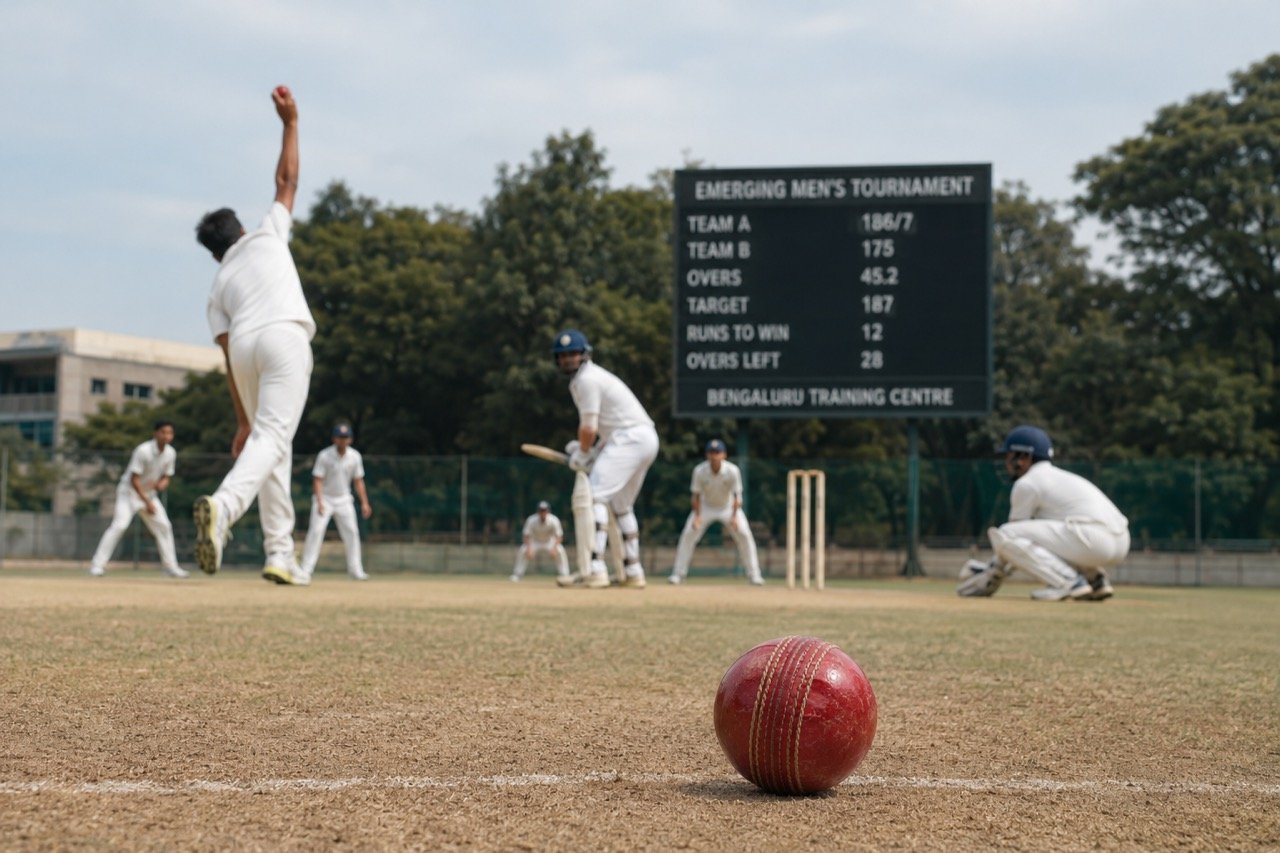
India's cricket production line is back under the microscope as the BCCI's emerging men's tournament opens a dedicated window for the country's next layer of talent. For young players caught between domestic promise and national recognition, the event is one of the clearest audition stages the system offers. It is a modest-sounding fixture on the calendar, yet its purpose sits close to the heart of how Indian cricket sustains itself: identifying, testing and eventually promoting the players who will carry the senior team forward once the current generation moves on.
Why the tournament matters
India's perennial problem is an enviable one: far more capable cricketers than senior-team slots. Emerging tournaments exist to help selectors separate the genuinely international-ready from the merely prolific, testing how players handle pressure, unfamiliar roles and different formats against their strongest peers. In a country where domestic cricket alone produces hundreds of centuries and five-wicket hauls each season, volume of runs and wickets is rarely the scarce commodity. What is scarce is certainty about which of those performers can reproduce their form when the conditions change, the opposition sharpens and the margin for error disappears.
This is precisely the gap an emerging-level tournament is designed to close. By bringing together the players just below full India recognition, the BCCI creates a controlled environment in which selectors can compare like against like, rather than relying solely on disparate domestic tallies accumulated in different conditions, at different venues, against attacks of uneven quality. A hundred scored in a lower-stakes domestic fixture and a fifty scored under the scrutiny of an emerging tournament, against players who are themselves fighting for the same limited opportunities, do not carry equal weight in a selector's eye.
Beyond the scorecard
Crucially, the evidence gathered goes beyond scorecards. Selectors and talent scouts use these windows to assess temperament, fitness standards and game awareness — the intangibles that often decide whether a domestic run-machine survives the step up to representative cricket. A player who scores freely against attacks he is comfortable facing may still falter when asked to bat under pressure in a run chase, or when tasked with a role he has not practised, such as batting up the order, bowling in a different phase of the innings, or fielding in a specialist position.
Fitness testing and game-awareness assessments, run alongside the on-field action, allow the BCCI's talent-identification apparatus to build a fuller picture of each cricketer. This matters because the jump from domestic cricket to India colours is rarely just a matter of skill; it is equally about durability across a long season, discipline in preparation, and the mental resilience to perform when a place is genuinely on the line. Tournaments of this kind are, in effect, a stress test that reveals character as much as craft.
A launchpad for future IPL and India names
For fans, tournaments like this routinely introduce names that later become IPL regulars or India prospects. It is easy to forget, watching an established international player anchor an innings or lead an attack, that many of them first drew wider attention through exactly this kind of emerging-level exposure, long before their names were familiar beyond domestic cricket circles. The pathway from an emerging tournament fixture to an IPL contract, and from there to India selection, has become one of the more reliable routes into the game's upper tiers.
For the players themselves, one strong week can transform their visibility, bridging the gap between the domestic grind and higher-intensity cricket. A single standout performance, well timed and well documented, can do more for a young cricketer's prospects than an entire domestic season of solid but unremarkable returns. That is why the eventual winner may matter less than the individual performances that force selectors to keep watching. Team results provide the context, but it is the accumulation of individual moments — a match-defining spell, an innings played under pressure, a sharp piece of fielding at a crucial juncture — that tends to linger in the minds of those making selection calls.
The wider stakes for Indian cricket
The significance of this tournament extends beyond the individual careers it might launch. India's strength as a cricketing nation has long rested on the depth of its talent pool, but depth alone is not the same as readiness. A structure is needed to convert raw promise into cricketers who can be trusted with the responsibility of representing the country, and that conversion process needs venues, exposure and consistent selectorial attention. An emerging tournament, properly resourced and properly watched, provides exactly that infrastructure.
There is also a broader stakeholder interest at play. IPL franchises watch these tournaments closely as a scouting ground for uncapped talent ahead of auctions. State associations see it as validation of their domestic development systems. And the players' families and support staff see it as tangible evidence that the pathway from junior and domestic cricket to the national stage is not simply theoretical but has a defined, visible rung to climb.
The NE Times View
India's dominance over the next decade will be decided less by its established stars than by how well it converts depth into readiness, and emerging tournaments are the quiet machinery of that conversion. The BCCI deserves credit for giving this layer of cricket a proper stage rather than leaving it to ad-hoc A-tours. What matters now is follow-through: performances here must feed visibly into India A selection and central planning, or the event risks becoming a showcase without consequence. For young cricketers watching pathways clog at the top, a transparent link between this tournament and the next rung is the real prize. Without that visible connection, even the strongest individual performances risk becoming isolated highlights rather than the first step of a defined career trajectory.
Sustaining faith in the system requires more than staging the tournament each year; it requires selectors, franchises and board officials to be seen acting on what the tournament reveals. If a standout batting or bowling display here is followed, within a reasonable timeframe, by an India A call-up or franchise interest, the message to every young cricketer in the country is unambiguous: performance is noticed and rewarded. If it is not, the tournament risks being remembered merely as a well-intentioned exercise rather than a genuine pipeline.
Key takeaways
- The BCCI's emerging men's tournament gives India's next tier of cricketers a dedicated stage to prove themselves against strong peers, beyond the raw volume of domestic scorecards.
- Selectors use the tournament to assess temperament, fitness and game awareness alongside runs and wickets, since these intangibles often determine success at the international level.
- The event has historically served as a launchpad toward IPL contracts and India recognition, meaning a single strong performance can significantly raise a player's profile.
- The tournament's long-term value depends on visible follow-through — standout performances must translate into India A selection and central contracts, not remain isolated highlights.
- A transparent, consistent pathway from this tournament to the next level is essential to maintaining trust among young cricketers navigating a crowded system.
You may also like to read
BCCI Emerging Men's Tournament to Hunt Test Prospects in Bengaluru
The BCCI's red-ball Emerging Men's Tournament, running at the Centre of Excellence in Bengaluru through July, is designed to give selectors a longer, harder look at India's next generation of Test cricketers.
BCCI's New Emerging Tournament Deepens India's Red-Ball Pipeline
The BCCI's plan for an emerging men's multi-day tournament is being seen as a deliberate move to widen India's long-format talent pool beyond the established Ranji Trophy spotlight.

BCCI Charts Structured Roadmap for India's 2027 ODI World Cup Build-Up
Secretary Devajit Saikia says the BCCI wants a clear path and adequate 50-over practice for the 2027 ODI World Cup, with selector Ajit Agarkar and coach Gautam Gambhir shaping a settled one-day core.
India Women Seal Cricket Spot at 2028 Los Angeles Olympics
India's women's cricket team has secured qualification for the 2028 Los Angeles Olympics, opening a new Olympic cycle that could reshape funding, visibility and player development in the women's game.
More from this section
More
Arnav Paparkar Advances at Wimbledon Boys' Singles in Boost for India
Indian junior Arnav Paparkar has moved into the second round of the Wimbledon boys' singles with a commanding serving display, handing Indian tennis a rare and encouraging grass-court result at the sport's biggest stage.

Axar Patel Becomes First Indian Spinner With 100 T20I Wickets
Axar Patel reached 100 T20 international wickets in the second T20I against England, becoming the first Indian spinner to hit the mark and cementing his standing as one of India's most durable white-ball performers.
BCCI Emerging Men's Tournament to Hunt Test Prospects in Bengaluru
The BCCI's red-ball Emerging Men's Tournament, running at the Centre of Excellence in Bengaluru through July, is designed to give selectors a longer, harder look at India's next generation of Test cricketers.