National Drone Summit Puts Cooperative-Led Drone Model in Focus
India's National Drone Summit has spotlighted a cooperative-led drone platform, signalling a shift in the country's drone economy from startups and defence towards rural and commercial applications.
Commentary & Analysis ·
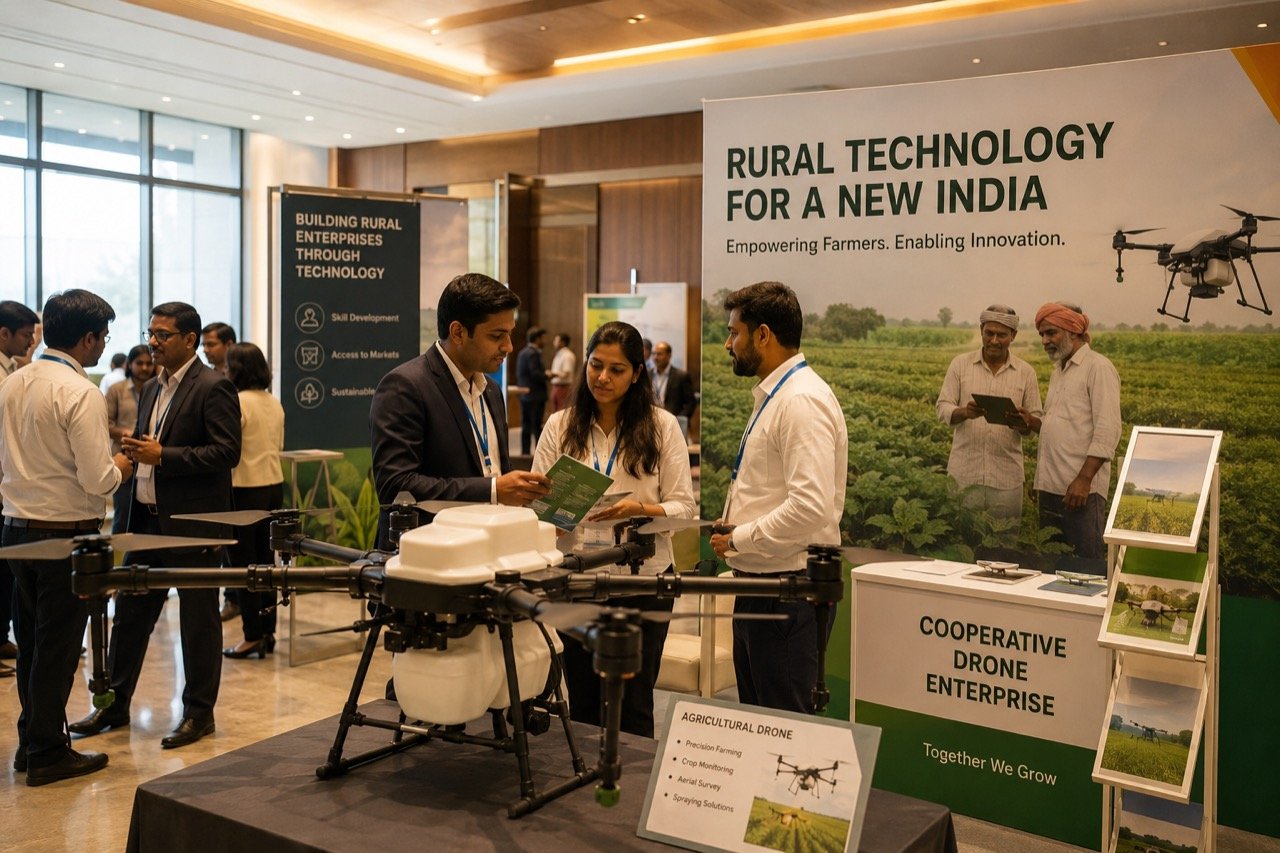
The National Drone Summit has pushed India's drone conversation beyond startups and defence contracts into new territory: cooperative-led adoption. Reports around a cooperative-run drone platform drew significant attention at the summit, reflecting a broader shift as drones move from demonstration projects into practical, everyday use cases. For an industry that has spent years oscillating between headline-grabbing defence procurement and venture-funded startup pilots, the emergence of a cooperative structure as a serious talking point marks a genuine change in framing, one that says more about where drones are headed in India than any single new aircraft or subsidy scheme could.
From showcase to working tool
The potential applications discussed at the summit are wide-ranging: crop spraying, land mapping, infrastructure monitoring, disaster assessment and logistics. Each of these is technically feasible today, and each has already been demonstrated in pilot form somewhere in India over the past few years. But demonstrations are not the same as adoption. Real adoption depends on far more than the machines themselves. Training, safety rules, financing, repair networks and local trust decide whether drones become routine tools or remain trade-show novelties. This is the gap that has quietly stalled many promising drone pilots in Indian agriculture and infrastructure: the hardware works in a demo, but the surrounding ecosystem needed to keep it working day after day, season after season, is often missing. A single crop-spraying drone that impresses at a summit stall means little if there is no certified pilot nearby, no spare parts within reach, and no financing structure that makes its use affordable for the farmers it is meant to serve.
Why the cooperative model matters
A cooperative-led approach is notable because it tackles the affordability barrier head-on. Expensive technology that no single small farmer could justify becomes viable when a cooperative owns, maintains and rents out the equipment. That structure can extend drone access to rural users and small institutions that the startup-driven market has largely bypassed. This is a familiar pattern in Indian rural development: individual ownership of costly equipment is rarely the route to scale, but shared ownership through a trusted institutional structure often is. Cooperatives already play this role for dairy processing, sugarcane crushing, and increasingly for solar-powered irrigation. Extending that logic to drones is a natural next step, and it explains why the idea generated more discussion at the summit than yet another product launch might have.
Building an ecosystem, not just selling hardware
The policy challenge, as the summit discussions underlined, is to build an ecosystem rather than merely sell hardware. Operators need certification pathways, clear data rules, maintenance support and defined liability standards, while farmers and local bodies need evidence that drone services are genuinely affordable and useful. Each of these requirements touches a different part of government and industry. Certification pathways sit with aviation regulators. Data rules touch questions of privacy and land records. Maintenance support requires a distributed network of trained technicians, not a handful of urban service centres. Liability standards determine who bears responsibility when a drone malfunctions over a farmer's field or a populated area. None of these questions can be resolved by a single ministry or a single company acting alone, which is precisely why summits of this kind, bringing together regulators, cooperatives and industry, matter more than they might first appear.
The affordability test that will decide everything
Underlying all of this is a simple but demanding test: will drone services actually prove affordable and useful to the people they are meant to serve. It is one thing to demonstrate that a cooperative can own and rent out a drone fleet; it is another to show that the rental price, the turnaround time, and the quality of the resulting data or spraying job are good enough that a farmer chooses this option over the traditional alternative. Cooperatives have succeeded in the past precisely because they found this balance in other sectors. Whether they can replicate it for a more technically complex, maintenance-intensive asset like a drone remains an open question that the summit itself could not answer, only frame.
The NE Times View
The most significant thing about this summit is where it places drones: inside India's development conversation, not just its technology showcase circuit. India has repeatedly shown, with telecom, UPI and low-cost solar, that scale arrives when technology is made institutionally cheap, and cooperatives are one of the few structures capable of doing that in rural India. If the cooperative model scales, drones could become part of everyday agrarian and civic infrastructure within a few years, quietly doing the work of crop assessment, land mapping and disaster response that would otherwise require far more expensive manual survey or aerial resources. The risk is familiar too: without maintenance networks and trained local operators, subsidised machines end up idle, gathering dust in a cooperative's storeroom while the underlying problem they were meant to solve persists. Policymakers should judge this push by utilisation rates, not procurement numbers. A dozen drones bought and deployed mean little if only two are flying on any given week. The real measure of success will be how often these machines are actually in the air, doing useful work for the people who need them, and how quickly a broken unit gets back into service rather than being written off as a loss.
Key takeaways
- The National Drone Summit shifted attention from startup and defence-driven drone narratives to a cooperative-led adoption model.
- Cooperative ownership addresses the core affordability barrier that has kept drones out of reach for individual small farmers.
- Scaling this model requires certification pathways, data rules, maintenance networks and liability standards, not just more hardware.
- India's precedent with telecom, UPI and low-cost solar suggests institutional structures like cooperatives can be the key to rural-scale technology adoption.
- The true test of this push will be utilisation rates and maintenance reliability, not the number of drones procured or showcased.
You may also like to read

Anthropic puts a Mythos-class model in public hands with Claude Fable 5
The company is releasing its most capable widely available model yet, paired with a locked-down sibling reserved for cybersecurity work, in a careful balancing act between power and safety.

India-US AI Chips Roundtable Puts Critical Minerals in the Spotlight
Discussions between India and the United States on AI, semiconductors and critical minerals underline how technology cooperation is fast becoming a supply-chain and resource-security story, not just a software one.

IndiaAI Mission Pushes Toward 100,000 GPUs As Foundational Model Race Heats Up
With more than 34,000 GPUs already onboarded at subsidised rates and over 500 model proposals received, the government is scaling its compute backbone to anchor a homegrown AI ecosystem.
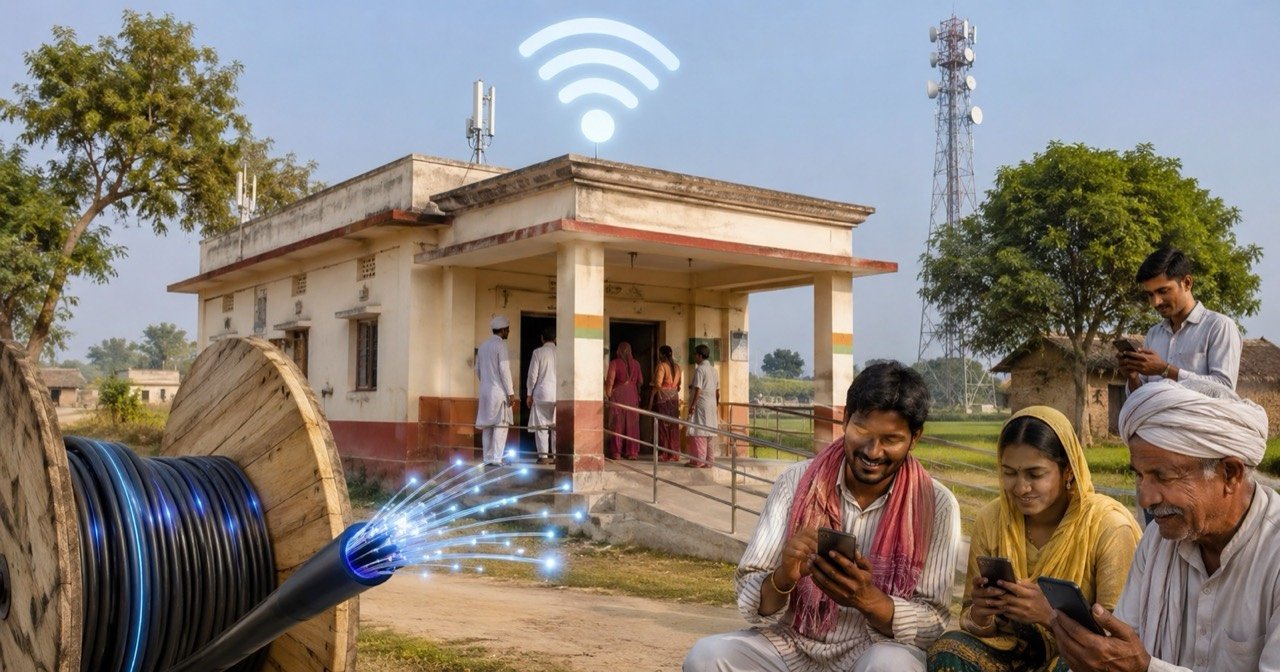
BharatNet's Last-Mile Gap Puts India's Rural Broadband Delivery Under Scrutiny
Fresh data on BharatNet shows active rural connections lagging far behind the fibre laid, sharpening the question of whether India's flagship village internet scheme is being used, not just built.
More from this section
More
CG Semi Sanand Plant Opens, Boosting India's Semiconductor Drive
Prime Minister Narendra Modi inaugurated CG Semi's chip assembly and test facility in Sanand, Gujarat, giving India's semiconductor mission a working manufacturing milestone rather than another policy promise.

Chinese E-Rickshaw Apps Banned in India Over Remote Disable Risk
The Centre has ordered the removal of three Chinese apps — BAT-BMS, Lossigy and Epoch-i-ion — over fears they could remotely disable battery-run e-rickshaws, turning mobility software into a public safety concern.

Connected Car Rules: India Plans Vehicle Software Update Norms
With cars increasingly run by software, the government is reportedly preparing update and security norms aimed at preventing vehicle hijacking and governing how connected cars in India are patched and protected.