BharatNet's Last-Mile Gap Puts India's Rural Broadband Delivery Under Scrutiny
Fresh data on BharatNet shows active rural connections lagging far behind the fibre laid, sharpening the question of whether India's flagship village internet scheme is being used, not just built.
Commentary & Analysis ·
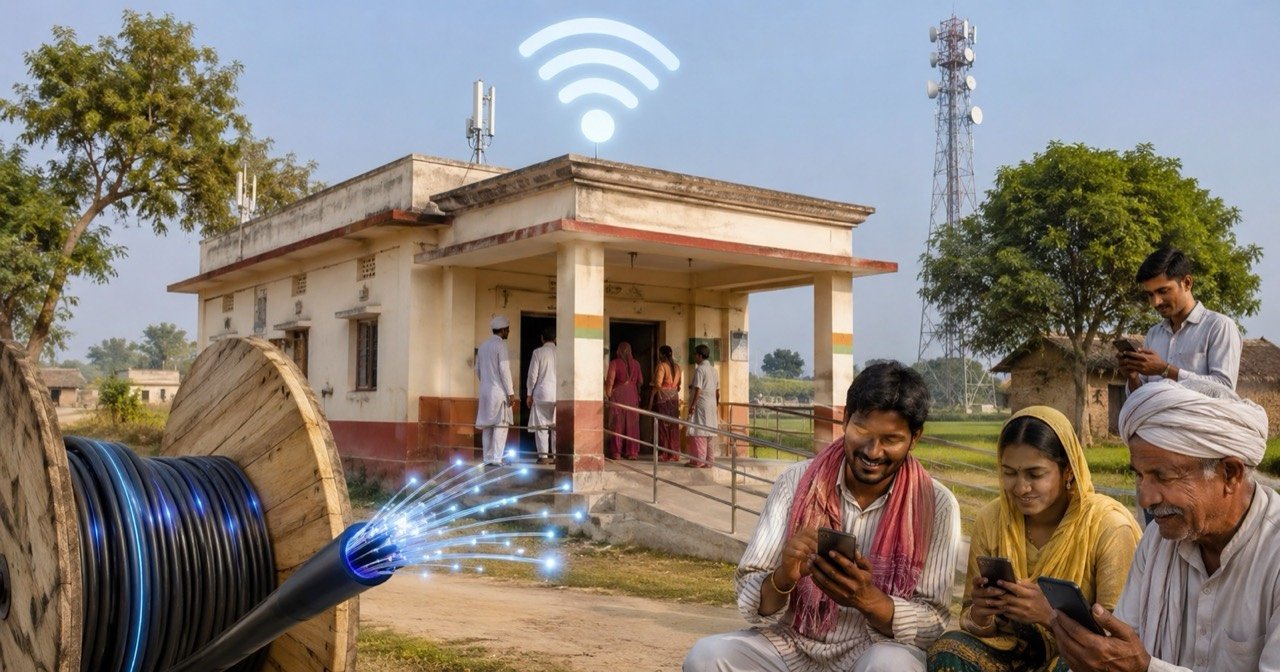
Fresh reporting on BharatNet has spotlighted a familiar challenge in India's digital infrastructure push: building a network is only the first step, and making it useful at the last mile is the harder one. The programme was designed to connect gram panchayats and extend high-speed internet across rural India, yet the share of active connections remains well below the ambition implied by the sheer length of fibre that has been laid. That single fact, more than any other in the latest reporting, captures the distance between what BharatNet was meant to be and what it has, so far, delivered.
Infrastructure built, but is it used?
BharatNet's headline metrics have long been measured in kilometres of cable and the number of gram panchayats reached. These are the numbers that make for impressive progress reports: so many thousand kilometres of optical fibre trenched or strung, so many panchayats declared connected. But a connected panchayat is not the same as a working, widely used service. The gap between fibre in the ground and households or institutions actually online is now the defining test of the scheme.
That distinction matters because the public investment is justified by outcomes, not by hardware alone. A village with a dormant connection delivers little of the promised dividend. It is easy to see how this gap forms in a programme of BharatNet's scale. Laying fibre is a discrete, contractible task with a clear physical output that can be inspected, measured and signed off. Ensuring that the fibre is actually lit, that a router is switched on in a panchayat office, that a household has a reason and a means to subscribe, is an ongoing operational challenge with no equivalent finish line. Governments and contractors alike find it simpler to report on the former, which is precisely why the metrics that dominate public discussion, cable length and panchayats reached, tell only part of the story.
Why the last mile is so hard
The obstacles are not purely technical. Reliable power supply, routine maintenance, affordable service packages, the presence of village-level operators, access to devices and basic digital awareness all shape whether broadband becomes a daily utility or an unused asset. When any of these links breaks down, a connection that exists on paper fails to translate into usage on the ground, which is precisely the pattern the latest figures appear to reflect.
Each of these factors deserves attention on its own terms. Power supply in many rural areas remains intermittent, and a fibre connection without consistent electricity to run the local equipment is of limited use regardless of bandwidth available. Maintenance is similarly unglamorous but essential: a cut cable, a faulty switch, or an unresponsive local technician can leave a panchayat disconnected for weeks, and unlike the original build-out, there is no national campaign dedicated to keeping every last link in repair. Affordability compounds the problem. Even where a connection is technically live, a household must still weigh the cost of a subscription and a capable device against other priorities, and in much of rural India that calculation does not favour adoption. Finally, the presence, or absence, of a trained village-level operator who can trouble-shoot, guide first-time users and keep the local node running is often the difference between a service that gets used daily and one that quietly falls into disrepair.
None of these are new observations in Indian infrastructure policy, but BharatNet's experience gives them fresh, concrete form. A scheme that is judged a success at the point of construction can still fail the people it was meant to serve if these operational layers are treated as afterthoughts.
What a working connection can change
For students, primary health centres, small traders and panchayat offices, a dependable link can transform access to education, telemedicine, banking and government services. The stakes are highest for exactly those rural users the programme was meant to serve.
Consider what each of these constituencies stands to gain, and lose, depending on whether a connection is merely present or genuinely active. A student able to reliably access online learning material or take a remote class is no longer constrained by the quality of the nearest physical school. A primary health centre with working connectivity can consult specialists elsewhere, request guidance on difficult cases, or access updated treatment protocols, narrowing the gap between rural and urban standards of care. A small trader gains access to digital payments, wider markets and financial services that were previously out of reach. A panchayat office, meanwhile, becomes able to deliver government services and records digitally, reducing the friction and travel that residents currently bear to access entitlements. Each of these is a meaningful shift in daily life, but each depends entirely on the connection being live, fast enough and supported when something goes wrong. An intermittent or nominal connection delivers none of this reliably, which is why the utilisation gap is not a technical footnote but the central policy question.
The accountability problem
Active BharatNet connections remain below the scale of fibre laid. Power, maintenance and local operators heavily influence real usage. Affordable packages and device access shape household adoption. Students, health centres and small traders gain most from reliable links. Future success will be judged by uptime and adoption, not cable length.
This points to a deeper structural issue in how large infrastructure programmes in India are typically financed, monitored and reported on. When funding and recognition are tied to construction milestones, the incentives of implementing agencies and contractors naturally gravitate toward hitting those milestones, even where the resulting asset sits idle. A shift toward measuring and rewarding utilisation, uptime, active subscriptions, institutional usage, would realign incentives with the programme's actual purpose. It would also make the scheme's progress harder to overstate, since a live, used connection is a far less ambiguous marker of success than a length of buried cable that may or may not ever be switched on.
"Utilisation matters as much as infrastructure spending." That single line captures the policy takeaway now facing BharatNet's next phase. The programme will be assessed by uptime, household and institutional adoption, and the quality of local support, rather than by kilometres of cable or the count of connected gram panchayats alone. Closing the last-mile gap, more than extending the backbone, will determine whether rural India truly comes online.
The NE Times View
This is the recurring failure of Indian infrastructure: we measure success by kilometres of fibre laid, not households actually online. Dark fibre serves no one. The real bottlenecks are last-mile connections, affordable devices and a reason to log on.
BharatNet's accountability should shift from build metrics to active usage, with funds released against connections lit, not cable buried. Such a reform would not require abandoning the physical build-out that has already occurred; it would simply mean that the next phase of funding, and the next round of public reporting, is anchored to something closer to the lived experience of rural users. Until then, rural broadband remains a map, not a service, an impressive line drawn across the country's villages that has yet to prove, panchayat by panchayat, that it works when someone actually tries to use it.
Key takeaways
- BharatNet's active connections lag well behind the scale of fibre already laid across rural India.
- Power supply, maintenance, village-level operators, affordability and device access are the real determinants of whether a connection gets used.
- Students, primary health centres, small traders and panchayat offices stand to gain the most from reliable last-mile connectivity.
- The programme's next phase should be judged on uptime and adoption, not on cable length or the count of connected panchayats.
- Policy and funding should shift toward rewarding connections actually lit and used, rather than infrastructure merely built.
You may also like to read
India's Satellite Internet Race Stalls as Operators Await Final Spectrum Rules
Starlink, Eutelsat OneWeb and Jio-SES backed Orbit Connect India hold licences but cannot switch on services, awaiting security clearances and a dedicated spectrum framework for low-earth-orbit constellations.
National Drone Summit Puts Cooperative-Led Drone Model in Focus
India's National Drone Summit has spotlighted a cooperative-led drone platform, signalling a shift in the country's drone economy from startups and defence towards rural and commercial applications.

India-US AI Chips Roundtable Puts Critical Minerals in the Spotlight
Discussions between India and the United States on AI, semiconductors and critical minerals underline how technology cooperation is fast becoming a supply-chain and resource-security story, not just a software one.

Anthropic puts a Mythos-class model in public hands with Claude Fable 5
The company is releasing its most capable widely available model yet, paired with a locked-down sibling reserved for cybersecurity work, in a careful balancing act between power and safety.
More from this section
More
CG Semi Sanand Plant Opens, Boosting India's Semiconductor Drive
Prime Minister Narendra Modi inaugurated CG Semi's chip assembly and test facility in Sanand, Gujarat, giving India's semiconductor mission a working manufacturing milestone rather than another policy promise.
Chinese E-Rickshaw Apps Banned in India Over Remote Disable Risk
The Centre has ordered the removal of three Chinese apps — BAT-BMS, Lossigy and Epoch-i-ion — over fears they could remotely disable battery-run e-rickshaws, turning mobility software into a public safety concern.
Connected Car Rules: India Plans Vehicle Software Update Norms
With cars increasingly run by software, the government is reportedly preparing update and security norms aimed at preventing vehicle hijacking and governing how connected cars in India are patched and protected.