Manipur CM's Churachandpur Visit: First Since 2023 Unrest
The Manipur Chief Minister travelled to Churachandpur for a BJP MLA's funeral, his first visit to the district since the 2023 violence, lending the sombre occasion an unmistakable political significance.
Commentary & Analysis ·
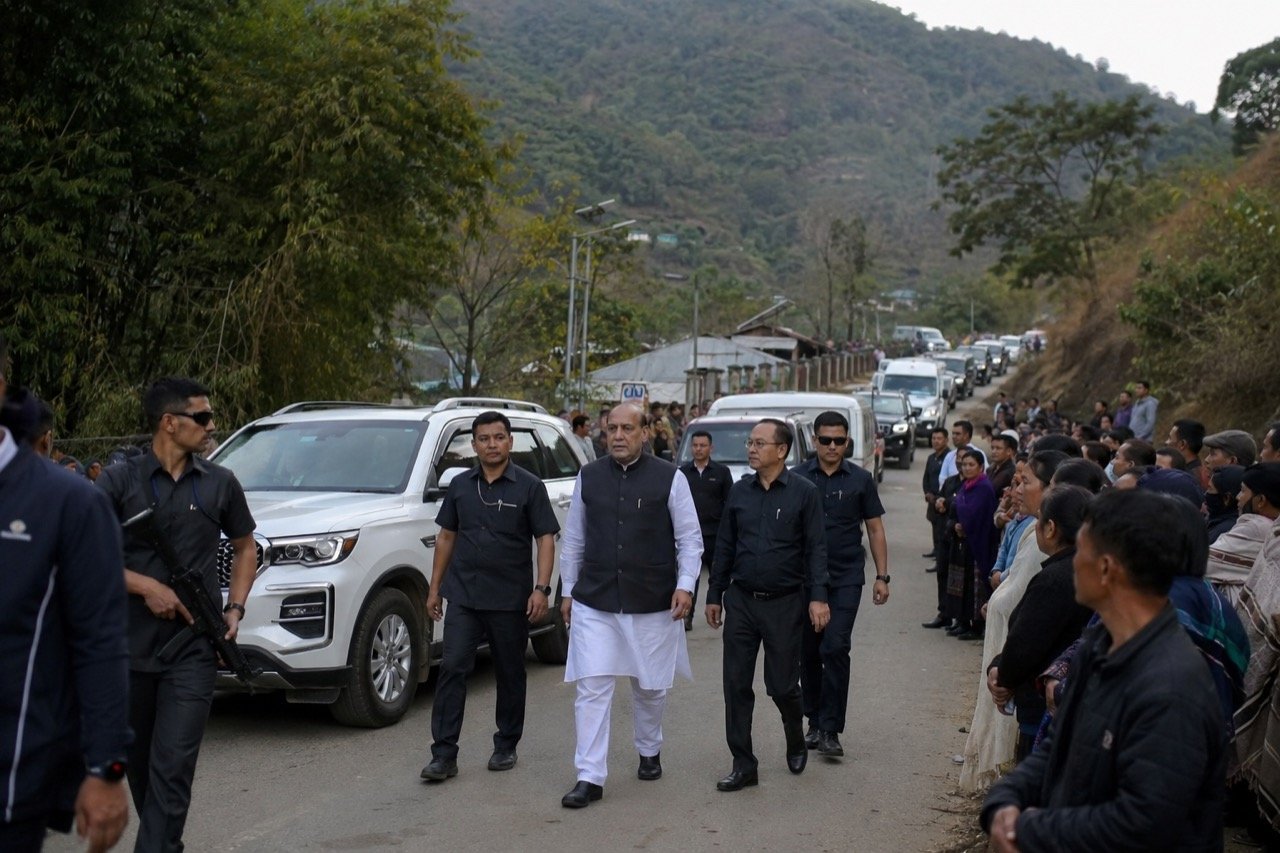
The Manipur Chief Minister's visit to Churachandpur to attend the funeral of a BJP MLA has become one of the most politically watched state stories of the week. According to Hindustan Times, it was his first visit to the district since the violence of 2023 — a fact that gives the appearance a significance well beyond the immediate funeral context. Churachandpur has been at the centre of Manipur's deep political and social tensions, and it has remained a difficult civic space for the state's top leadership since the unrest began. Any high-level visit there carries symbolic weight, which is why a chief minister's physical presence — even on a sombre occasion — is being read as a form of political outreach.
A district that had become off-limits
To understand why this single visit has drawn so much attention, it helps to recall what Churachandpur has represented in Manipur's recent political life. Since the 2023 unrest, the district has effectively existed outside the normal orbit of the state's chief executive. That is an unusual and telling state of affairs: a sitting chief minister unable, or unwilling, to travel to a significant district within his own state for years at a stretch. The absence itself became a kind of political fact, understood by residents, community leaders and observers alike as a marker of how deep the estrangement between Churachandpur and the state government had become. Against that backdrop, even a brief visit tied to a funeral is not a neutral event. It is a re-entry into a space that had been, in practical political terms, closed off.
Why a funeral becomes a political moment
The stated purpose of the visit was attendance at the funeral of a BJP MLA, and the occasion itself demands restraint in interpretation — grief is not a stage, and it would be wrong to reduce a death to political theatre. Yet in a state as fractured as Manipur, public appearances by senior leaders rarely stay confined to their stated purpose. A funeral requires the chief minister to be physically present in Churachandpur, to be seen there, and to interact, however briefly, with the security apparatus, local officials and the public that such a visit necessitates. That combination — presence, visibility and interaction — is precisely what has been missing since 2023, which is why an occasion of mourning has also become, almost by default, a data point in the state's political recovery.
Three threads worth watching
The wider meaning of the visit lies in three threads, each a quiet measure of how far normalisation has, or has not, progressed. The first is outreach: whether a district that has felt estranged from the state government reads this visit as a genuine gesture or as a one-off dictated by circumstance. The second is security: the scale and nature of the arrangements required to enable a chief minister to travel safely to Churachandpur will itself say something about the current state of tension on the ground, since heavier security implies persistent risk while a lighter footprint would suggest greater confidence in stability. The third is public reception: how residents and community leaders respond to the visit, whether with cautious acknowledgement, indifference or open hostility, will indicate whether trust is being rebuilt or whether the gap between the district and the state government remains as wide as before. None of these threads can be fully assessed from a single event, but together they form the lens through which this visit should be read.
Presence itself as the change
For readers asking what has actually changed, the honest answer is that presence itself is the change. After a prolonged period in which the district was effectively off-limits to the state's chief executive, a visit — however brief and however solemn the occasion — signals an attempt to re-enter that space and test the conditions for engagement. This is a modest claim, and deliberately so. It does not assert that grievances have been resolved, that displaced communities have returned, or that the political and ethnic fault lines exposed by the 2023 violence have healed. It asserts only that the physical barrier to engagement, the simple fact of a leader not going to a place, has been tested and, at least for one day, overcome. In a state where symbolism carries real political weight, that is not a small thing, even as it falls well short of resolution.
The limits of a single gesture
Careful, neutral framing matters here, because it is equally important not to overstate what has occurred. The visit does not by itself resolve the underlying grievances or the questions of trust between communities and the state government. It is a data point in a long and unfinished process, not a conclusion. Manipur's recent history offers ample reason for caution: gestures have been made before in the state's politics without translating into sustained engagement, and a single appearance, prompted by an unplanned and sombre occasion rather than a deliberate policy of outreach, does not on its own establish a pattern. The risk is that the visit is remembered chiefly for its symbolism and not followed by the kind of structured engagement that would give that symbolism lasting meaning.
The NE Times View
Symbolism is not a substitute for reconciliation, but in Manipur it is not nothing either. A chief minister setting foot in Churachandpur after years of distance acknowledges a simple truth: a state cannot heal a district it does not visit. The test now is whether this appearance becomes the start of sustained engagement — regular presence, dialogue with community leaders, and visible investment in rebuilding — or remains a one-off occasioned by grief. For the Northeast, the difference between those two outcomes is the difference between a gesture and a policy. Readers should watch what follows the funeral, not just the funeral itself. Governments across India, and indeed across the Northeast, have often treated a single high-profile visit as sufficient political capital in itself, when in fact its value lies almost entirely in what it enables afterward: follow-up visits, administrative attention, and a visible commitment to the district's recovery. Churachandpur's residents, having lived through years of both violence and neglect, are unlikely to be persuaded by appearance alone.
Key takeaways
- The Manipur Chief Minister's visit to Churachandpur, to attend the funeral of a BJP MLA, was his first to the district since the 2023 unrest, according to Hindustan Times.
- The visit's significance lies less in its stated purpose than in what it represents: the re-entry of the state's top leadership into a district that had become politically and civically estranged.
- Three factors will determine how the visit is ultimately read: the sincerity of outreach it represents, the security arrangements it required, and the nature of its public reception on the ground.
- The visit does not resolve underlying grievances or rebuild trust on its own; it is one data point in a long, unfinished process of normalisation.
- The real test lies ahead — whether this appearance is followed by sustained engagement with Churachandpur, or remains an isolated gesture prompted only by grief.
You may also like to read
West Bengal's First BJP Budget Bets on DA Hike, One Lakh Jobs and Welfare
Finance Minister Swapan Dasgupta's debut budget pairs a 20-point DA hike, one lakh government jobs and a major Annapurna Yojna outlay with industry incentives, framing the BJP's first big policy test in Bengal.
Suvendu Adhikari's BJP Government Settles In as Bengal Adjusts to Historic Power Shift
Six weeks after ending 15 years of Trinamool rule, West Bengal's first BJP administration under Suvendu Adhikari has completed its cabinet, signalling priorities on law and order, jobs and administrative reset.
Bengal's New BJP Government Rolls Out First Policy Wave: Women's Schemes, Pay Panel, UCC Pledge
Chief Minister Suvendu Adhikari's BJP government moved quickly after ending Trinamool's 15-year rule, doubling women's assistance, ordering a pay commission and committing to a Uniform Civil Code within six months.
Odisha BJP Claims Several BJD Leaders Are Keen to Switch Sides
BJP leaders in Odisha claim several BJD figures want to switch sides, comparing the possible churn to earlier splits in regional parties, though no mass defection has been confirmed.
More from this section
More
K Kavitha Party Denied TRS Name by Election Commission
The Election Commission has refused to register K Kavitha's Telangana Rakshana Sena under the TRS acronym after objections, forcing a branding reset for the new party at a politically sensitive moment in Telangana.
Lalu Prasad Yadav Security Downgrade, Bungalow Order Stir Bihar
A government order downgrading Lalu Prasad Yadav's security cover and asking him to vacate an official bungalow has opened a fresh political flashpoint in Bihar, with the RJD chief's reaction fuelling the row.
Odisha SIR: 20 Lakh Voter List Deletions Spark Opposition Alarm
Odisha's special intensive revision has placed electoral-roll accuracy under scrutiny after officials reported roughly 20 lakh deletions from the draft voter list and opposition parties raised fears of wrongful exclusion.