Jio Platforms IPO Filing Puts India's Digital Market in Spotlight
Reports that Reliance has filed draft papers for a Jio Platforms IPO have pushed India's equity market and digital economy back into focus, with the listing tipped to be one of the country's largest.
Commentary & Analysis ·

Reports that Reliance has filed draft papers for a Jio Platforms initial public offering have pushed India's equity market and digital economy firmly back into focus. Business coverage from the Times of India, the Economic Times and others suggests the planned listing, if it proceeds, could become one of the largest market events in the country's history, drawing the attention of domestic retail investors, global funds and telecom-sector watchers alike. That such a filing alone can generate this scale of commentary says something about the position Jio Platforms occupies in India's economic imagination, and it is worth taking the time to unpack why a single company's move towards public markets carries implications well beyond its own balance sheet.
Why this listing matters
Jio Platforms sits at the centre of India's connected economy. Through mobile connectivity, broadband, digital services and consumer technology, it touches a vast share of the country's internet users. A company of that reach coming to public markets is not a routine event; it is a referendum on how investors value India's digital growth story. Should it proceed, the scale alone would make it a landmark, with the potential to absorb significant investor demand and set benchmarks that ripple far beyond a single company's balance sheet.
It is worth pausing on what that referendum actually tests. India's digital economy has, for the better part of a decade, been discussed in terms of potential: subscriber growth curves, data consumption trends, the promise of monetising services layered on top of connectivity. A public listing forces that potential to be priced. Markets do not reward stories in the abstract; they reward numbers that can be checked, audited and compared quarter on quarter. For a company as large and as central to daily life for hundreds of millions of Indians as Jio Platforms, that pricing exercise becomes, by extension, a pricing exercise for the sector as a whole.
Sharper scrutiny ahead
A public listing would force far more detailed disclosure than a privately held entity is required to provide. Investors would gain a clearer window into revenue streams, subscriber trends, capital spending and long-term growth strategy, the metrics that determine whether the valuation narrative holds up under examination. That transparency cuts both ways. It offers investors hard numbers to assess, but it also exposes the company to continuous market judgement on quarterly performance, competitive pressure and the heavy capital expenditure that a telecom and digital-services business demands.
This dual nature of disclosure deserves emphasis. Private companies can manage their own narrative on their own timeline, releasing information selectively and framing growth in whatever terms suit them. Public companies lose that latitude. Once Jio Platforms is required to report on a quarterly cycle, every subscriber addition, every shift in average revenue per user, and every rupee of capital expenditure becomes fodder for analyst notes and market reaction. For a business that has built its position through aggressive network investment and pricing strategy, this level of scrutiny will test whether the underlying economics are as strong as the narrative built around them over the years.
What the market will be watching
Several concrete signposts will determine how this story develops. Formal regulatory filings that confirm and detail the offering are the first and most obvious marker; until such documents are public, much of the current discussion remains necessarily speculative. Beyond that, disclosures on revenue mix, subscriber growth and capital spending will matter enormously, since these are the figures analysts will use to build valuation models and comparisons with global telecom and internet peers. Reliance's own announcements on timing and structure will shape expectations, as will prevailing market conditions and investor appetite at the time of launch. A listing of this magnitude cannot be divorced from the broader mood of the market; even a fundamentally sound offering can struggle if it lands during a period of weak risk appetite, while a buoyant market can amplify demand well beyond what fundamentals alone might justify.
There are also likely to be knock-on effects for valuations across telecom, internet and platform peers. When a company of this scale lists, it inevitably becomes a reference point. Analysts will use its pricing to reassess comparable businesses, and smaller or mid-sized firms in adjacent sectors may find their own valuations pulled up or down depending on how the market receives the Jio Platforms offering. A market analyst, paraphrased in coverage of the filing, put it plainly: a listing of this scale would force sharper disclosure and could reset how the market values India's digital and telecom companies. That is a reasonable assessment, and it underlines why the story is being tracked so closely well before any shares actually change hands.
Stakeholders with a lot riding on the outcome
For Reliance, a successful listing would validate years of investment in building out Jio's network and service ecosystem, and would likely provide a substantial capital event for the parent group. For domestic retail investors, the offering represents a rare opportunity to gain direct exposure to a business that already shapes their daily digital lives, though that same familiarity can also breed a kind of enthusiasm that outpaces careful valuation analysis. Global funds will be watching for what the listing says about the depth and maturity of Indian capital markets more broadly, since an offering of this size tests whether the market can absorb demand without excessive volatility. Telecom-sector competitors, meanwhile, will be watching for the disclosure of metrics they have previously had to estimate rather than observe directly, information that could inform their own competitive strategy going forward.
None of these stakeholder interests are inherently in conflict, but they do pull in different directions. Retail enthusiasm can inflate demand beyond what disclosed fundamentals support, while institutional investors will likely take a more measured view, waiting for the detailed filings before committing capital at scale. That gap between retail sentiment and institutional caution is a recurring feature of large Indian IPOs, and there is little reason to expect this one, if it proceeds, would be any different.
The NE Times View
A Jio Platforms listing of this scale would test the depth of Indian markets as much as it rewards Reliance. Mega-IPOs can crowd out smaller issuers and concentrate index weight further in one conglomerate, a dynamic that deserves more attention than it typically receives amid the excitement of a headline-grabbing debut. For retail investors, the lesson from past blockbuster debuts is caution about valuation versus hype; enthusiasm for a familiar brand is not the same as a sound assessment of subscriber economics and capital spending trajectories. The filing is significant; whether it broadens India's capital markets or merely deepens concentration in one dominant conglomerate is the real story, and one that will only become clear once the formal paperwork, and the numbers within it, are made public. Until then, the prudent stance is to track the regulatory process closely without getting ahead of the facts.
Key takeaways
- Reliance has reportedly filed draft papers for a Jio Platforms IPO, a move that could rank among the largest market events in Indian history if it proceeds.
- A public listing would require far greater disclosure of revenue streams, subscriber trends and capital spending than Jio Platforms has previously had to provide as a private entity.
- Key signposts to watch include formal regulatory filings, Reliance's statements on timing and structure, and prevailing market conditions at launch.
- The offering could reset valuations across India's telecom and internet sectors given Jio Platforms' scale and market reach.
- The central open question is whether a mega-IPO of this size broadens participation in Indian capital markets or simply deepens concentration around one large conglomerate.
You may also like to read

Reliance Gears Up For June 19 AGM As Jio Platforms IPO Hopes Build
All eyes are on Mukesh Ambani's address at Reliance Industries' 49th annual general meeting on June 19, with investors hunting for clarity on a potential Jio Platforms listing that could become India's largest-ever IPO.

NSE IPO Filing With SEBI Moves India's Top Exchange Closer to Listing
The National Stock Exchange has filed draft IPO papers with SEBI for an offer estimated near Rs 30,000 crore, a long-delayed move that could rank among India's biggest-ever public issues if cleared.

Akasa Air Eyes IPO in Two to Four Years: A Question of When, Not If
Akasa Air CFO Ankur Goel has signalled the young carrier could pursue a stock-market listing within two to four years, framing an IPO as a matter of timing rather than intent.
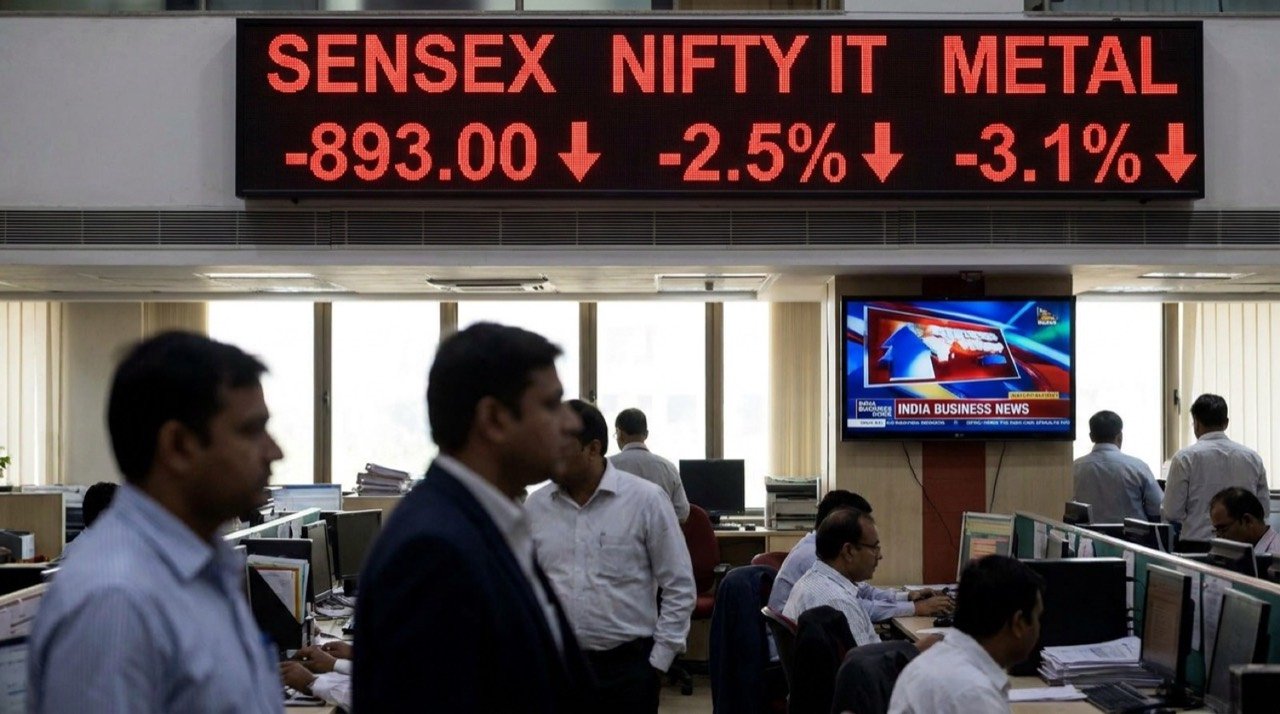
Sensex Tumbles 893 Points as IT and Metal Stocks Lead Broad Market Selloff
Indian equities slid sharply on 23 June, with the Sensex down 893 points and the Nifty closing at 23,824, as IT, metals and PSU banks led a broad-based selloff driven by weak global cues.
More from this section
More
Adani Case: US DOJ Pushes for Permanent Dismissal of Charges
The US Department of Justice has urged a judge to permanently dismiss charges against Gautam Adani, calling the case legally flawed — a reversal with consequences for markets, diplomacy and cross-border enforcement.

Akasa Air Inducts 40th Aircraft in Indian Aviation Scale-Up
Akasa Air's 40th aircraft, ferried to Bengaluru via Seattle, Reykjavik and Cairo, marks a fleet milestone for the young carrier and a fresh signal that India's aviation market remains firmly in expansion mode.

BARC Ratings Suspension Leaves Indian TV Industry Flying Blind
BARC's pause on television ratings has put India's broadcast measurement system under fresh scrutiny, leaving broadcasters, advertisers and media planners without the weekly audience data that anchors the TV economy.