Akasa Air Eyes IPO in Two to Four Years: A Question of When, Not If
Akasa Air CFO Ankur Goel has signalled the young carrier could pursue a stock-market listing within two to four years, framing an IPO as a matter of timing rather than intent.
Commentary & Analysis ·
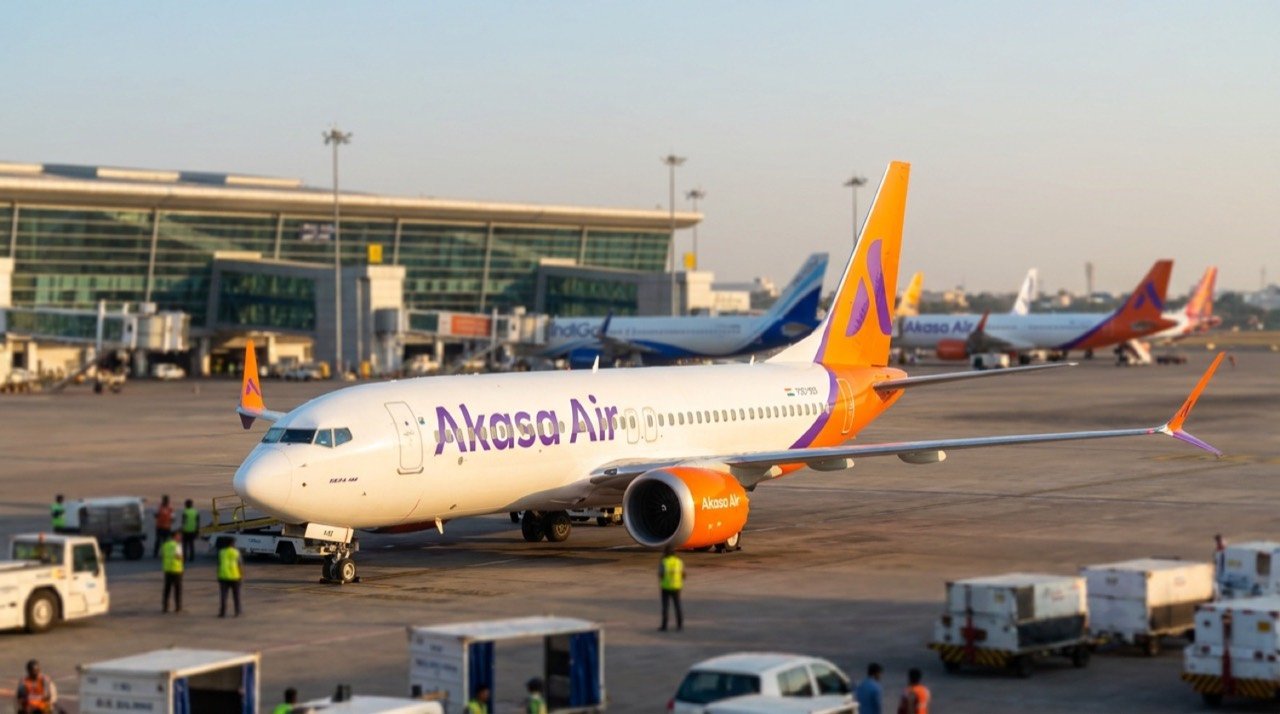
Akasa Air has placed itself firmly in India's aviation-finance conversation, indicating that a stock-market listing is part of its longer-term growth plan. Chief Financial Officer Ankur Goel has said the airline could consider an initial public offering within the next two to four years, depending on the business milestones it reaches, framing the move as a question of when rather than if. The statement is notable less for what it reveals about immediate plans than for what it signals about how a relatively young Indian carrier now sees its own trajectory: as a business preparing, deliberately and in stages, for the discipline of public markets.
What the airline actually said
The signalled timeline is not an immediate filing. Instead, it is a statement of ambition that gives investors a clearer view of how the young carrier sees its future, with a public listing positioned as a step it intends to take once the conditions are right. By tying any IPO to business milestones, rather than to a fixed calendar date, the airline is keeping the timing flexible while making clear that going public is firmly on its roadmap. This is a common approach among companies that want to signal confidence to the market without boxing themselves into a deadline that external shocks, be they fuel-price spikes, regulatory changes or a slowdown in travel demand, could force them to miss. The two-to-four-year window itself is wide enough to accommodate a range of outcomes, which suggests the airline is being deliberately cautious about overpromising.
What makes Goel's framing notable is the choice of language: an IPO as inevitable, contingent only on timing. That is a subtly different message from saying an IPO is merely one of several options under consideration. It tells employees, competitors, lessors and potential investors that the airline is building its internal processes, its financial reporting and its operational metrics with a future listing in mind, even if the paperwork is years away.
Why the timing matters
The statement comes as passenger demand in India keeps rising and carriers juggle fleet growth, costs and the pursuit of sustained profitability. An IPO would require Akasa to demonstrate greater scale, stable operations and confidence that it can hold its own in a market dominated by larger, well-entrenched players. Reaching that point means proving a credible path to profitability against high fuel costs and fierce fare competition, the twin pressures that define Indian aviation economics.
These pressures are not new to Indian aviation, but they are unusually unforgiving. Fuel typically represents one of the largest single cost lines for any airline operating in India, and that cost is largely outside a carrier's control, shaped by global crude prices and domestic taxation on aviation turbine fuel. At the same time, fare competition among Indian carriers remains intense, with airlines routinely undercutting one another on price to protect or grow market share. For a newer entrant such as Akasa, this combination means that growth in passenger numbers or route network alone is not sufficient; the airline must show that it can grow while also narrowing losses and moving toward sustained profitability, a much harder needle to thread. Any prospective IPO will be scrutinised by investors precisely on this basis, since public markets tend to reward businesses that can demonstrate a repeatable, resilient earnings model rather than growth built on aggressive pricing or heavy capital infusion alone.
What it means for passengers and the sector
For travellers, access to public capital can underwrite fleet expansion, new routes and improved service reliability over time. A successful listing would give Akasa a further avenue, beyond private investment and debt, to fund the acquisition of new aircraft, expand into underserved routes, and invest in the kind of operational infrastructure, from maintenance capacity to ground handling, that supports reliability. Passengers, in principle, stand to benefit from more competition, more choice of routes, and potentially more consistent service standards, provided that growth is not pursued at the expense of financial stability.
For the broader industry, the plan is a vote of confidence that India's aviation market remains attractive to investors despite its well-known cost headwinds. It is also a signal to other privately held Indian carriers that public markets remain a viable exit and funding route, which could shape how the sector as a whole thinks about capital raising in the coming years. As one of the newer entrants in a competitive field, Akasa's listing ambition will be judged against its ability to grow profitably. For now, the message to the market is one of confidence, with the airline betting that India's expanding travel demand can support its next phase of growth.
The path from ambition to listing
Between a CFO's public statement of intent and an actual IPO lies a considerable amount of groundwork. Regulatory approvals, audited financial track records, and the demonstration of consistent operational metrics such as on-time performance, load factors and unit costs are all typically required before an airline can credibly approach public markets. Investors evaluating any future Akasa prospectus will likely look closely at trends in yield management, cost per available seat kilometre, and the airline's ability to manage its fleet expansion without overextending its balance sheet. The two-to-four-year window gives Akasa room to build this track record, but it also means the company will be operating under a degree of implicit market scrutiny well before any formal filing, since stakeholders will now be watching its milestones as informal markers of IPO readiness.
It is also worth noting that the airline has explicitly avoided committing to a fixed date, which is itself a form of risk management. Indian aviation has seen carriers rush toward public listings or aggressive expansion only to be undone by cost pressures they had not fully priced in. By tying the IPO to milestones rather than a calendar, Akasa preserves the option to delay if conditions in fuel markets, competitive pricing or broader capital markets turn unfavourable.
The NE Times View
Framing a listing as inevitable is shrewd messaging, but India's aviation graveyard is full of carriers that grew fast and listed too soon. Akasa's two-to-four-year window is sensible only if profitability, not market hype, drives the timing. The NE Times View: investors should remember that fleet expansion and fuel costs, not IPO confidence, decide airline survival. A public listing rewards discipline, and punishes haste, more brutally than in most sectors.
The measured tone of Goel's statement, tying the IPO to milestones rather than to a marketing calendar, is itself a reassuring sign. But statements of intent are cheap; what will matter in the intervening years is whether Akasa can show, quarter after quarter, that it is narrowing losses while continuing to grow. Any airline that treats the IPO date as the goal, rather than profitability and operational stability as the goal with the IPO as a natural consequence, risks repeating mistakes seen elsewhere in Indian aviation. The market will, in time, separate genuine readiness from well-crafted ambition.
Key takeaways
- Akasa Air CFO Ankur Goel has said an IPO could be considered within two to four years, tied to business milestones rather than a fixed date.
- The statement is a signal of intent, not an imminent filing, and reflects confidence rather than a concrete near-term plan.
- Any listing will require Akasa to demonstrate greater scale, operational stability and a credible path to profitability amid high fuel costs and intense fare competition.
- Public capital, if raised, could support fleet expansion, new routes and improved reliability for passengers.
- The NE Times View cautions that profitability and operational discipline, not IPO enthusiasm, should determine the actual timing of any listing.
You may also like to read

Akasa Air Inducts 40th Aircraft in Indian Aviation Scale-Up
Akasa Air's 40th aircraft, ferried to Bengaluru via Seattle, Reykjavik and Cairo, marks a fleet milestone for the young carrier and a fresh signal that India's aviation market remains firmly in expansion mode.

NSE IPO Filing With SEBI Moves India's Top Exchange Closer to Listing
The National Stock Exchange has filed draft IPO papers with SEBI for an offer estimated near Rs 30,000 crore, a long-delayed move that could rank among India's biggest-ever public issues if cleared.

Jio Platforms IPO Filing Puts India's Digital Market in Spotlight
Reports that Reliance has filed draft papers for a Jio Platforms IPO have pushed India's equity market and digital economy back into focus, with the listing tipped to be one of the country's largest.

TCS Earnings, Crude Oil and Global Cues Set to Steer Dalal Street
Indian equities head into a cue-heavy week as the June-quarter earnings season opens with TCS, while crude oil prices and global risk signals shape how investors position across sectors.
More from this section
More
Adani Case: US DOJ Pushes for Permanent Dismissal of Charges
The US Department of Justice has urged a judge to permanently dismiss charges against Gautam Adani, calling the case legally flawed — a reversal with consequences for markets, diplomacy and cross-border enforcement.
Akasa Air Inducts 40th Aircraft in Indian Aviation Scale-Up
Akasa Air's 40th aircraft, ferried to Bengaluru via Seattle, Reykjavik and Cairo, marks a fleet milestone for the young carrier and a fresh signal that India's aviation market remains firmly in expansion mode.

BARC Ratings Suspension Leaves Indian TV Industry Flying Blind
BARC's pause on television ratings has put India's broadcast measurement system under fresh scrutiny, leaving broadcasters, advertisers and media planners without the weekly audience data that anchors the TV economy.