IPO Calendar Brings Six Public Issues for Indian Investors This Week
India's primary market turns busy with six IPOs in play, spanning jewellery, tourism, fintech, textiles and snacks, offering retail and high-ticket investors sharply different risk choices.
Commentary & Analysis ·
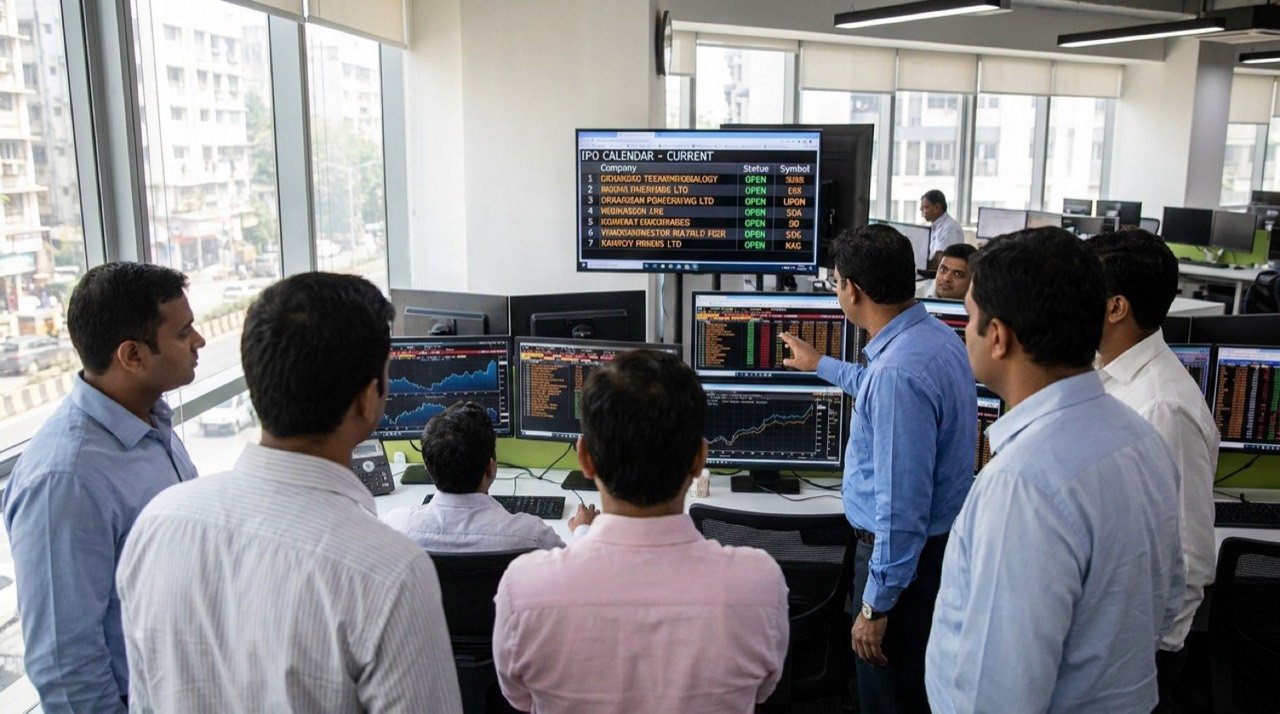
India's primary market is unusually crowded this week, with three public issues already live and three more lined up to open, giving investors a packed menu of choices across very different sectors. The cluster of listings shows that appetite for fresh paper, particularly in the small and medium enterprise (SME) segment, remains intact even when the broader market is choppy. For a market that has, in recent years, oscillated between bouts of exuberance and sudden caution, a six-issue week is a useful barometer of where retail and institutional confidence currently stands.
Who is in the market
According to market data, Advit Jewels, Waterways Leisure Tourism and Turtlemint Fintech Solutions were active on June 23, drawing bids across the jewellery, tourism and financial-technology spaces. Three more issues, Aastha Spintex, CSM Technologies and Crazy Snacks, are set to follow, rounding out a line-up that touches textiles, enterprise technology and packaged foods. The spread of sectors is itself notable: rather than a single theme dominating the calendar, this week's slate reflects a diverse set of mid-sized companies tapping public capital at the same time.
This sectoral breadth is worth dwelling on. A calendar dominated by, say, only technology or only consumer names would tell a narrower story about where capital is flowing and why. Instead, the presence of jewellery alongside tourism, fintech alongside textiles, and enterprise software alongside packaged snacks suggests that the appetite for new listings is not confined to a single "hot" theme. It points instead to a broader, more structural willingness among India's mid-sized companies, across quite unrelated industries, to use the public markets as a source of growth capital right now, and a corresponding willingness among investors to consider each on its own merits rather than chasing a single narrative.
Why the terms matter
The six issues vary sharply by price band, lot size and subscription window, which means they carry very different entry costs and risk profiles. Smaller lot sizes can lower the ticket for retail participants, while pricier issues tend to attract high-net-worth and institutional money. Investors are being advised to read each offer document closely rather than treating the week as a single trade.
This distinction matters more than it might first appear. A retail investor with a modest amount to deploy may find that a lower-priced, smaller-lot issue offers an accessible entry point, while the same investor could be priced out, or simply outcompeted by larger institutional bids, on a costlier issue. Subscription windows that overlap also force investors to make choices about where to allocate limited capital across a single week, rather than evaluating each offer in isolation and at leisure. In practice, this means the six-issue calendar is not one opportunity but six separate decisions, each demanding its own diligence on financials, promoter background, use of proceeds and valuation.
SME momentum amid volatility
The week also illustrates a recurring feature of the Indian market: SME and sector-specific listings continue to find takers even when benchmark indices are volatile. That resilience reflects both the depth of domestic retail participation and the willingness of smaller firms to use the public route for growth capital.
This pattern has broader implications for how the Indian capital markets are evolving. A primary market that keeps functioning even when the secondary market is unsettled suggests that domestic retail liquidity has become a more durable pillar of the system than in years past, less dependent on foreign institutional sentiment swinging in and out. For smaller companies in sectors such as textiles, tourism or packaged foods, sectors that may not always draw headline attention, continued access to public capital during choppy periods is itself a sign of a maturing ecosystem, one where mid-sized businesses no longer need to wait for calmer conditions to raise funds.
What retail investors should weigh
With six issues competing for attention in a single week, allotment outcomes and listing-day performance will offer a fresh read on retail sentiment heading into the second half of the year. For now, the calendar confirms that India's IPO pipeline remains busy, rewarding investors who do their homework on each prospectus.
As a markets analyst quoted in connection with this week's calendar observed, each issue carries its own price, lot size and window, so investors face genuinely different risk choices this week. That framing is a useful discipline for anyone tempted to treat "IPO season" as a single, undifferentiated wave to ride. Jewellery retail, leisure tourism, fintech infrastructure, textile manufacturing, enterprise technology and packaged snacks are not comparable businesses merely because they happen to be listing in the same seven-day window. Each carries its own demand cycle, margin structure and competitive pressures, and each deserves to be judged against those specifics rather than against the general mood of the week.
The NE Times View
Six IPOs in a single week signals confidence, but a crowded calendar also tempts weaker companies to ride the bull market's coattails. The NE Times reminds retail investors that variety is not the same as value; jewellery, tourism and snacks carry very different risks. Read the prospectus, not the buzz. A busy primary market rewards the disciplined and quietly punishes the merely enthusiastic.
It is worth adding that a packed calendar like this one places a heavier burden on investors' own filtering, not a lighter one. When only one or two issues are on offer, the temptation to subscribe indiscriminately is naturally limited. When six are open at once, spanning sectors as different as jewellery and enterprise technology, the ease of treating them as an interchangeable basket grows, and so does the risk of doing so. The soundest approach remains the same one that applies in quieter weeks: assess each company's fundamentals, understand what the proceeds will fund, and size any commitment to a level that reflects the specific risk of that business, not the general excitement of a busy primary market.
Key takeaways
- Six IPOs are active this week: Advit Jewels, Waterways Leisure Tourism and Turtlemint Fintech Solutions were live from June 23, with Aastha Spintex, CSM Technologies and Crazy Snacks opening subsequently.
- The issues span jewellery, tourism, fintech, textiles, technology and packaged foods, reflecting broad-based rather than sector-specific demand for public capital.
- Price bands, lot sizes and subscription windows differ significantly across all six, meaning each carries a distinct entry cost and risk profile that warrants separate evaluation.
- Continued SME listing activity despite broader market volatility points to resilient domestic retail participation underpinning India's primary market.
- Allotment outcomes and listing-day performance across these six issues will offer an early signal of retail sentiment heading into the second half of the year.
You may also like to read

India's Global IPO Share Slips to Six-Year Low After Mega SpaceX Listing
India raised about $5.3 billion from IPOs in 2026, roughly 4.9 percent of global proceeds and its lowest share since 2020, as a giant SpaceX listing reshaped the worldwide league table.
CSM Technologies IPO Opens June 24 With Price Band of Rs 107-113
The Odisha-based govtech and IT services firm enters India's busy primary market on June 24, testing investor appetite for e-governance and digital public infrastructure plays.
Turtlemint IPO Enters Final Day: Rs 883-Crore Issue Tests India's Insurtech Appetite
Turtlemint's Rs 883-crore IPO reached its final bidding day on 23 June, with investors weighing subscription levels, profitability and regulatory risk in India's growing insurance-technology market.

Waterways Leisure Tourism IPO Opens As Cruise Operator Seeks Growth Capital
The cruise tourism operator's IPO gives investors rare exposure to India's experience-led travel economy, as capital markets open up to consumer businesses beyond banks, manufacturers and tech firms.
More from this section
More
Adani Case: US DOJ Pushes for Permanent Dismissal of Charges
The US Department of Justice has urged a judge to permanently dismiss charges against Gautam Adani, calling the case legally flawed — a reversal with consequences for markets, diplomacy and cross-border enforcement.

Akasa Air Inducts 40th Aircraft in Indian Aviation Scale-Up
Akasa Air's 40th aircraft, ferried to Bengaluru via Seattle, Reykjavik and Cairo, marks a fleet milestone for the young carrier and a fresh signal that India's aviation market remains firmly in expansion mode.
BARC Ratings Suspension Leaves Indian TV Industry Flying Blind
BARC's pause on television ratings has put India's broadcast measurement system under fresh scrutiny, leaving broadcasters, advertisers and media planners without the weekly audience data that anchors the TV economy.