India-Israel Investment Agreement Talks Aim to Boost Capital Flows
Discussions on a bilateral investment agreement between India and Israel signal a push to broaden economic ties beyond defence and technology, promising clearer rules and greater confidence for investors on both sides.
Commentary & Analysis ·
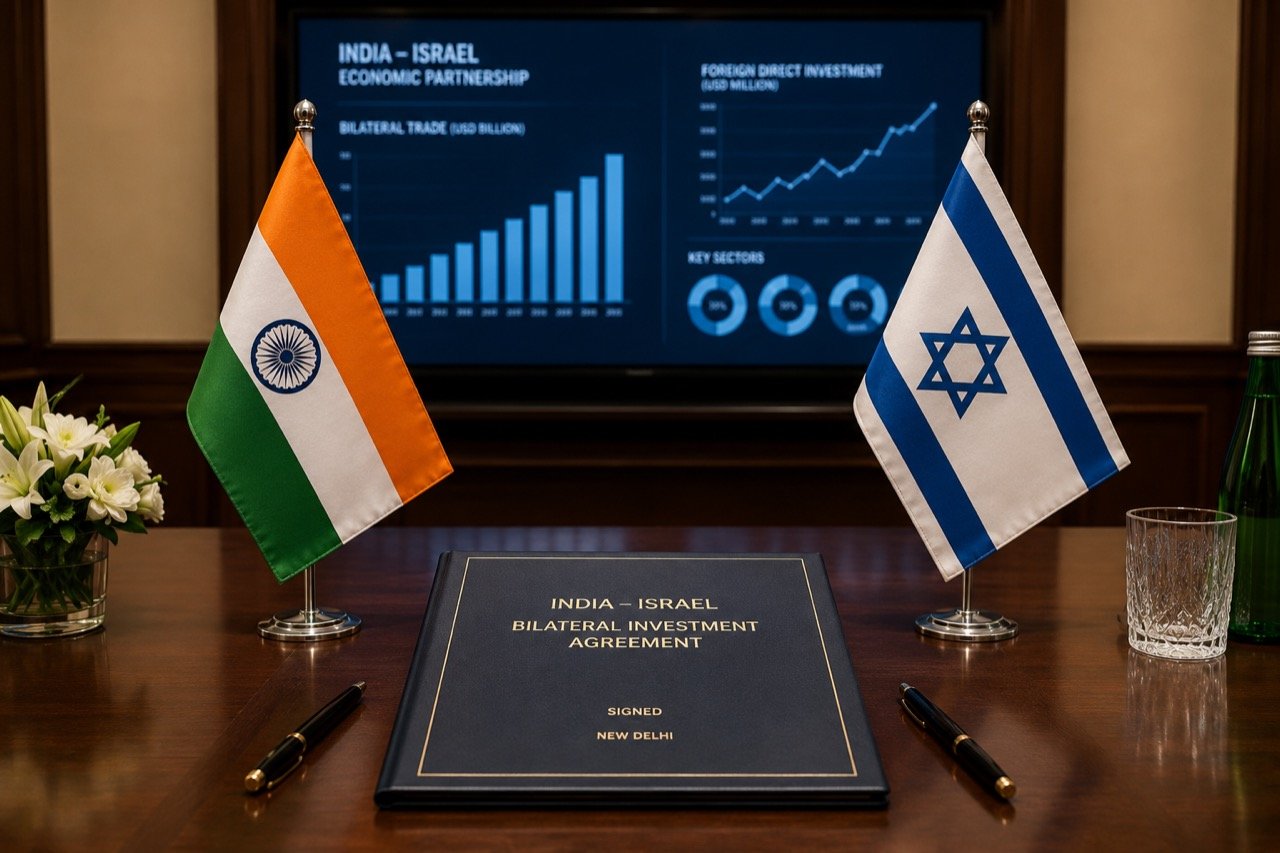
India and Israel are talking about money — not weapons systems or startup accelerators, but the legal plumbing of investment itself. Reports that the two countries are discussing a bilateral investment agreement have drawn fresh attention to an economic relationship usually framed through defence and technology. For companies and investors on both sides, the question is what such a pact could actually change. The answer lies in predictability: investment agreements set out the rules of the road for foreign capital long before any dispute arises, and it is precisely that quiet, procedural quality that makes the news significant rather than incidental.
Why an investment agreement is different from other diplomatic news
Most India-Israel headlines concern missiles, drones, or joint technology ventures — visible, often dramatic markers of a partnership. A bilateral investment agreement belongs to a different register altogether. It is not about a single transaction or a single sector; it is about the architecture that governs every transaction and every sector for years to come. Such treaties are technical documents with a practical purpose. They define protections for investors, establish how disputes are handled, and give long-term capital the confidence to commit money for years or decades rather than months. Investors are not simply reacting to a single announcement or a single company's plans; they are pricing in the legal environment in which their capital will sit. When that environment is unclear, capital tends to wait, or to demand a higher return to compensate for the uncertainty — which in effect raises the cost of doing business for both sides.
What New Delhi is trying to balance
For India, the framework matters because New Delhi wants to attract foreign investment while preserving its own policy space — a balance it has been recalibrating since overhauling its model treaty. That recalibration was not undertaken lightly. India's earlier generation of investment treaties left it exposed to a wave of investor-state arbitration claims that proved costly and, at times, constraining on domestic policymaking. The revised model treaty reflects lessons learned from that experience: it aims to protect India's ability to regulate in the public interest — on taxation, environmental standards, public health, and other core state functions — while still offering foreign investors meaningful assurances. Any agreement with Israel would need to thread this same needle. Get it right, and India demonstrates that its post-arbitration caution has matured into a workable, exportable model. Get it wrong, or leave it too vague, and the agreement risks becoming another symbolic gesture rather than a genuine confidence-builder for capital.
What Israel stands to gain from the Indian market
For Israel, India offers scale: a vast market for its strengths in technology, agriculture, water management, defence-adjacent innovation and manufacturing partnerships. Israeli firms have long punched above their weight in innovation — particularly in water technology, precision agriculture, and cybersecurity — but scaling that innovation requires large markets and manufacturing partners, both of which India can supply in abundance. An investment agreement would not itself create new business, but it would lower the perceived risk of committing capital to Indian ventures, joint manufacturing arrangements, or research collaborations. For Israeli companies weighing whether to expand into India versus other emerging markets, a credible legal framework could tip the balance, particularly for firms in water management and agri-tech that are already natural fits for India's needs in irrigation efficiency and crop yield improvement.
A partnership stepping beyond the security lens
The talks are notable for what they say about the relationship's direction. India-Israel coverage tends to centre on security cooperation; a capital-flows agreement shifts the spotlight toward business, innovation and supply chains, giving the partnership a more diversified public profile. This diversification matters beyond optics. A relationship anchored solely in defence and security cooperation is, by nature, narrower and more exposed to shifts in geopolitical alignment or domestic political sentiment in either country. A relationship that also runs through commercial investment, manufacturing supply chains, and innovation partnerships has more surfaces of mutual interest, and arguably more durability, because it draws in a broader set of stakeholders — companies, investors, state governments courting foreign capital, and sector regulators — rather than being the preserve of defence ministries and intelligence services alone.
Why the details will determine the outcome
The substance will live in the details — the final treaty language, the protections offered, the exclusions carved out and the dispute-resolution mechanism chosen. These are not minor technicalities. The scope of protected "investment," the definition of fair and equitable treatment, the carve-outs for public policy measures, and the choice between international arbitration and domestic courts for dispute resolution can each make the difference between a treaty that genuinely reassures investors and one that reads well in a press release but changes little in practice. Until those specifics are settled, this is best read as a policy direction with real commercial potential rather than a completed transformation. Businesses on both sides watching this development would do well to treat it as an early signal rather than a green light, and to look for the actual treaty text once negotiations conclude before recalibrating investment plans.
The NE Times View
This is the kind of unglamorous diplomacy that ultimately matters more than photo opportunities. India's cautious approach to investment treaties is understandable after past arbitration battles, but caution should not become paralysis: investors read the absence of a framework as risk, and risk carries a price. Every year that passes without updated treaty coverage between two economies is a year in which capital defaults to more conservative assumptions about legal protection, which in turn shapes how much investment actually flows and on what terms. If New Delhi can strike a deal with Israel that protects genuine regulatory space while giving capital enforceable assurances, it creates a template for other mid-sized partners — a demonstration that India's revised treaty model can accommodate serious bilateral relationships without reopening the vulnerabilities of the past. For Indian businesses eyeing Israeli deep tech — and for states courting Israeli investment in water and agriculture — the sooner the fine print arrives, the better. Delay has a cost that rarely makes headlines but is felt in every deferred investment decision and every deal structured more cautiously than it needed to be.
Key takeaways
- India and Israel are discussing a bilateral investment agreement aimed at giving foreign capital clearer legal protections and predictability.
- India's revised model investment treaty seeks to balance investor protection with preserving the government's own regulatory and policy space, a lesson drawn from earlier arbitration disputes.
- Israel's interest lies in accessing India's scale for its strengths in technology, agriculture, water management and manufacturing partnerships.
- The move signals a broadening of the India-Israel relationship beyond its traditional security and defence focus toward business and investment ties.
- The treaty's real impact will depend on unresolved details — protections, exclusions and the dispute-resolution mechanism — that have yet to be finalised.
You may also like to read

India-Israel Investment Pact Takes Effect With Investor Safeguards
The India-Israel bilateral investment agreement has formally come into force, replacing an earlier accord and promising stronger investor protection, clearer dispute-resolution rules and greater confidence for businesses in both countries.

India-Israel Investment Pact Takes Effect, Opening New Capital Doors
The bilateral investment agreement between India and Israel has come into force, giving investors in both countries clearer protections and a formal framework for deeper commercial cooperation.

Fairfax India's $1 Billion Government Bond Purchase Puts IDBI Stake Bid in Focus
Fairfax India has reportedly bought nearly $1 billion in Indian government bonds, a capital move widely read as positioning ahead of a possible bid for a stake in IDBI Bank.

Waterways Leisure Tourism IPO Opens As Cruise Operator Seeks Growth Capital
The cruise tourism operator's IPO gives investors rare exposure to India's experience-led travel economy, as capital markets open up to consumer businesses beyond banks, manufacturers and tech firms.
More from this section
More
Adani Case: US DOJ Pushes for Permanent Dismissal of Charges
The US Department of Justice has urged a judge to permanently dismiss charges against Gautam Adani, calling the case legally flawed — a reversal with consequences for markets, diplomacy and cross-border enforcement.

Akasa Air Inducts 40th Aircraft in Indian Aviation Scale-Up
Akasa Air's 40th aircraft, ferried to Bengaluru via Seattle, Reykjavik and Cairo, marks a fleet milestone for the young carrier and a fresh signal that India's aviation market remains firmly in expansion mode.

BARC Ratings Suspension Leaves Indian TV Industry Flying Blind
BARC's pause on television ratings has put India's broadcast measurement system under fresh scrutiny, leaving broadcasters, advertisers and media planners without the weekly audience data that anchors the TV economy.