India-Israel Investment Pact Takes Effect, Opening New Capital Doors
The bilateral investment agreement between India and Israel has come into force, giving investors in both countries clearer protections and a formal framework for deeper commercial cooperation.
Commentary & Analysis ·

The India-Israel bilateral investment agreement has come into force, effective from Friday, adding a significant business-diplomacy milestone to the economic calendar and setting a formal framework for capital flows between the two countries, the Economic Times reported. On the surface, this is the kind of development that can pass with little notice outside trade circles: a treaty text, a commencement date, a paragraph in the business pages. But agreements of this kind carry weight well beyond their modest public profile, because they alter the calculus that investors and companies make long before any single transaction is signed.
Why investment treaties matter more than they appear to
Agreements of this kind are designed to give investors confidence: clearer protections for their capital, safeguards against arbitrary treatment and defined dispute-resolution mechanisms. For companies weighing cross-border commitments, that predictability often matters as much as the commercial opportunity itself. A firm deciding whether to build a factory, fund a joint venture or commit research capital abroad is not merely asking whether the opportunity is attractive today. It is asking whether its investment will be treated fairly a decade from now, whether a change of government or policy could expose it to arbitrary treatment, and whether there is a credible, neutral mechanism to resolve disputes if things go wrong. A bilateral investment agreement answers precisely those questions in advance. It does not create demand or manufacture opportunity, but it removes a layer of uncertainty that often sits quietly behind boardroom hesitation. In that sense, the value of Friday's milestone lies less in what it promises and more in what it de-risks.
The sectors already primed to benefit
The India-Israel economic relationship already spans defence technology, agriculture, water systems, cybersecurity, innovation and startups. These are not arbitrary areas of cooperation; they reflect a genuine complementarity between the two economies. Israel has built deep expertise in water-scarce agriculture, precision irrigation, cybersecurity and defence innovation, often out of necessity, given its own resource and security constraints. India, by contrast, offers scale: a vast agricultural base that could benefit from efficiency gains, a growing digital economy that needs robust cybersecurity infrastructure, and a startup ecosystem hungry for technology partnerships and capital. The new agreement gives businesses in these sectors a firmer legal foundation on which to build joint ventures, technology partnerships and long-term investments. Where previously a company might have approached cross-border collaboration with caution, wary of legal ambiguity, the treaty framework now offers a clearer set of rules under which such partnerships can be structured, financed and, if necessary, defended.
A framework, not a guarantee
It would be a mistake, however, to read Friday's development as itself a driver of new capital flows. The pact will not by itself trigger a flood of new capital. Its practical value depends on how actively companies use it, how faithfully both governments implement it and whether sector-specific opportunities are developed with intent rather than left as diplomatic talking points. Treaties of this nature are permissive rather than directive: they make certain kinds of investment safer and more attractive, but they do not compel anyone to invest. History offers no shortage of examples where bilateral agreements were signed with fanfare and then left largely dormant, either because implementation lagged or because neither side did the follow-up work of translating legal protections into actual deal flow. The distinction between a framework that unlocks activity and one that simply exists on paper comes down entirely to execution.
A structural step, not a single deal
The right way to judge the agreement is over time: through announced investments, new partnerships and, eventually, how disputes are handled under its provisions. It is scaffolding for a deeper commercial relationship, not the building itself. This is an important distinction for anyone tracking the story going forward. The immediate news value of the agreement coming into force is limited; there is no single transaction, no headline investment figure, no marquee company attached to the announcement. Its significance will only become visible in retrospect, measured by the volume and quality of activity that follows. Observers should watch for the first substantive cases that test the dispute-resolution mechanisms, the first joint ventures explicitly structured to take advantage of the treaty's protections, and whether either government publishes data on investment flows that can be attributed, even partially, to the new framework.
What it signals about the wider relationship
Beyond the commercial mechanics, the timing and substance of the agreement also say something about where both countries see their economic relationships heading. For India, the pact fits into a broader pattern of courting capital from partners perceived as reliable and strategically aligned, at a time when global supply chains and investment flows are being reshaped by geopolitical considerations. For Israel, diversifying its economic relationships, reducing overreliance on any single market or partner, is a similarly strategic objective. Neither side is treating this as a purely transactional matter; it sits within a longer arc of defence, technology and diplomatic cooperation between the two countries. That context matters because it suggests both governments have an incentive to make the agreement work in practice, not merely to let it sit as a signed instrument.
The NE Times View
This agreement lands at a moment when India is actively courting trusted-partner investment and Israel is looking to diversify its economic relationships. The framework is welcome, but frameworks reward follow-through. Indian states and industry bodies should move quickly to convert treaty protections into concrete pipelines in agri-tech, water management and cybersecurity, where Israeli expertise meets Indian scale. The onus now shifts from negotiators to implementers: state investment promotion agencies, industry chambers and individual companies on both sides need to treat this as an invitation to act rather than a diplomatic accomplishment to be filed away. If both sides treat Friday's milestone as a starting gun rather than a finish line, the payoff for Indian businesses and consumers could be substantial. If, instead, it becomes another treaty that exists mainly in principle, the opportunity cost will be measured in the joint ventures, technology transfers and capital commitments that never materialised.
Key takeaways
- The India-Israel bilateral investment agreement came into force on Friday, formalising protections, safeguards and dispute-resolution mechanisms for cross-border capital.
- The agreement builds on an existing relationship spanning defence technology, agriculture, water systems, cybersecurity, innovation and startups.
- Its impact depends entirely on implementation and uptake by companies and governments, not on the treaty text itself.
- The agreement should be judged over time, through announced investments, partnerships and how disputes are eventually handled under its provisions.
- India and Israel both have strategic reasons, trusted-partner investment for India and diversification for Israel, to ensure the framework translates into real activity.
You may also like to read

India-Israel Investment Pact Takes Effect With Investor Safeguards
The India-Israel bilateral investment agreement has formally come into force, replacing an earlier accord and promising stronger investor protection, clearer dispute-resolution rules and greater confidence for businesses in both countries.
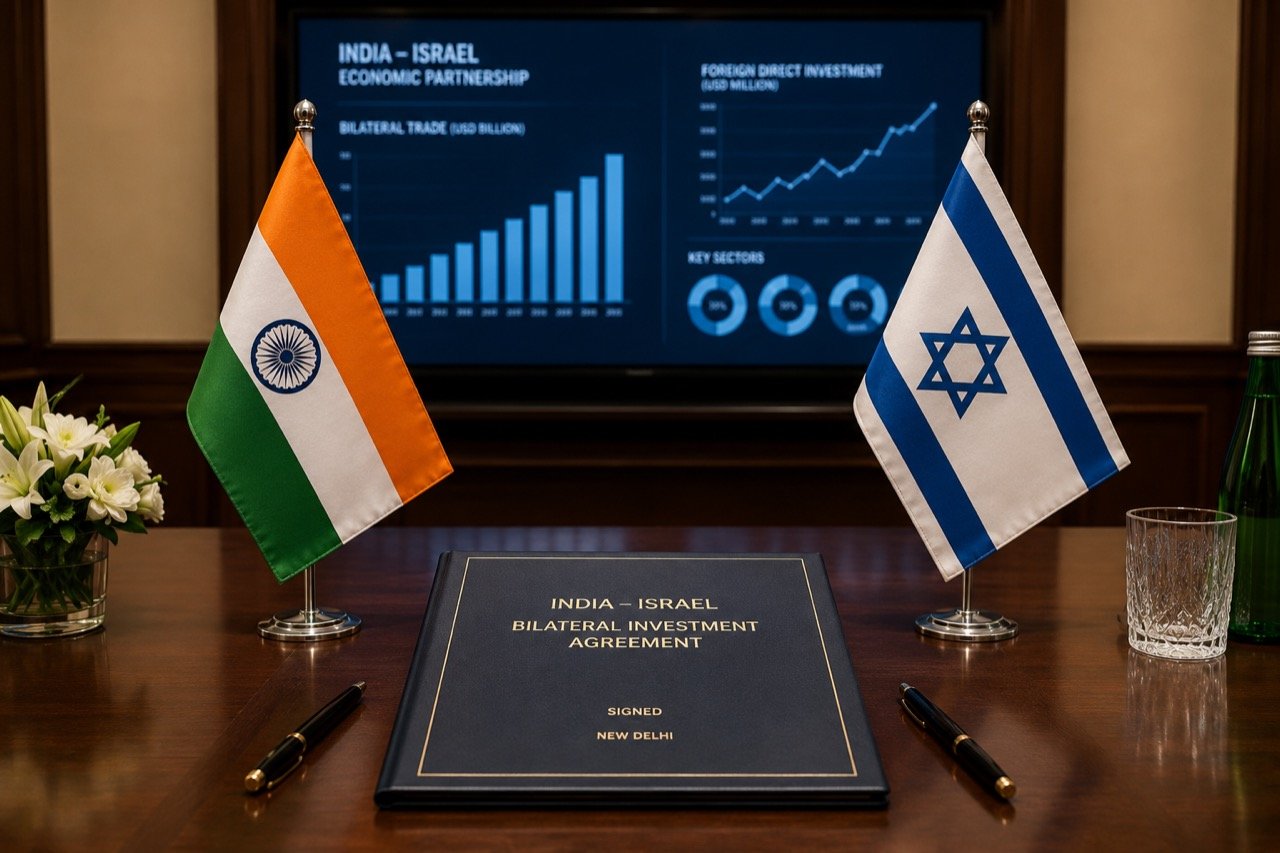
India-Israel Investment Agreement Talks Aim to Boost Capital Flows
Discussions on a bilateral investment agreement between India and Israel signal a push to broaden economic ties beyond defence and technology, promising clearer rules and greater confidence for investors on both sides.
India and US Resume High-Level Trade Talks in Delhi to Finalise First Phase of Pact
Commerce Minister Piyush Goyal says his US counterpart is in Delhi for ministerial talks, with reports naming USTR Jamieson Greer for two days of negotiations on tariffs and market access.

India-US Trade Talks Enter Final Lap as Limited Deal Takes Shape
Negotiators in New Delhi and Washington push toward a limited trade pact that could ease tariffs and widen market access for India's textiles, gems, engineering goods and farm exports.
More from this section
More
Adani Case: US DOJ Pushes for Permanent Dismissal of Charges
The US Department of Justice has urged a judge to permanently dismiss charges against Gautam Adani, calling the case legally flawed — a reversal with consequences for markets, diplomacy and cross-border enforcement.

Akasa Air Inducts 40th Aircraft in Indian Aviation Scale-Up
Akasa Air's 40th aircraft, ferried to Bengaluru via Seattle, Reykjavik and Cairo, marks a fleet milestone for the young carrier and a fresh signal that India's aviation market remains firmly in expansion mode.

BARC Ratings Suspension Leaves Indian TV Industry Flying Blind
BARC's pause on television ratings has put India's broadcast measurement system under fresh scrutiny, leaving broadcasters, advertisers and media planners without the weekly audience data that anchors the TV economy.