India AI Law: Regulation Debate Weighs Innovation Against User Safety
India's debate over artificial-intelligence regulation is shifting from broad principles to hard questions of liability, deepfake labelling and high-risk system obligations, as the government weighs how to protect users without stifling innovation.
Commentary & Analysis ·
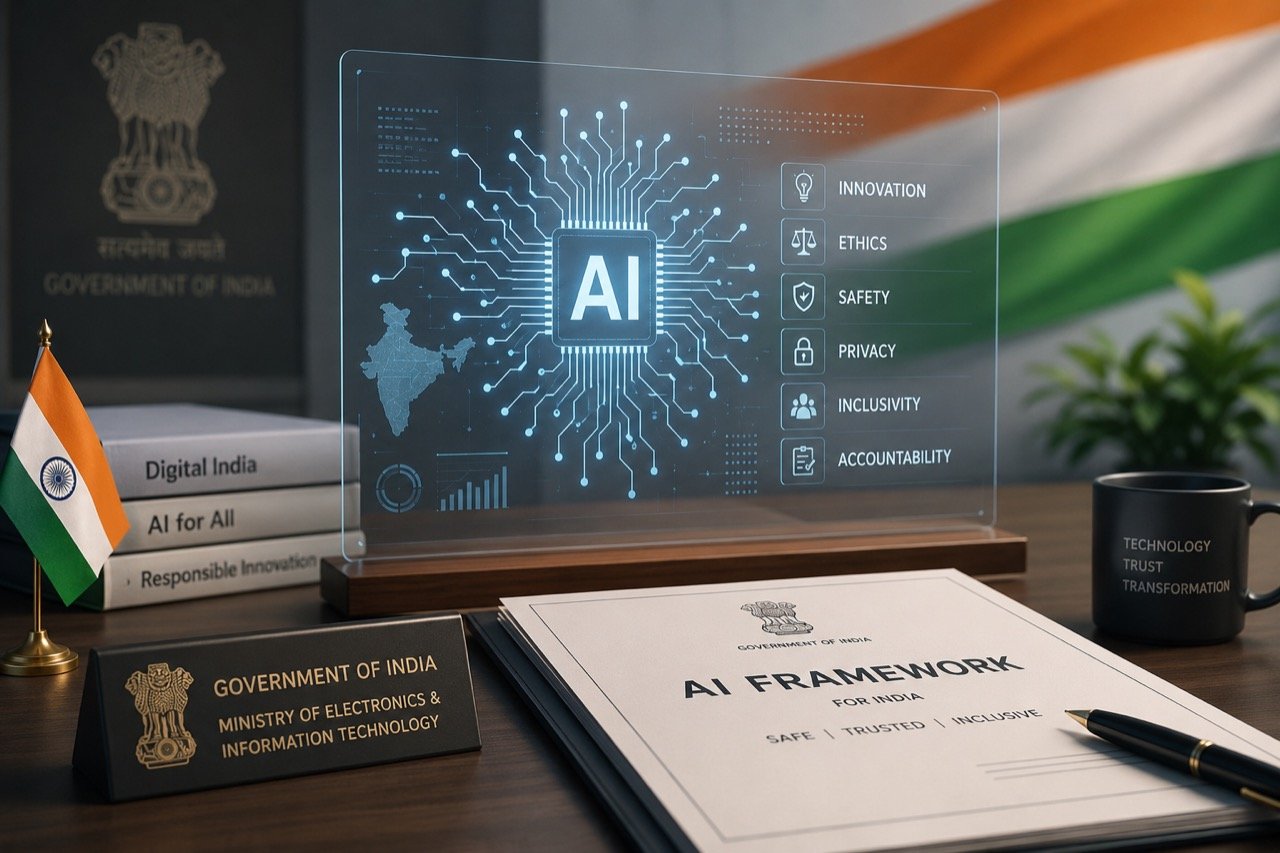
India's debate over how to regulate artificial intelligence is sharpening into one of the country's biggest technology-policy stories. Reports that the government is weighing legal and regulatory options have intensified public interest, reflecting India's dual identity as both a huge AI market and a fast-growing builder of AI products. The policy challenge is delicate. New Delhi wants startups, enterprises and public-sector systems to adopt AI aggressively, yet citizens need protection from deepfakes, fraud, discrimination, privacy abuse and opaque automated decisions. A law that is too vague risks chilling innovation; a framework that is too weak leaves users exposed.
What makes this moment significant is the sheer scale at which any Indian AI framework will operate. With well over a billion people connected to digital services, and a startup ecosystem that has grown rapidly around consumer apps, fintech and enterprise software, decisions made in New Delhi will not stay confined to a niche regulatory corner. They will shape how ordinary citizens experience everything from loan approvals to content moderation, and how thousands of smaller companies decide whether to build AI features at all. This is why the debate has moved from specialist policy circles into mainstream public conversation.
Why the stakes are unusually high
Unlike many regulatory questions that affect a narrow industry, AI governance touches nearly every sector at once — banking, healthcare, media, e-commerce and government services among them. That breadth is precisely what makes the balancing act so hard. Regulators must weigh the ambitions of a young, fast-moving startup ecosystem against the very real vulnerabilities of ordinary users who may have little recourse when an automated system denies them a service, misidentifies them, or is used to defraud them through convincingly fabricated audio or video. The government's task is not simply to write rules for a single technology, but to anticipate how that technology will keep changing even as the rules are being drafted.
This tension between speed of adoption and speed of protection is not unique to India, but it is felt more acutely here because of the scale of deployment and the relative youth of the regulatory institutions being asked to keep pace. A framework calibrated for a smaller, slower-moving economy would likely buckle under Indian conditions; equally, a framework copied wholesale from a more heavily regulated market risks smothering the very startups the government wants to encourage.
The practical questions on the table
The core public-interest questions are concrete: who is liable when an AI system causes harm, what obligations should apply to high-risk systems, how synthetic media should be labelled, and how regulators can enforce rules without overwhelming smaller companies with compliance burdens. Each of these questions carries its own complications. Liability is complicated by the fact that AI systems often involve multiple parties — the developer of the underlying model, the company that fine-tunes or deploys it, and the end user — making it unclear where responsibility should legally sit if something goes wrong. Defining "high-risk" systems is equally fraught, since a classification that is too broad could capture harmless applications, while one that is too narrow could leave genuinely dangerous uses unregulated.
Labelling synthetic media is arguably the most urgent of these questions, given how directly deepfakes and AI-generated fraud already affect ordinary Indians, from impersonation scams to manipulated videos circulating on social media. Any workable rule here will need to be simple enough to enforce at scale, since the volume of content being generated and shared already exceeds what manual review could ever handle.
A layered rather than sweeping approach
Rather than a single sweeping statute, India may opt for a layered approach — combining rules under existing IT law, sector-specific guidelines and future dedicated legislation. That would let regulators move quickly on urgent harms like deepfakes while longer-term architecture takes shape. This incremental strategy has clear advantages: it avoids the risk of a single, poorly calibrated law locking in mistakes for years, and it allows enforcement to begin on the most pressing harms immediately rather than waiting for a comprehensive bill to work its way through the legislative process.
The trade-off is that a patchwork of rules issued under existing IT law, alongside sector-specific guidelines from bodies overseeing finance, health or telecommunications, can create uncertainty for companies trying to determine which obligations actually apply to them. Smaller startups in particular may struggle to track overlapping requirements issued by different authorities at different times. If India pursues this layered path, clarity about how the pieces fit together will matter almost as much as the substance of the rules themselves.
What happens next
The story will stay live because AI adoption is outpacing public understanding. Businesses are integrating AI tools into customer service, hiring, credit assessment and content creation faster than most users, and indeed many regulators, can fully track. This gap between deployment and comprehension is itself a policy problem: it makes it harder for citizens to know when they are interacting with an automated system, harder for civil society to identify emerging harms early, and harder for lawmakers to draft rules that address real rather than hypothetical risks.
The next meaningful milestone to watch is a draft bill, consultation paper or official statement that sets out specific obligations rather than broad principles. Until such a document appears, much of the current debate will remain speculative, built on signals and reported intentions rather than concrete legal text. When a draft does emerge, the details will matter enormously: definitions of high-risk systems, the scope of labelling requirements for synthetic media, and the compliance thresholds set for smaller companies will determine whether the eventual framework achieves the balance policymakers say they want.
The NE Times View
India has a rare second-mover advantage here: it can study the EU's compliance-heavy AI Act and the lighter-touch approaches elsewhere, and pick what fits a country of 1.4 billion users and a young startup ecosystem. This is not a trivial advantage. Watching how other jurisdictions have struggled to implement complex compliance regimes, and how lighter-touch approaches have fared in practice, gives Indian policymakers a genuine opportunity to avoid known pitfalls rather than repeat them.
The priority should be clear liability rules and fast, enforceable action against deepfakes and AI-enabled fraud — the harms Indians actually face today — rather than sprawling paperwork regimes that primarily benefit large firms with the resources to manage compliance departments. A framework overloaded with documentation requirements risks entrenching incumbents while doing little to protect the ordinary citizen from a fraudulent video call or a manipulated voice message.
Whatever framework emerges, the government must publish drafts early and consult widely; regulation written behind closed doors rarely survives contact with technology moving this fast. Early and open consultation is not merely a procedural nicety. It is the only realistic way to catch blind spots before they become embedded in law, and to give the startups, civil society groups and everyday users who will live under these rules a genuine chance to shape them.
Key takeaways
- India is weighing a layered regulatory approach combining existing IT law, sector-specific guidelines and possible future legislation rather than one sweeping AI statute.
- Unresolved questions include liability for AI-caused harm, obligations for high-risk systems, labelling of synthetic media, and enforcement that does not overwhelm smaller companies.
- The next concrete milestone to watch is a draft bill, consultation paper or official government statement setting out specific obligations.
- The NE Times View favours clear liability rules and swift, enforceable action against deepfakes and AI-enabled fraud over heavy compliance paperwork.
- Early publication of drafts and wide public consultation are essential if the eventual framework is to keep pace with fast-moving technology.
You may also like to read
Kalshi Bars India Users as Prediction-Market Crackdown Widens
US event-contract platform Kalshi has added India to its restricted jurisdictions, barring Indian users from trading as MeitY tightens its squeeze on offshore betting and prediction-market platforms.

Preity Zinta Deepfake Case: Bombay HC Weighs Celebrity AI Rights
Preity Zinta's petition against AI-generated deepfakes and morphed images has drawn Google and Meta into a Bombay High Court discussion on how fast platforms must remove content that misuses a person's identity.

IISc Quantum-Safe Chip Points To India's Defence Against Tomorrow's Hackers
Researchers at IISc have demonstrated a quantum-resilient security chip for IoT devices, presented at the world's premier semiconductor forum, as India accelerates its National Quantum Mission.

Gaganyaan Parachute Test Success Moves ISRO Closer to Crewed Flight
ISRO has completed successful integrated parachute tests for the Gaganyaan crew capsule, validating a critical part of the descent and recovery system as India's human spaceflight programme advances through key engineering milestones.
More from this section
More
CG Semi Sanand Plant Opens, Boosting India's Semiconductor Drive
Prime Minister Narendra Modi inaugurated CG Semi's chip assembly and test facility in Sanand, Gujarat, giving India's semiconductor mission a working manufacturing milestone rather than another policy promise.
Chinese E-Rickshaw Apps Banned in India Over Remote Disable Risk
The Centre has ordered the removal of three Chinese apps — BAT-BMS, Lossigy and Epoch-i-ion — over fears they could remotely disable battery-run e-rickshaws, turning mobility software into a public safety concern.
Connected Car Rules: India Plans Vehicle Software Update Norms
With cars increasingly run by software, the government is reportedly preparing update and security norms aimed at preventing vehicle hijacking and governing how connected cars in India are patched and protected.