Rupee Claws Back To 94.55 As US-Iran Deal Hopes Ease Oil Fears
The rupee recovered to around 94.55 against the dollar by mid-June 2026, rebounding from a record low near 97 as reports of a US-Iran agreement to reopen the Strait of Hormuz lifted sentiment.
Commentary & Analysis ·

After a bruising stretch that dragged it to a record low near 97 to the dollar in May, the rupee has staged a notable recovery, provisionally closing around 94.55 on Tuesday, June 16, as easing West Asia tensions and renewed foreign inflows steadied the currency. The bounce offered relief to importers and policymakers alike after weeks of one-way pressure on the exchange rate. For a currency that had been sliding almost without interruption for months, a recovery of this scale in a matter of weeks is significant, and it is worth examining both why it happened and how durable it is likely to prove.
Geopolitics turns the tide
The catalyst behind the rupee's turnaround was mounting expectation of a US-Iran agreement to end hostilities and reopen the Strait of Hormuz, reportedly set to be signed in Switzerland on June 19. For a market that had spent weeks pricing in the risk of a prolonged closure of one of the world's most critical oil chokepoints, the mere prospect of a negotiated settlement was enough to change sentiment. The prospect of unimpeded oil flows pulled crude prices off their highs and reduced the dollar demand that had weighed on the rupee, which had earlier eased to around 92.6 before the worst of the panic set in and pushed it down toward 97. It is a reminder of how quickly currency markets can swing on diplomatic headlines alone, well before any deal is formally inked. Traders and corporate treasuries, who had been scrambling to hedge dollar exposure through May, found themselves suddenly unwinding those positions as the risk premium embedded in the rupee began to deflate.
This is not merely a technical market reaction. The Strait of Hormuz carries a substantial share of the world's seaborne oil trade, and any threat to its passage immediately raises the spectre of supply disruption for oil-importing economies such as India. When that threat recedes, even provisionally, the knock-on effects ripple through crude prices, shipping and insurance costs, and ultimately the demand for dollars that Indian importers need to settle their energy bills. The rupee's swift move from near 97 back to 94.55 illustrates just how much of its recent weakness was geopolitical risk premium rather than a reflection of any deterioration in India's underlying economic fundamentals.
Foreign capital returns
Fresh foreign money helped too. With FPIs channelling tens of thousands of crores into Indian bonds in June, and inflows of over Rs 25,000 crore recorded for the month, the dollar supply on the local market improved, giving the rupee firmer footing after months of equity-driven outflows. This dual support, a fading geopolitical risk premium alongside genuine foreign portfolio buying, is precisely what has allowed the recovery to gather pace rather than remain a brief, headline-driven blip.
It is worth noting the contrast with the pattern seen earlier in the year, when foreign investors were net sellers of Indian equities and the rupee bore the brunt of that exit. Bond inflows returning at this scale suggest that at least a segment of foreign capital is now viewing Indian debt as an attractive destination again, whether on yield grounds, currency stabilisation expectations, or simply a broader re-allocation toward emerging markets as global risk appetite improves. For the Reserve Bank of India, this improvement in the capital account gives it more room to manage volatility without drawing down reserves aggressively.
The oil link that will not go away
The rupee's fortunes remain tightly bound to crude, given India's heavy import dependence. A sustained $10-per-barrel rise in oil could widen the current account deficit by 40-50 basis points, HDFC Bank has warned, which in turn pressures the currency. This is the mechanical link that explains why every twist in the Hormuz negotiations moves the rupee almost in lockstep with crude benchmarks. A durable de-escalation would unwind much of that risk premium, but the operative word is durable. The market has been trading, in effect, on the assumption that the worst-case scenario, a prolonged closure of the strait, is now off the table. That assumption has not yet been tested by an actual signed agreement.
For a country that imports the overwhelming majority of its crude requirements, this is not an abstract macroeconomic footnote. Every basis point of current account deterioration eventually shows up in the exchange rate, in inflation via imported fuel costs, and in the fiscal calculus around subsidies and duties. The link between crude prices and the rupee is one of the most consistent relationships in Indian macroeconomics, and it is precisely why a diplomatic breakthrough half a world away can move the currency more than a quarter's worth of domestic data releases.
What lies ahead
Traders caution that the recovery is contingent on the deal actually materialising and on oil staying contained. The RBI has the reserves to smooth volatility, but a relapse in West Asia or a fresh bout of equity outflows could quickly test the rupee again. As one treasury head at a state-run bank put it, "The currency is trading on headlines right now. Confirm the Hormuz deal and oil holds lower, and the path of least resistance for the rupee is back toward the low 90s." That comment captures both the optimism in the market and its conditionality. Nothing about the current rally is guaranteed; it is a bet on an outcome that is expected but not yet confirmed.
For now, the combination of cooling crude and returning foreign capital has handed the rupee a reprieve, though few are willing to call the bottom until the ink dries on any agreement. Importers who had been rushing to cover dollar payables at increasingly unfavourable rates through May will welcome the breathing room, as will policymakers watching imported inflation. But the very speed of this reversal, up nearly two and a half rupees in a matter of weeks, underlines how fragile the underlying calm actually is. A single setback in the negotiations, or a resumption of hostilities in the region, could reverse the move just as quickly as it appeared.
The NE Times View
A rupee rescued by Hormuz headlines is a rupee still at the mercy of West Asian geopolitics, not domestic strength. The rebound from near 97 is welcome relief for importers and inflation, but it rests on a deal that has not closed. India's structural vulnerability to imported oil remains the real story, and it is one that has been apparent for years and will remain so regardless of how this particular episode resolves. Diversifying energy supply matters more than cheering each diplomatic rumour. Until India meaningfully reduces its dependence on imported crude, whether through a faster shift to alternative energy sources, larger strategic reserves, or diversified sourcing that reduces exposure to any single chokepoint, its currency will continue to swing on events playing out in capitals and straits thousands of miles away. The recovery to 94.55 is good news. It should not be mistaken for resilience.
Key takeaways
- The rupee closed near 94.55 to the dollar on June 16, recovering from a record low near 97 hit in May.
- The recovery was driven by expectations of a US-Iran deal to reopen the Strait of Hormuz, reportedly due to be signed in Switzerland on June 19.
- Falling crude prices reduced dollar demand and eased the risk premium built into the rupee.
- FPI bond inflows of over Rs 25,000 crore in June added further support to the currency.
- The gains remain conditional on the Hormuz deal materialising and oil prices staying contained, leaving India's structural oil-import dependence as the underlying vulnerability.
You may also like to read

Sensex Jumps 1,695 Points as Oil Slides on Peace-Deal Hopes
Indian equities staged one of their strongest sessions of the year after crude prices fell on reports of a possible US-Iran agreement, easing pressure on the oil-importing economy.
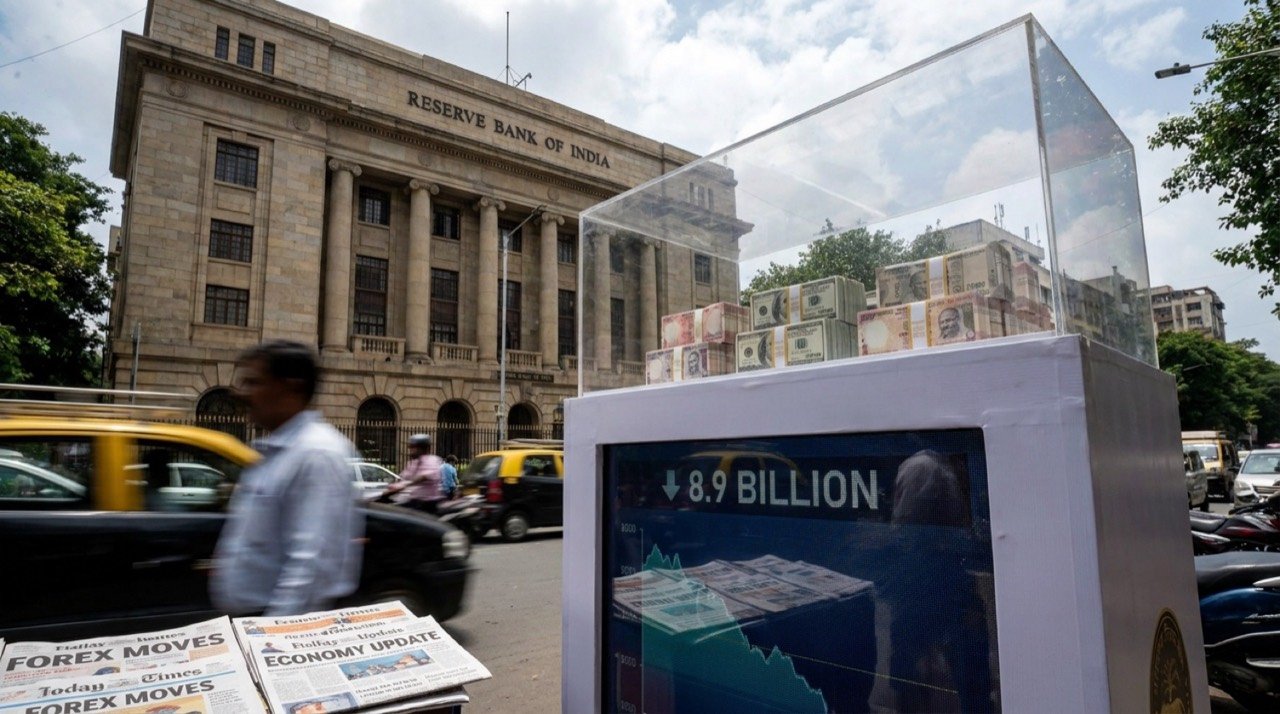
RBI Sold $8.9 Billion in April as Rupee Pressure Persisted
India's central bank sold a net $8.9 billion in the spot foreign-exchange market in April, RBI data showed, underlining how it manages currency volatility while balancing reserves and liquidity.
Crude spike from West Asia conflict pins rupee near record low, widens deficit fears
Surging oil prices have revived pressure on the currency and the current account, exposing India's enduring vulnerability to energy shocks.
RBI Sells Nearly $9 Billion in April as Rupee Faces Sustained Pressure
The central bank's net dollar sales in the spot forex market signal another month of intervention to smooth volatility, with importer demand and West Asia uncertainty weighing on the rupee.
More from this section
More
Adani Case: US DOJ Pushes for Permanent Dismissal of Charges
The US Department of Justice has urged a judge to permanently dismiss charges against Gautam Adani, calling the case legally flawed — a reversal with consequences for markets, diplomacy and cross-border enforcement.

Akasa Air Inducts 40th Aircraft in Indian Aviation Scale-Up
Akasa Air's 40th aircraft, ferried to Bengaluru via Seattle, Reykjavik and Cairo, marks a fleet milestone for the young carrier and a fresh signal that India's aviation market remains firmly in expansion mode.

BARC Ratings Suspension Leaves Indian TV Industry Flying Blind
BARC's pause on television ratings has put India's broadcast measurement system under fresh scrutiny, leaving broadcasters, advertisers and media planners without the weekly audience data that anchors the TV economy.