Meta-CRED Deal Puts Kunal Shah at Centre of the Global WhatsApp Story
Reports that Meta is investing in CRED and lining up founder Kunal Shah for a senior global WhatsApp role have placed Indian fintech talent at the heart of a worldwide messaging and payments contest.
Commentary & Analysis ·

A technology and fintech development with global reach has placed Indian entrepreneur Kunal Shah firmly in the international spotlight. Multiple outlets have reported that Meta is investing in CRED, the premium consumer fintech firm Shah founded, and that he is in line for a senior global WhatsApp role following the tenure of long-time executive Will Cathcart. The reported figures vary between publications, but the underlying theme is consistent: a leading Silicon Valley technology company is looking to India not merely as a market to be served but as a source of executive talent and product thinking that could shape one of its flagship global platforms.
Taken together, the reports describe two related but distinct developments. The first is a financial one, a Meta investment into CRED, a company that has built its reputation on premium credit-card bill management, curated rewards and a distinctly upmarket brand positioning within India's crowded fintech landscape. The second is a leadership question, whether Shah himself will step into a senior global role at WhatsApp, the messaging platform that counts India as its single largest market by user numbers. Neither element has been confirmed with precision by the companies involved, which is itself an important caveat for readers to bear in mind as the story develops.
Why Meta is looking to India
Meta's reported interest reflects a fairly simple commercial reality. India is WhatsApp's largest market by users, and it is also one of the world's most dynamic digital-payments economies. The country's appetite for instant messaging, bill payments and app-based credit has produced both scale and a sophisticated form of consumer behaviour that global platforms increasingly want to study and, where possible, replicate elsewhere. Indian consumers have, in effect, been running a large-scale, real-world experiment in how messaging, payments and credit can be woven together into daily habits, and that experiment has not gone unnoticed in Menlo Park.
This is not a new instinct for Meta. The company has for years treated India as a proving ground for WhatsApp Pay and related commerce features, given the depth of penetration the app enjoys here and the comparative openness of India's Unified Payments Interface, or UPI, ecosystem to third-party integration. What appears to be different this time is the degree of ambition. Rather than simply localising features for the Indian market, the reported CRED investment and the talk of a senior role for Shah suggest Meta wants Indian fintech thinking embedded at the level of global product strategy, not just regional execution.
CRED's brand and what it offers Meta
CRED built a recognisable, aspirational brand around credit-card bill management, rewards and a carefully curated user base, an approach that set it apart from more mass-market Indian fintech players chasing volume above all else. That positioning matters here. Pairing CRED's fintech sensibility with WhatsApp's sheer reach hints at where Meta may see the next phase of growth for its messaging platform, one that blends messaging, commerce and financial services into a more seamless experience than currently exists in most markets, including the United States.
For Meta, the appeal of this pairing is not hard to trace. WhatsApp already has the distribution. What it may lack, relative to dedicated fintech apps, is the kind of product instinct that turns a payments feature into something users trust, return to and build habits around. CRED's approach to rewards, curation and brand trust is precisely the kind of thinking that a platform the size of WhatsApp would need if it wants payments and financial services to become a durable part of its offering rather than a bolted-on feature.
Bigger than one founder
For India's startup ecosystem, the story carries weight well beyond a single executive's career trajectory. It signals that Indian founders are being considered for top operating roles at the largest global technology companies, not merely as market managers overseeing a regional operation but as architects of worldwide product strategy. That is a meaningful distinction. India has long supplied technology leadership to Silicon Valley at the level of chief executives and senior engineering leaders, but a founder-led fintech figure being positioned to shape a global consumer platform's strategy is a somewhat different marker of how far home-grown entrepreneurial talent has travelled.
It also ties together several threads at once, consumer credit, rewards, bill payments, business messaging and increasingly AI-powered services, all under one roof. If Shah moves into WhatsApp leadership, the focus will inevitably turn to how the platform handles payments, privacy and monetisation across very different regulatory environments, from India's data-protection framework to the European Union's stricter digital rules and the United States' more fragmented approach. Running a global product with those competing regulatory pressures is a materially harder task than running a domestic fintech brand, however successful.
What to watch next
Several open questions will shape how this story develops in the months ahead. Chief among them is how much Meta ultimately invests in CRED and on what terms, since the reported figures have varied across publications and no confirmed structure has emerged. Equally significant is whether Shah formally takes on a global WhatsApp leadership position, and if so, what that role's actual mandate looks like relative to Cathcart's departing responsibilities.
Beyond the personnel question, there is the matter of how deeper links between messaging and financial services will be regulated in India, particularly given the sensitivities around data sharing between a foreign-owned messaging platform and a domestic fintech company. The impact on WhatsApp's payments push and its business-messaging tools is another thread worth following, since any changes in leadership or strategic direction could accelerate or slow the rollout of features Indian users have already grown accustomed to. Finally, and perhaps most importantly, how Meta balances consumer trust and privacy with commercial monetisation will determine whether this development is remembered as a positive turning point or a cautionary tale.
Industry reporting has broadly framed the situation as one in which Meta sees strategic value in Indian fintech talent, payments behaviour and WhatsApp's huge India user base. Until the companies confirm the specifics, the reports remain a fast-moving narrative rather than a closed deal. But even at this stage, the prospect of an Indian founder steering one of the world's most-used apps marks a notable moment for the country's technology and fintech sectors, and regulators and users alike will be watching closely.
The NE Times View
An Indian founder steering WhatsApp's global ambitions would be a genuine marker of how far home-grown fintech talent has travelled. It would sit alongside, and in some ways exceed, the symbolic weight of Indian-origin executives leading other global technology giants, because Shah's rise would be rooted in a company he built from within India's own fintech ecosystem rather than through a conventional corporate career path abroad.
But the more consequential story here is leverage. WhatsApp's payments push leans heavily on India's UPI rails and its enormous domestic user base, which means New Delhi holds real bargaining power on questions of data localisation, competition policy and consumer protection, regardless of who sits atop WhatsApp's org chart. A senior Indian executive at WhatsApp does not, by itself, guarantee that Indian regulators will be treated more favourably or that Indian users will see better outcomes on privacy and pricing. Celebrate the talent, yes, but watch closely whether Indian users gain tangible benefits from this arrangement or simply become the testbed on which Meta refines a model it later exports, at greater profit, to markets elsewhere.
Key takeaways
- Reports indicate Meta is investing in CRED, the fintech firm founded by Kunal Shah, while Shah is separately reported to be in line for a senior global WhatsApp role after Will Cathcart's tenure.
- Meta's interest is driven by India's status as WhatsApp's largest market and its advanced digital-payments culture, which the company appears keen to leverage for global product strategy rather than purely local features.
- The development is significant for India's startup ecosystem as a signal that Indian founders can be considered for top global operating roles, not just regional management positions.
- Key unresolved questions include the size and terms of Meta's investment in CRED, whether Shah's role is formally confirmed, and how messaging-finance integration will be regulated across different jurisdictions.
- The NE Times View stresses that India's leverage stems from its UPI rails and user base, and that the real test is whether Indian users benefit directly or merely serve as a testing ground for features exported elsewhere.
You may also like to read

Kunal Shah Named WhatsApp Global Head, Putting India at Centre of Meta's Strategy
CRED founder Kunal Shah has been named global head of WhatsApp as Meta deepens its India bets, placing an Indian fintech entrepreneur in charge of the platform's largest market.

Meta Backs CRED With $900 Million As Kunal Shah Is Tapped To Lead WhatsApp Globally
Meta is investing about $900 million in Indian fintech CRED and has chosen founder Kunal Shah to lead WhatsApp globally, a twin move that ties one of the world's biggest platforms ever closer to Indian consumer technology.
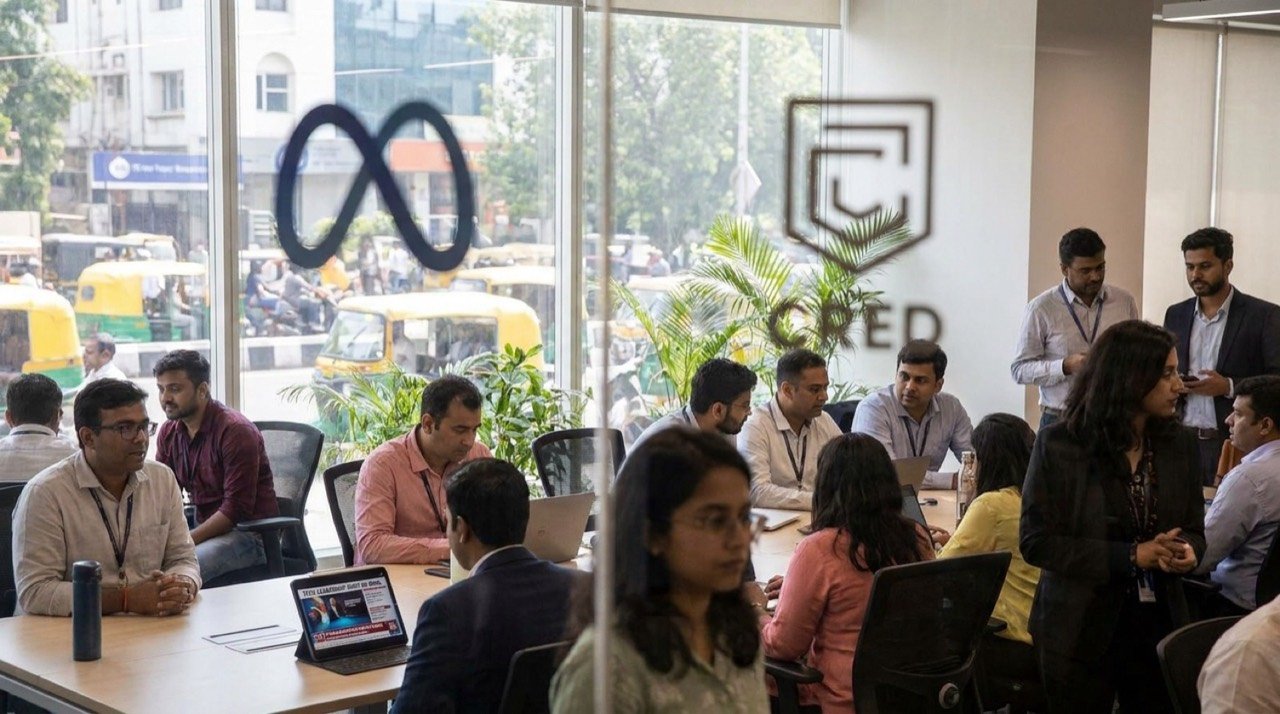
Meta Buys Stake in CRED and Names Kunal Shah WhatsApp Head, Reports Say
Reports that Meta has acquired a stake in CRED at an $8.8 billion valuation and tapped founder Kunal Shah to lead WhatsApp thrust Indian fintech leadership into a global spotlight.

Kunal Shah Named WhatsApp Global CEO as Meta Leads $900 Million CRED Round
CRED founder Kunal Shah has been named global CEO of WhatsApp as Meta leads a $900 million round valuing the Indian fintech at about $4.5 billion, placing a homegrown founder atop one of the world's biggest apps.
More from this section
More
Adani Case: US DOJ Pushes for Permanent Dismissal of Charges
The US Department of Justice has urged a judge to permanently dismiss charges against Gautam Adani, calling the case legally flawed — a reversal with consequences for markets, diplomacy and cross-border enforcement.

Akasa Air Inducts 40th Aircraft in Indian Aviation Scale-Up
Akasa Air's 40th aircraft, ferried to Bengaluru via Seattle, Reykjavik and Cairo, marks a fleet milestone for the young carrier and a fresh signal that India's aviation market remains firmly in expansion mode.

BARC Ratings Suspension Leaves Indian TV Industry Flying Blind
BARC's pause on television ratings has put India's broadcast measurement system under fresh scrutiny, leaving broadcasters, advertisers and media planners without the weekly audience data that anchors the TV economy.