Kunal Shah Named WhatsApp Global Head, Putting India at Centre of Meta's Strategy
CRED founder Kunal Shah has been named global head of WhatsApp as Meta deepens its India bets, placing an Indian fintech entrepreneur in charge of the platform's largest market.
Commentary & Analysis ·

CRED founder Kunal Shah has been named global head of WhatsApp, according to reports from The Times of India, AFP via Barron's and MediaPost, in a move that places an Indian fintech entrepreneur at the helm of a platform whose largest market is India. The appointment, reported alongside Meta's minority investment in CRED, signals how central the country has become to the company's consumer technology ambitions. Taken together, the two developments read less like a routine executive reshuffle and more like a statement of intent from Meta about where its next phase of growth is expected to come from.
Why the appointment matters
The significance runs on two tracks. First, WhatsApp is no longer merely a messaging utility; for hundreds of millions of Indians it is a payments, commerce, business communication and public-service channel woven into daily life. It sits at the intersection of how small traders take orders, how families exchange money, and how government and civic notices increasingly reach citizens. Second, Shah brings deep experience in consumer fintech, rewards, payment behaviour and high-frequency mobile engagement, precisely the skills Meta needs as it searches for a stronger revenue model without eroding user trust.
Putting a founder who built a rewards-driven payments business in charge of WhatsApp suggests Meta intends to lean harder into monetisation, especially through commerce and financial services. CRED made its name by turning routine credit card bill payments into a gamified, rewards-led experience that kept affluent, high-intent users engaged far beyond the moment of transaction. Transplanting that instinct onto a platform with WhatsApp's scale is an ambitious wager: the same mechanics that worked for a niche fintech app with a curated user base will need to be adapted for a mass-market utility used across income groups, literacy levels and device types.
What changes for Indian users
For everyday users, the app they open each day may not change overnight. The more meaningful shifts are likely to surface through business messaging, payments experiments, verification tools, fraud controls and creator or commerce features. These are the layers where Meta has already been experimenting quietly for years, and a leadership change of this kind typically accelerates decisions that were previously stuck in pilot mode rather than introducing entirely new product categories from scratch.
India has frequently served as WhatsApp's testing ground because adoption runs deep across metros, small towns and rural markets alike. New features and safeguards often debut here before scaling globally, partly because of the sheer size of the user base and partly because India's payments infrastructure, built around the Unified Payments Interface, gives WhatsApp a live laboratory for embedded financial services that does not exist in the same form in most other markets. A leader with Shah's background is well placed to identify which of these experiments are ready to be pushed harder and which need to be quietly shelved.
A rising global profile for Indian founders
The leadership shift also underlines the growing global stature of Indian startup founders, adding to a roster of India-born executives leading major technology platforms. It reinforces a narrative that has been building for years: that India is not just a market to be served but a source of the ideas, talent and operating instincts that shape how global platforms evolve. For a generation of Indian entrepreneurs who built and sold or scaled consumer apps domestically, Shah's elevation offers a visible marker of what a path from local founder to global platform leader can look like.
Shah's role will be watched closely by regulators, small businesses, payment companies and privacy advocates. Each of these constituencies has a different stake in the outcome. Regulators will want assurance that any deepening of WhatsApp's commerce and payments ambitions in India stays within the country's data protection and financial regulatory frameworks. Small businesses, many of which already rely on WhatsApp Business tools to reach customers, will be watching for whether new features make it easier or more expensive to operate. Payment companies that compete with or plug into WhatsApp's payment rails will be assessing whether Meta is about to become a more aggressive competitor or a bigger partner. Privacy advocates, meanwhile, will be alert to any sign that monetisation pressure is being allowed to compromise the encryption and simplicity that have defined WhatsApp's reputation.
The tension between growth and trust
Industry analysts have framed the central question succinctly: whether WhatsApp can expand monetisation while remaining simple, encrypted and dependable for everyday communication. This is not a new dilemma for Meta, but it takes on sharper edges when the person now responsible for navigating it comes from a business built explicitly around converting user engagement into commercial value. Shah's challenge will be to grow revenue from a service users value precisely because it is uncluttered and private. How he balances commercial ambition against the platform's reputation for simplicity and encryption will shape WhatsApp's next phase, with India at the heart of the experiment.
There is a broader lesson here for how large technology platforms approach mature markets. WhatsApp did not need to chase growth in India in the way it once did; penetration is already near-saturation among smartphone users. What Meta appears to be chasing instead is depth of engagement and monetisable use cases layered on top of an already dominant install base. That shift in strategy, from acquiring users to extracting more value per user, tends to invite more scrutiny, not less, because the trade-offs become more visible to the people actually using the app every day.
What to watch next
Over the coming months, the clearest signals of intent will come from three areas. The first is any expansion or refinement of WhatsApp's payments features in India, given the country's UPI-driven digital payments ecosystem. The second is the pace and nature of business messaging tools aimed at small and medium enterprises, an area where Meta has long signalled ambition but moved cautiously. The third is how Meta's minority stake in CRED evolves, and whether it deepens into tighter product integration between the two platforms or remains a purely financial arrangement. Any visible blending of CRED's rewards mechanics into WhatsApp's payment flows would be a strong indicator of the direction Shah intends to take the platform.
The NE Times View
An Indian leading WhatsApp globally is a milestone worth marking, and it confirms that India is no longer just Meta's largest user base but a source of its talent and strategy. The NE Times reads this less as a personal triumph than as leverage: India should expect WhatsApp to answer more seriously to Indian concerns on privacy, payments and misinformation, not merely host its biggest crowd. A platform this embedded in the country's daily commercial and civic life carries a responsibility that goes beyond user growth metrics, and the appointment of a leader who understands Indian consumer behaviour intimately should, in principle, make that responsibility easier to discharge. Whether it does so in practice will depend on choices made far from public view, in the trade-offs between revenue targets and the trust that made WhatsApp indispensable in the first place.
Key takeaways
- Kunal Shah moves from CRED to lead WhatsApp globally, with Meta reportedly taking a minority stake in CRED alongside the appointment.
- India remains WhatsApp's single largest market, and the appointment reinforces the country's growing weight in shaping Meta's global product and monetisation strategy.
- Expect the most visible changes to appear in business messaging, payments experiments, verification tools and fraud controls rather than in WhatsApp's core everyday interface.
- Regulators, small businesses, payment companies and privacy advocates will scrutinise how monetisation moves are balanced against WhatsApp's reputation for simplicity and encryption.
- The appointment adds to a broader trend of Indian-origin founders and executives taking on leadership of major global technology platforms.
You may also like to read
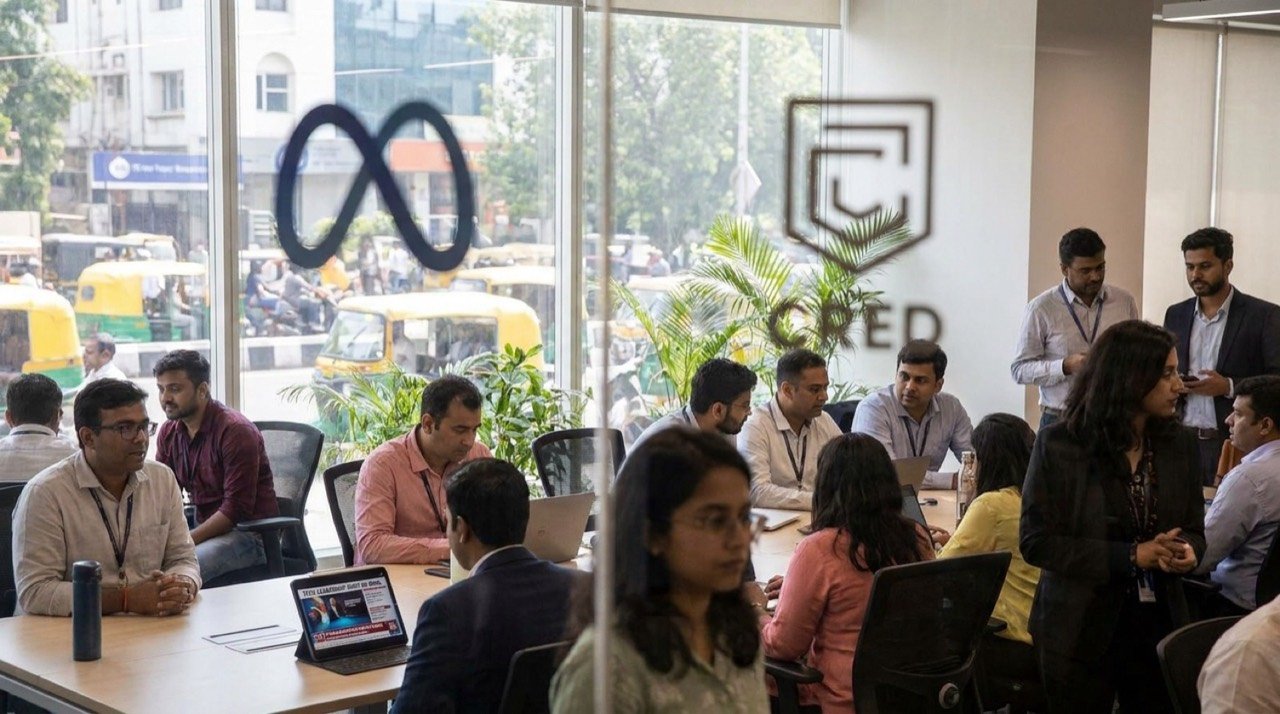
Meta Buys Stake in CRED and Names Kunal Shah WhatsApp Head, Reports Say
Reports that Meta has acquired a stake in CRED at an $8.8 billion valuation and tapped founder Kunal Shah to lead WhatsApp thrust Indian fintech leadership into a global spotlight.

Meta Backs CRED With $900 Million As Kunal Shah Is Tapped To Lead WhatsApp Globally
Meta is investing about $900 million in Indian fintech CRED and has chosen founder Kunal Shah to lead WhatsApp globally, a twin move that ties one of the world's biggest platforms ever closer to Indian consumer technology.

Kunal Shah Named WhatsApp Global CEO as Meta Leads $900 Million CRED Round
CRED founder Kunal Shah has been named global CEO of WhatsApp as Meta leads a $900 million round valuing the Indian fintech at about $4.5 billion, placing a homegrown founder atop one of the world's biggest apps.

Meta-CRED Deal Puts Kunal Shah at Centre of the Global WhatsApp Story
Reports that Meta is investing in CRED and lining up founder Kunal Shah for a senior global WhatsApp role have placed Indian fintech talent at the heart of a worldwide messaging and payments contest.
More from this section
More
CG Semi Sanand Plant Opens, Boosting India's Semiconductor Drive
Prime Minister Narendra Modi inaugurated CG Semi's chip assembly and test facility in Sanand, Gujarat, giving India's semiconductor mission a working manufacturing milestone rather than another policy promise.

Chinese E-Rickshaw Apps Banned in India Over Remote Disable Risk
The Centre has ordered the removal of three Chinese apps — BAT-BMS, Lossigy and Epoch-i-ion — over fears they could remotely disable battery-run e-rickshaws, turning mobility software into a public safety concern.

Connected Car Rules: India Plans Vehicle Software Update Norms
With cars increasingly run by software, the government is reportedly preparing update and security norms aimed at preventing vehicle hijacking and governing how connected cars in India are patched and protected.