Maharashtra Milk Crackdown Puts Food Safety Back on the Agenda
Enforcement drives against milk adulteration in Maharashtra have revived public debate on food quality, spotlighting the need for regular testing, supply-chain vigilance and consumer awareness across India's most-consumed daily staple.
Commentary & Analysis ·
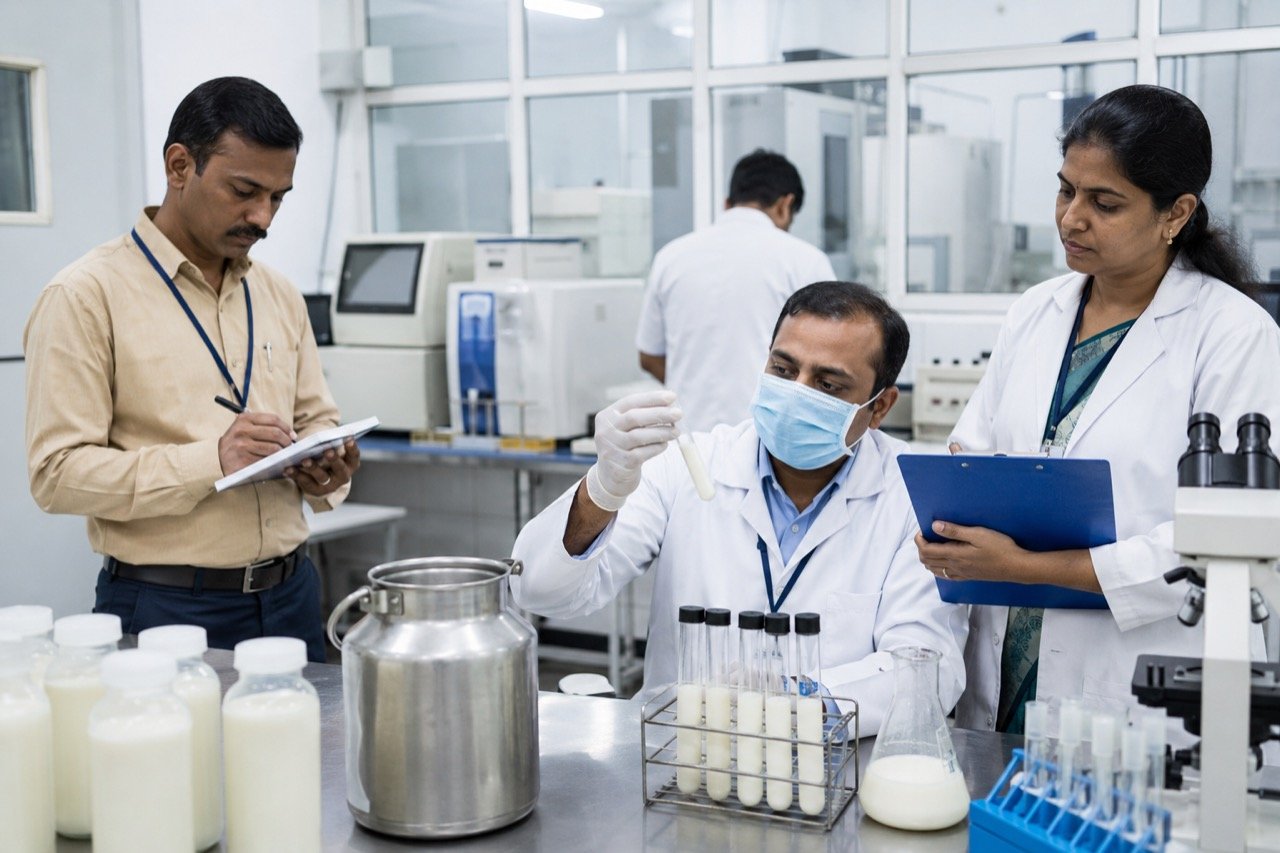
Milk quality has re-entered Maharashtra's civic conversation after a spell of enforcement action and official messaging around adulteration and testing. Civic coverage of the drive has served as a reminder that food safety is not a niche regulatory matter but a household concern cutting across income groups. That such a routine commodity can generate this much anxiety says something about how central milk is to the daily rhythm of Indian life, and about how little room there is for error when a product this ubiquitous goes wrong.
Why milk is the front line
Milk is among the most widely consumed daily products in Indian homes, which means any lapse — adulteration, contamination or mislabelling — can escalate into a public-health problem with unusual speed. Unlike a niche packaged good that a household might buy occasionally, milk is consumed daily, often by the most vulnerable members of a family: infants, young children, the elderly and the unwell. A contaminant or adulterant that might cause only mild concern in an infrequently consumed item becomes a chronic, cumulative exposure risk when it enters something poured into a glass or a cup of tea every single day. This is precisely why milk sits at the front line of food-safety enforcement rather than at its margins. Regulators and civic administrations understand, at least in principle, that the tolerance for failure here is far lower than for almost any other food category.
Effective enforcement depends on routine sampling, adequate laboratory capacity, transparent reporting of results and visible action against violators. Each of these elements does distinct work. Routine sampling establishes a baseline of vigilance that adulterators cannot simply wait out; adequate laboratory capacity ensures that samples are actually tested promptly rather than queued indefinitely; transparent reporting allows the public and independent observers to judge whether enforcement is real or cosmetic; and visible action against violators — fines, licence suspensions, prosecutions — is what ultimately changes the calculus for anyone tempted to cut corners. Remove any one of these four pillars and the entire structure weakens. A sampling regime without adequate labs becomes a paperwork exercise. Lab testing without transparent reporting becomes invisible to the public it is meant to protect. And enforcement without genuine consequences for violators becomes little more than theatre.
A supply chain, not a single checkpoint
Crucially, quality control cannot stop at the retail counter. The integrity of milk has to be protected across the entire supply chain: at collection centres, in transport, during processing, and in retail storage. A failure at any single link undermines the rest. This is a point worth dwelling on, because public attention during an enforcement drive tends to gravitate toward the most visible stage — the shop or vendor selling the final product — while the more consequential vulnerabilities often lie further upstream. Collection centres, where milk from numerous small and marginal dairy farmers is pooled, are a natural point where adulteration can occur at scale, sometimes without the knowledge of the farmers themselves. Transport conditions determine whether milk remains safe between collection and processing, particularly in a climate where refrigeration is not universally available or reliably maintained. Processing facilities introduce their own set of quality-control requirements, from pasteurisation standards to packaging hygiene. And retail storage — how long milk sits, at what temperature, and under what conditions before it reaches a household — is the final variable before consumption.
Treating enforcement as a supply-chain problem rather than a retail problem has practical implications for how inspection resources ought to be allocated. It suggests that periodic raids on shops and street vendors, however useful for visibility and deterrence, are an incomplete strategy if collection centres and transport networks are not subject to comparable scrutiny. A crackdown that photographs well at the retail level but leaves upstream vulnerabilities untouched risks solving the symptom while leaving the underlying condition in place.
The economics of trust
There is an economic dimension too. When adulteration scandals erode public trust, it is honest dairy farmers and small vendors who pay the price alongside consumers. This is an underappreciated cost of lax enforcement. Dairy farming in Maharashtra, as elsewhere in India, is dominated by smallholders operating on thin margins, many of whom have no involvement whatsoever in adulteration but whose livelihoods depend on a market where consumers trust the product on the shelf. When adulteration scandals surface — whether through enforcement drives, media investigations, or word of mouth — consumer suspicion tends to fall indiscriminately across the sector rather than narrowly on the specific culprits. Sales can dip, prices can be squeezed, and legitimate producers can find themselves defending a reputation they did nothing to damage.
Robust, well-publicised testing regimes protect households while shoring up the credibility of legitimate producers — a rare policy where consumer and producer interests align. This alignment is worth emphasising because it cuts against a common assumption in regulatory debates, where consumer protection and producer interests are often framed as being in tension, with tighter rules imposing costs on business. Food safety enforcement in the dairy sector is one of the comparatively rare cases where stronger, more consistent regulation is a net positive for nearly every legitimate stakeholder in the chain. Farmers who produce clean milk benefit from a market that rewards their diligence rather than one where they are undercut by adulterated, cheaper alternatives. Vendors who operate honestly benefit from a level playing field. And consumers, obviously, benefit from a safer product. The only losers are those actively engaged in adulteration — which is exactly the outcome sound regulation should produce.
What institutionalisation would actually look like
The gap between an enforcement drive and an enforcement system is largely a matter of institutionalisation. A drive is, by definition, temporary — a burst of activity triggered by a scandal, a media report, or a change in political attention, which recedes once the news cycle moves on. A system, by contrast, operates on a fixed schedule regardless of whether it is currently newsworthy. The distinction matters because adulterators, like any rational economic actors responding to enforcement risk, adjust their behaviour to the pattern of scrutiny they observe. If testing intensifies only in the wake of a scandal and then quietly tapers off, the rational response is to wait out the intensified period and resume as before once attention fades. Only a testing regime with genuine, unpredictable regularity — not tied to news cycles — removes that option.
This is also where laboratory capacity becomes a binding constraint rather than a technical footnote. Sampling is only as useful as the system's ability to process samples quickly and reliably. Concentrated laboratory capacity in major cities, while understandable given historical investment patterns, leaves smaller towns and rural collection points — often precisely where oversight is weakest — dependent on samples being transported long distances before they can be tested, introducing delay that blunts the deterrent effect of testing altogether.
The NE Times View
Periodic enforcement blitzes make headlines, but food safety is won through boring consistency, not seasonal crackdowns. Maharashtra should treat this moment as an opportunity to institutionalise what works: publish sampling data on a regular schedule, expand accredited lab capacity beyond the big cities, and make penalties swift enough to change commercial behaviour. None of these three prescriptions is glamorous, and none will generate the kind of headline that a dramatic raid does. But headlines are not the metric that matters here; sustained behavioural change among producers, transporters and vendors is. Publishing sampling data on a regular schedule creates a public record against which future performance can be measured and complacency can be called out. Expanding lab capacity beyond metropolitan centres closes the geographic gap that currently lets rural and peri-urban supply chains escape meaningful scrutiny. And penalties that are swift — rather than merely severe on paper but slow in practice — are what actually alter the risk calculation for anyone tempted to adulterate.
Residents, for their part, can amplify enforcement by buying from reliable suppliers and reporting suspect products through official channels. Civic vigilance of this kind is not a substitute for institutional enforcement, but it is a meaningful complement to it, particularly in a landscape as vast and varied as Maharashtra's dairy market, where official inspectors cannot possibly be everywhere at once. The lesson for the rest of India is straightforward — regulation and public awareness are strongest when they move together, and milk is the right place to prove it. Few other food categories offer as clear a test case: a product consumed universally, a supply chain that is well understood, and a set of enforcement tools that are neither exotic nor expensive to deploy. If Maharashtra can convert this enforcement moment into a durable system rather than a passing headline, it will have offered a template that other states, wrestling with similar dairy-adulteration concerns, would do well to study.
Key takeaways
- Milk's status as a near-universal daily staple means adulteration or contamination risks escalate into public-health concerns faster than with most other food products.
- Quality control must cover the entire supply chain — collection centres, transport, processing and retail storage — since a single weak link undermines the whole system.
- Robust, transparent testing protects both consumers and honest dairy farmers and vendors, who otherwise suffer reputational and economic damage from adulteration scandals they had no part in.
- Sustainable food safety depends on institutionalised, regularly scheduled sampling and expanded laboratory capacity beyond major cities, not one-off enforcement drives.
- Swift, consistent penalties and active civic participation — buying from reliable suppliers and reporting violations — together reinforce the deterrent effect of regulation.
You may also like to read
Expressway Pothole Row Puts Maharashtra Road Upkeep in Spotlight
Chief Minister Devendra Fadnavis' reported claim that the Pune-Mumbai Expressway has only two potholes has escalated a monsoon maintenance complaint into a statewide debate over highway accountability.

Maharashtra Weighs MCOCA Charges In TET Paper Leak Crackdown
Maharashtra may invoke the stringent organised crime law MCOCA against those accused in the TET exam paper leak, while a chief secretary-led panel examines whether state exams should move online.
Anakapalli Pharma-City Fire Puts Andhra Pradesh Industrial Safety Back Under the Lens
A deadly fire at a unit in Andhra Pradesh's Anakapalli pharma-city has reignited scrutiny of industrial safety, compliance and worker protection across one of the state's key manufacturing belts.

Pune Metro Line 3 Enters Safety Inspection, First Stretch Nears Launch
India's first public-private metro corridor is undergoing statutory safety checks in mid-June, clearing the way for a planned opening of its initial 12-station section to commuters.
More from this section
More
AICTE Industry Fellowship 2026: Rs 1.5 Lakh Scheme Closes July 5
The AICTE Industry Fellowship Programme 2026, which places technical-education faculty inside leading companies on a Rs 1.5 lakh monthly stipend, reached its application deadline on July 5.

Bay of Bengal Low Pressure System Revives Monsoon Over Western India
A low-pressure system over the Bay of Bengal has pushed the monsoon back into an active phase, bringing steady heavy rain to Kerala, coastal Karnataka and Maharashtra, and putting Mumbai and Pune on preparedness watch.
Bishnoi Gang Suspects Injured in Haryana Encounter as Police Tighten Net
A joint Haryana-Delhi Police operation in Bahadurgarh left two suspected Lawrence Bishnoi gang members injured, spotlighting the multi-state coordination now central to India's fight against organised crime networks.