ISRO Pushes Toward First Uncrewed Gaganyaan Flight With Humanoid Vyommitra Aboard
ISRO has confirmed that flight integration for its first uncrewed Gaganyaan mission is underway, with the humanoid robot Vyommitra set to ride an LVM3 rocket ahead of a crewed launch in 2027.
Commentary & Analysis ·
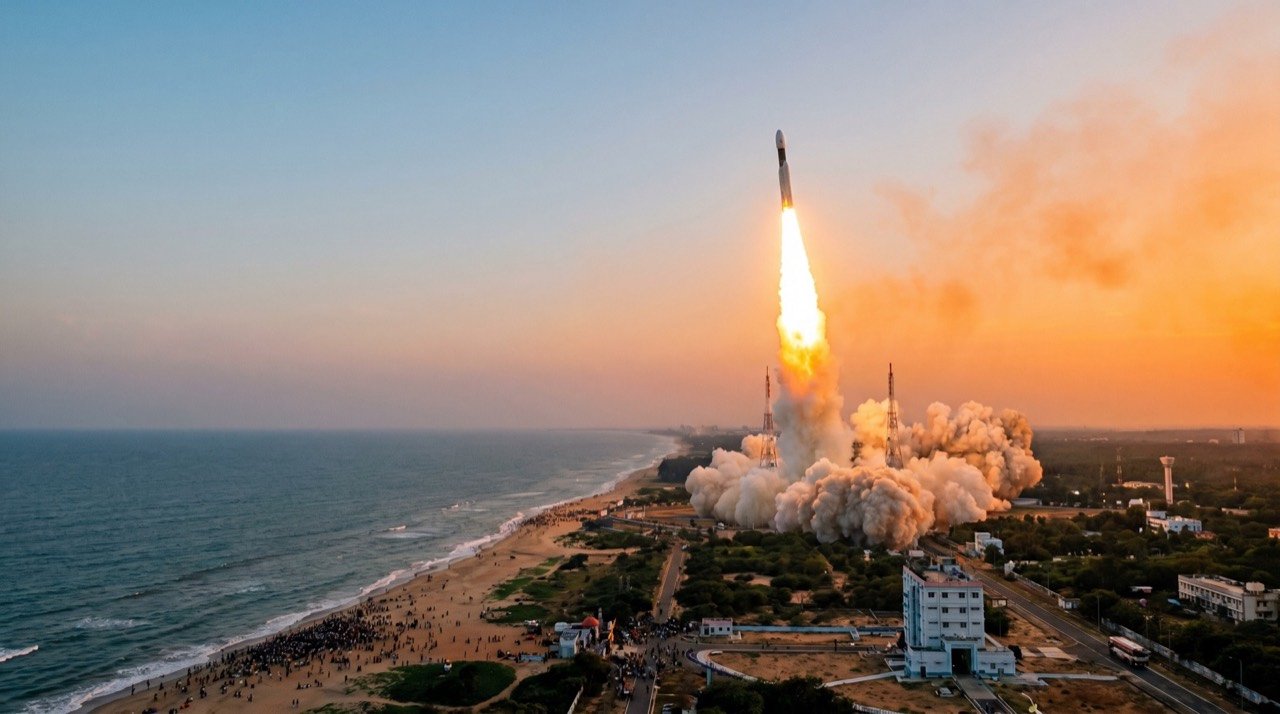
ISRO has moved into the decisive phase of its human spaceflight programme. The agency has confirmed that flight integration of the propulsion stages of its LVM3 rocket is complete, and the launch campaign for the first uncrewed Gaganyaan mission, designated G1, has begun. The flight will carry Vyommitra, a half-humanoid robot designed to simulate the conditions an astronaut would experience, and is now slated for the second half of 2026. For a programme that has been years in the making, this is the point where paper plans and ground tests give way to an actual rocket on a pad, and where the margin for error narrows considerably.
Why an uncrewed flight comes first
Before any Indian astronaut is allowed to fly, ISRO must demonstrate, in the most literal sense, that its systems can keep a crew alive and bring them home safely. The G1 mission exists to prove exactly that, and nothing more glamorous than that. It is built to validate the heavy-lift LVM3 launch vehicle under real flight loads, the aerodynamic behaviour of the crew module as it climbs through the atmosphere, the fiery re-entry sequence as the capsule falls back to Earth, and the recovery of the capsule after it splashes down. Each of these phases carries its own set of risks that cannot be fully replicated on a test stand or in a simulation, which is precisely why an actual flight, even an uncrewed one, is indispensable.
This is not a new philosophy in human spaceflight; it is the same logic that has governed every serious crewed space programme. The difference for India is that this is the first time the country is walking through these steps for a domestically developed, human-rated system. Vyommitra's role in this sequence is to serve as a stand-in occupant. It monitors module parameters, issues alerts and exercises life-support routines throughout the flight, effectively giving ISRO's engineers a live data stream on how the capsule would behave with an occupant aboard, without placing an actual human at risk. In that sense, Vyommitra is less a novelty and more a diagnostic instrument shaped like a crew member.
A deliberately staged road to a crewed mission
ISRO Chairman Dr V Narayanan has described the programme as progressing in deliberate stages, and the sequencing bears that out. G1 is to be followed by further uncrewed test flights before any astronaut boards a Gaganyaan capsule. The first crewed mission, which will take three Indian astronauts to low Earth orbit and bring them back, is now targeted for 2027. This phased approach reflects the agency's stated emphasis on safety over speed, even as public anticipation for a crewed launch continues to build. It would have been easy, in principle, to compress the schedule and chase a headline date, but the structure of the campaign suggests ISRO has resisted that temptation in favour of a more conservative, stage-by-stage validation process.
That conservatism is worth dwelling on, because it is also a form of institutional signalling. Every additional uncrewed flight before the crewed mission is, implicitly, an admission that human spaceflight tolerates no shortcuts. Agencies elsewhere have learned this at considerable cost, and ISRO's insistence on multiple validation flights before committing astronauts to the vehicle appears to be a conscious choice to avoid repeating those lessons the hard way.
What a successful G1 flight would mean for India
A successful G1 flight would place India among a small group of nations that have demonstrated indigenous human-rated spaceflight capability, a technical achievement that carries both strategic and symbolic weight. It also feeds into a considerably wider roadmap. The Gaganyaan programme is not an isolated feat of engineering; it is a foundation for the proposed Bharatiya Antariksh Station and for future lunar ambitions that ISRO has signalled interest in pursuing. Each of these depends, in some measure, on the confidence built during the Gaganyaan uncrewed and crewed test flights.
Beyond the strategic dimension, the programme also anchors space as a pillar of national technological prestige and increasingly as a growing commercial sector. A demonstrated human-rated launch and re-entry capability has implications well beyond the immediate mission profile, touching on satellite servicing, space tourism ambitions, and the broader ecosystem of private space companies that have begun to grow around ISRO's institutional base. In that light, G1 is not merely a rehearsal for astronauts; it is also a credibility marker for India's space sector as a whole, one that domestic industry and international partners alike will be watching.
The stakes of getting the sequence right
As an ISRO official has noted, in paraphrase, the uncrewed flights are where the programme proves its safety credentials, and nothing about crewed spaceflight is rushed. This framing is important because it tempers expectations around the 2026 and 2027 dates. Neither is presented as an immovable deadline; both are described as targets contingent on the outcomes of the flights that precede them. If G1 reveals problems with the propulsion stages, the aerodynamics of the crew module, the re-entry sequence, or the recovery operation, it is reasonable to expect the subsequent uncrewed flights, and ultimately the crewed mission, to shift accordingly.
This is also why each milestone in the Gaganyaan campaign is watched so closely, both for its engineering significance and for what it signals about India's place in the new space race. Nations and private companies around the world are pursuing human spaceflight capability on different timelines and with different risk appetites, and India's approach, careful, staged, and unhurried, gives outside observers a clear sense of how the country is choosing to compete: not by racing to a date, but by racing to reliability.
What to watch next
The coming months will show whether G1 lifts off on schedule and clears the way for astronauts in 2027. The immediate markers to track are straightforward: whether the launch campaign proceeds without further delay now that propulsion stage integration is complete, how Vyommitra's onboard systems perform during the actual flight compared with ground simulations, and whether the crew module survives re-entry and splashdown recovery as designed. Any of these could either reinforce confidence in the 2027 crewed timeline or introduce a need for additional uncrewed validation flights.
For a public accustomed to satellite launches and lunar missions, a human spaceflight programme moving through its uncrewed validation phase may seem to lack the drama of a crewed liftoff. But this is precisely the phase in which the programme's credibility is earned, quietly, through a rocket, a capsule and a humanoid stand-in doing exactly what they are meant to do.
The NE Times View
An uncrewed test flight with Vyommitra aboard is exactly the methodical caution that human spaceflight demands, and ISRO is right not to rush astronauts onto an unproven stack. The 2027 crewed timeline remains ambitious, but the agency has earned the benefit of the doubt through a programme that has consistently prioritised staged validation over headline-chasing deadlines. Success here would cement India among an elite handful of nations capable of putting humans into orbit independently, and would do so on the back of a process that took the time it needed rather than the time that looked good on a calendar. That, more than the launch date itself, is the achievement worth watching for.
Key takeaways
- The first uncrewed Gaganyaan flight, G1, is slated for the second half of 2026, with LVM3 propulsion stage integration now complete and the launch campaign underway.
- The humanoid robot Vyommitra will fly aboard G1 to simulate astronaut conditions, monitoring module parameters, issuing alerts and exercising life-support routines.
- The first crewed Gaganyaan mission, carrying three Indian astronauts to low Earth orbit and back, is targeted for 2027, following further uncrewed test flights after G1.
- A successful G1 flight would mark India as one of a small group of nations with demonstrated indigenous human-rated spaceflight capability, feeding into future plans such as the proposed Bharatiya Antariksh Station.
- ISRO Chairman Dr V Narayanan has framed the programme as a deliberately staged process, prioritising safety validation over speed at every step.
You may also like to read
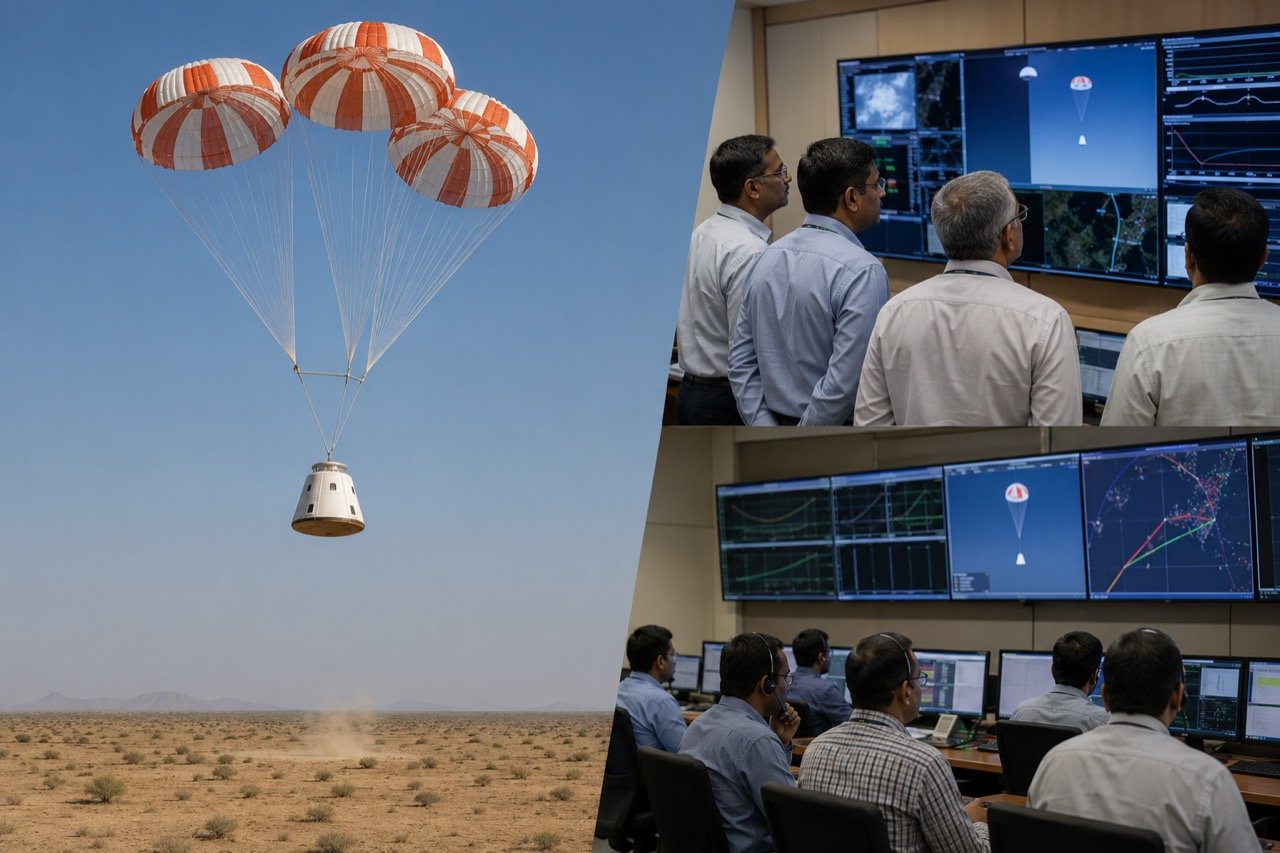
Gaganyaan Parachute Test Success Moves ISRO Closer to Crewed Flight
ISRO has completed successful integrated parachute tests for the Gaganyaan crew capsule, validating a critical part of the descent and recovery system as India's human spaceflight programme advances through key engineering milestones.
ISRO Lines Up Uncrewed Gaganyaan Test Flights Ahead of 2027 Crewed Mission
The space agency has detailed a packed schedule of uncrewed missions for 2026, including the debut Gaganyaan flight carrying the humanoid robot Vyommitra, as it prepares for India's first human spaceflight.
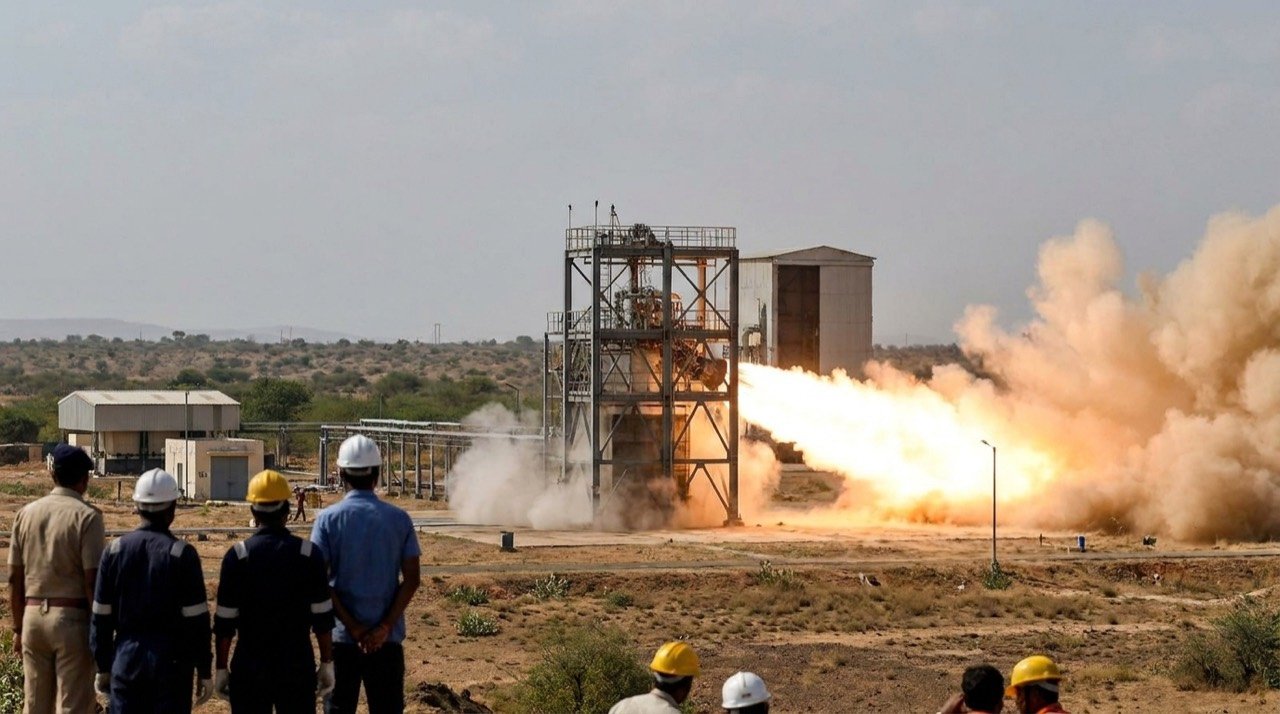
ISRO Fires Semi-Cryogenic Engine Power Head at 175 Tonnes in Landmark Hot Test
ISRO successfully ran its indigenous semi-cryogenic engine power head at 175 tonnes of thrust, clearing a key hurdle toward powering the LVM3 upgrade and the Next Generation Launch Vehicle.
ISRO Successfully Launches Next-Generation Navigation Satellite
The mission strengthens India's homegrown positioning system, with applications spanning aviation, disaster response and everyday navigation.
More from this section
More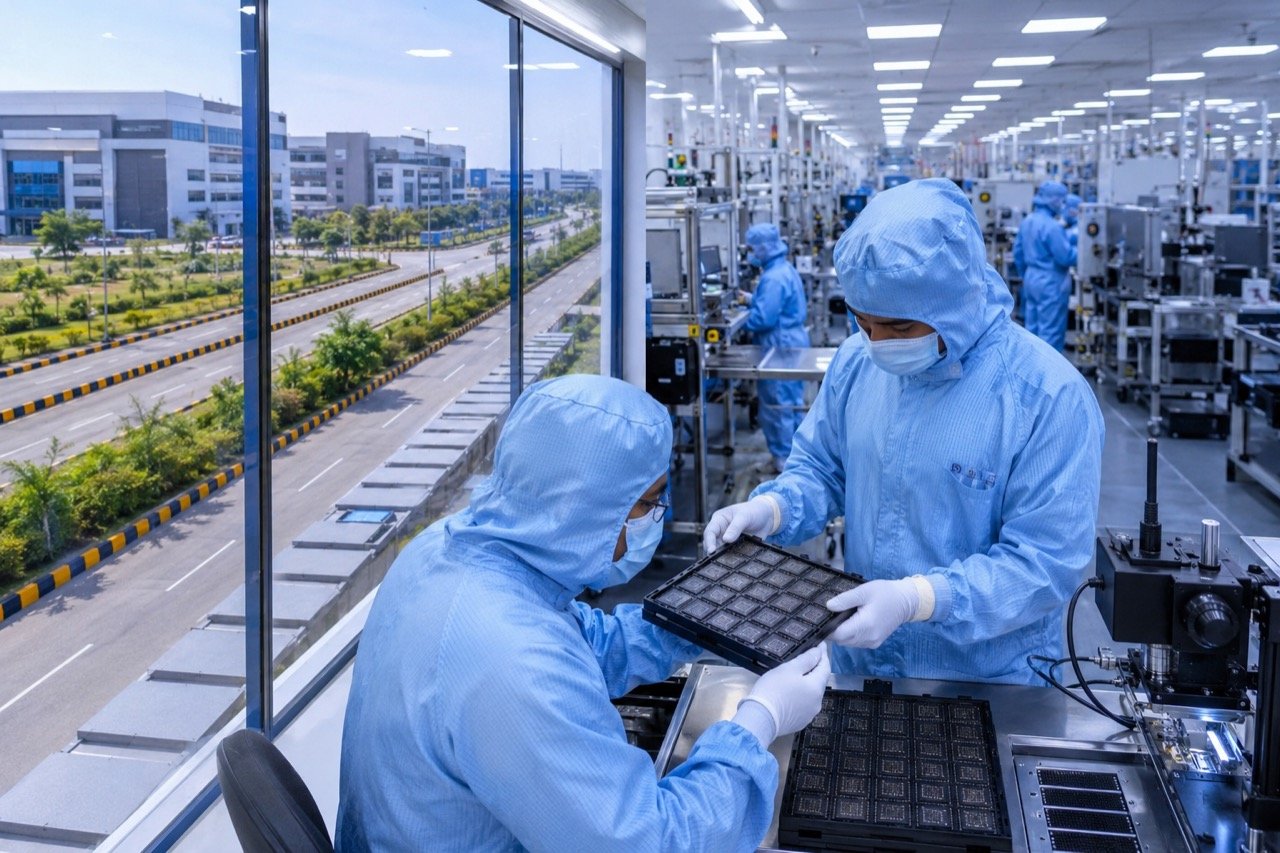
CG Semi Sanand Plant Opens, Boosting India's Semiconductor Drive
Prime Minister Narendra Modi inaugurated CG Semi's chip assembly and test facility in Sanand, Gujarat, giving India's semiconductor mission a working manufacturing milestone rather than another policy promise.
Chinese E-Rickshaw Apps Banned in India Over Remote Disable Risk
The Centre has ordered the removal of three Chinese apps — BAT-BMS, Lossigy and Epoch-i-ion — over fears they could remotely disable battery-run e-rickshaws, turning mobility software into a public safety concern.
Connected Car Rules: India Plans Vehicle Software Update Norms
With cars increasingly run by software, the government is reportedly preparing update and security norms aimed at preventing vehicle hijacking and governing how connected cars in India are patched and protected.