Indian Firms Eye Asian AI Models as US Frontier Access Narrows
With access to some US frontier AI models growing harder, Indian companies are widening their supplier options toward Asian and Chinese alternatives, turning AI procurement into a strategic business decision.
Commentary & Analysis ·
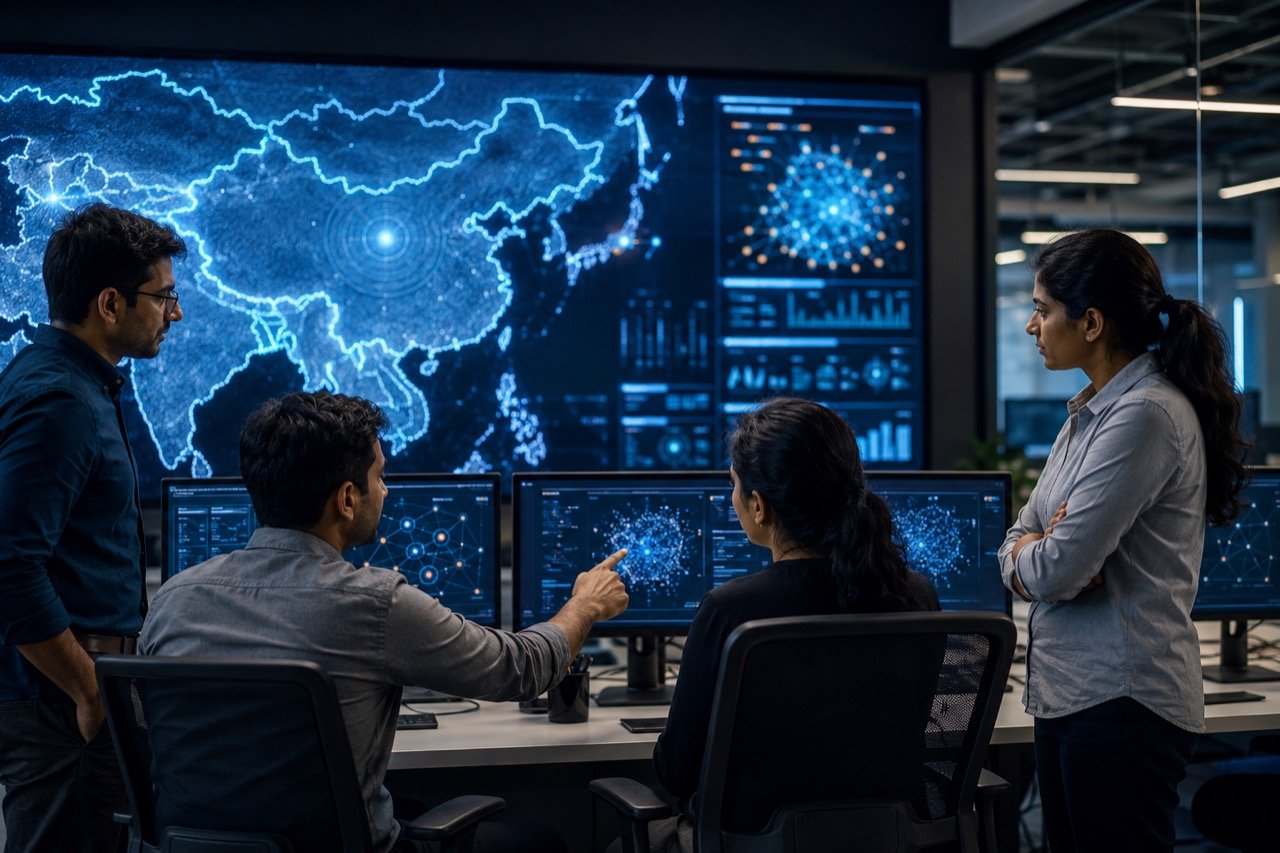
Indian companies are increasingly exploring Asian and Chinese AI alternatives as access to some US frontier models becomes harder, according to current technology coverage. The shift shows how geopolitics, export controls and enterprise demand are reshaping AI adoption decisions in India. What began as a narrow procurement question in a handful of technology departments is turning into a broader strategic conversation about where Indian enterprises should place their bets in a fast-moving and increasingly contested global AI market.
Continuity has become the priority
AI is no longer experimental for Indian firms. Models now power coding, customer support, analytics, productivity tools and internal automation. These are not peripheral pilot projects confined to innovation labs; they are systems embedded in daily operations, feeding customer-facing services and internal workflows that businesses now depend on to function. When access to preferred US systems becomes restricted, expensive or uncertain, businesses must secure continuity, and that opens the door to regional providers and open-source stacks.
This dynamic is a direct consequence of how quickly AI has moved from novelty to infrastructure. A company that has wired a large language model into its customer support pipeline, its coding workflow, or its internal analytics cannot simply pause operations if that model becomes unavailable or prohibitively expensive overnight. The imperative, therefore, is not necessarily to find the best possible model in the abstract, but to find one that is reliably available, reasonably priced and fit for purpose. That practical calculus is what is now nudging Indian enterprises to look east.
Not a simple supplier swap
This is not a simple supplier swap. Enterprise AI decisions turn on performance, cost, latency, data rules, security and vendor reliability. Chinese and other Asian models may win on price and availability, but companies must also weigh data governance and compliance risks before moving critical workloads.
Each of these variables carries its own weight. Performance benchmarks matter for technical teams, but latency can be just as decisive for customer-facing applications where delays translate directly into poor user experience. Cost matters enormously for firms operating at scale, where even marginal differences in per-query pricing compound quickly across millions of interactions. And security and data governance are not abstract concerns: enterprises handling sensitive customer information, financial data or proprietary business logic must be confident that whichever model they choose will not expose them to regulatory censure or reputational damage. A shift toward Asian alternatives, in other words, does not remove these considerations; it simply changes which vendor is being scrutinised against them.
The sovereign AI question sharpens
The trend feeds directly into India's sovereign AI debate. If dependence on foreign model providers creates strategic vulnerability, domestic model-building, public compute capacity and local AI platforms become more urgent. Yet businesses need tools that work today, not just future policy ambitions, a tension that will define India's AI procurement for years.
This tension is worth sitting with. Policymakers naturally think in terms of years and decades: building domestic compute capacity, nurturing home-grown model developers, and establishing regulatory frameworks are all long-horizon projects. Enterprises, by contrast, operate on quarterly and annual cycles, and cannot wait for sovereign capability to mature before making decisions about which AI systems will run their businesses next year. The result is a structural mismatch between the pace of policy and the pace of enterprise need, one that is likely to persist even as India invests more seriously in domestic AI infrastructure.
Why this matters beyond the technology sector
Although the immediate story concerns technology procurement, its implications extend well beyond IT departments. AI is increasingly a substrate for competitiveness across sectors, from financial services and manufacturing to logistics and retail. Decisions made now about which AI ecosystems Indian firms plug into will shape dependencies, cost structures and even data flows for years to come. This is precisely why the comparison to strategic commodities is apt: just as reliance on a single source for oil or semiconductors can leave an economy exposed to external shocks, reliance on a narrow set of foreign AI providers could leave Indian enterprises exposed to decisions made in Washington, Beijing or elsewhere, decisions over which they have no control.
There is also a competitive dimension worth noting. If Indian firms are forced into ad hoc, defensive diversification, while competitors in other markets enjoy more stable access to frontier systems, that could translate into a subtle but real disadvantage. Conversely, firms that manage this transition well, building flexible, multi-vendor AI architectures rather than singular dependencies, may find themselves better insulated against future disruptions, whatever their source.
The NE Times View
India is learning in real time that AI supply chains are as geopolitical as oil or semiconductors. Diversifying toward Asian models is rational hedging, but swapping one dependency for another, particularly where data governance norms differ sharply, is not sovereignty. The durable answer is a layered strategy: negotiate reliable access to frontier models where possible, build serious domestic compute and model capability, and lean on open-source stacks that no single government can switch off. Indian CIOs should treat this moment as a stress test, and New Delhi should treat it as a deadline.
The instinct to hedge is sound, but hedging only works if it is deliberate rather than reactive. A CIO who quietly migrates workloads to whichever provider currently offers the most convenient access, without weighing the compliance and governance implications, has not solved the underlying vulnerability; they have merely relocated it. Genuine resilience will come from architectural choices that keep options open: modular systems that are not welded to a single provider, contractual terms that anticipate disruption, and a realistic assessment of which workloads can tolerate open-source or regional alternatives and which cannot.
For policymakers, the stakes are just as high. Talk of sovereign AI capability means little if it is not backed by the unglamorous work of compute capacity, funding for domestic model development, and a regulatory environment that gives enterprises confidence to invest locally. Absent that, Indian businesses will keep making the most pragmatic choice available to them in the moment, and those choices, made firm by firm, will collectively determine India's AI dependencies long before any national strategy catches up.
Key takeaways
- Indian firms are exploring Asian and Chinese AI alternatives as access to some US frontier models grows harder, expensive or uncertain.
- The shift is driven by operational continuity needs, since AI is now embedded in coding, customer support, analytics and internal automation.
- Switching providers is not a simple swap: performance, cost, latency, data governance and security must all be weighed afresh.
- The trend intensifies India's sovereign AI debate, exposing a tension between long-term policy ambitions and immediate enterprise needs.
- The NE Times View calls for a layered strategy: reliable frontier access where possible, serious domestic compute and model capability, and reliance on open-source stacks resistant to any single government's control.
You may also like to read
IndiaAI Mission Backs Eight New Foundational Models and Expands AI Data Lab Network
The government's IndiaAI Mission has greenlit eight new indigenous foundational model projects and rolled out 30 fresh AI Data Labs, deepening the push for sovereign, India-built artificial intelligence.

OpenAI Makes GPT-5.5 the Heart of ChatGPT as Older Models Retire
OpenAI has rolled GPT-5.5 into ChatGPT as the new default and begun phasing out GPT-5.2, while pushing personalisation upgrades to free and lower-tier users in June.

Amazon Tests Alexa+ in India With Hindi Support and Local Features
Amazon is trialling its upgraded Alexa+ assistant in India with Hindi language support and India-specific features, betting on multilingual households to defend its lead in the AI assistant race.

Digital India Turns 11: AI GPUs, Chips and the Harder Next Phase
Eleven years in, Digital India is being judged less by its early public-service wins and more by whether it can deliver semiconductors, AI compute and resilient payments infrastructure at scale.
More from this section
More
CG Semi Sanand Plant Opens, Boosting India's Semiconductor Drive
Prime Minister Narendra Modi inaugurated CG Semi's chip assembly and test facility in Sanand, Gujarat, giving India's semiconductor mission a working manufacturing milestone rather than another policy promise.

Chinese E-Rickshaw Apps Banned in India Over Remote Disable Risk
The Centre has ordered the removal of three Chinese apps — BAT-BMS, Lossigy and Epoch-i-ion — over fears they could remotely disable battery-run e-rickshaws, turning mobility software into a public safety concern.

Connected Car Rules: India Plans Vehicle Software Update Norms
With cars increasingly run by software, the government is reportedly preparing update and security norms aimed at preventing vehicle hijacking and governing how connected cars in India are patched and protected.