Amazon Tests Alexa+ in India With Hindi Support and Local Features
Amazon is trialling its upgraded Alexa+ assistant in India with Hindi language support and India-specific features, betting on multilingual households to defend its lead in the AI assistant race.
Commentary & Analysis ·
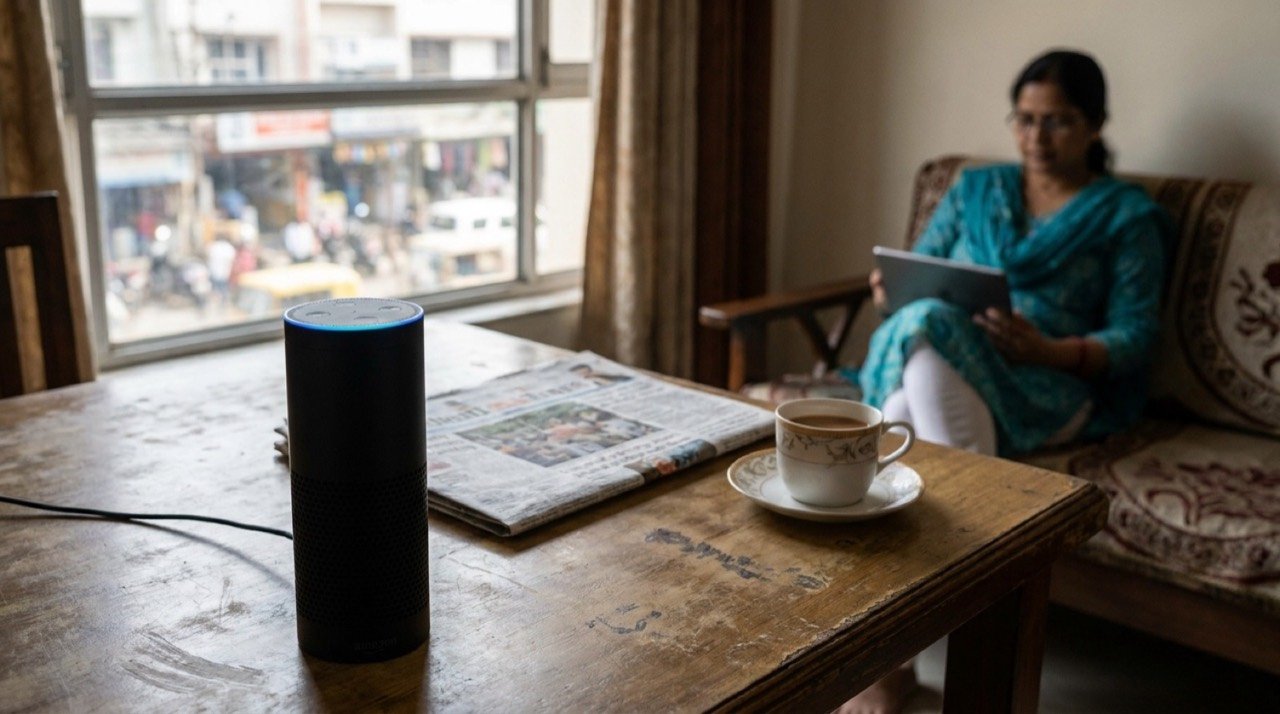
Amazon has begun testing Alexa+, its overhauled AI assistant, in India ahead of a wider rollout, with reports indicating that Hindi support and India-specific features sit at the heart of the update. The trial signals how seriously the company is treating one of its most important and linguistically complex consumer markets. That a global technology giant is running a market-specific test in India, rather than simply exporting a version tuned for English-speaking markets, says something about how central this country has become to the calculus of voice-driven computing.
What the upgrade promises
The new assistant is expected to deliver more conversational, context-aware responses, improved smart-home control and deeper integration with local services. The shift reflects a broader industry move away from rigid voice commands towards assistants that can handle multi-step, task-based help. Where the older generation of Alexa was built around fixed phrases and narrow intents, the newer model is meant to follow a train of thought, remember what was asked a moment earlier, and act on loosely worded requests rather than precise commands.
Crucially for India, the test puts Hindi support front and centre, alongside features tailored to local shopping, entertainment and everyday use. The ambition is an assistant that understands not just words but context, accent and the mixed-language speech common in Indian homes. This is a considerably harder engineering problem than simply translating an English-language model into Hindi. It requires the system to cope with regional pronunciation, informal phrasing, and the constant switching between languages that characterises ordinary conversation in most Indian households.
Why India is a strategic market
India matters because smart speakers, mobile voice search and multilingual households together create strong demand for assistants that can switch fluidly between languages. A family that blends Hindi and English in a single sentence is a demanding test case, and getting that right is both a technical challenge and a commercial opportunity. Any assistant that can navigate this kind of code-mixed speech convincingly stands to win a level of everyday trust that a merely functional, English-only system never could.
For Amazon, Alexa+ is also a defensive play. As rivals race to embed generative AI into assistants and devices, holding its place in Indian living rooms depends on proving that the new system is genuinely more useful than the old one. Amazon built an early lead in India's smart-speaker category, but that lead is not permanent. A market this large and this linguistically diverse rewards whichever company solves the language problem first, and punishes complacency quickly, since users who feel unheard by one assistant have little reason not to try another.
What will decide success
Accuracy in Indian languages will be the first hurdle, followed by privacy safeguards and real day-to-day usefulness across shopping, reminders, entertainment and home devices. An assistant that mishears regional accents or fumbles code-mixed speech will struggle to win trust. The bar for success in India is not simply parity with the English-language experience elsewhere; it is fluency across a set of factors that together determine whether people actually rely on Alexa+ rather than tolerate it.
Several factors stand out as decisive. Accuracy and fluency in Hindi and other Indian languages is the foundation, since nothing else matters if the assistant cannot understand what is being asked. Handling of accents and code-mixed, everyday speech follows closely, given how naturally Indian speakers move between languages mid-sentence. Privacy and data-handling safeguards for households are essential too, particularly as assistants are asked to manage more sensitive tasks such as payments and reminders tied to personal schedules. Usefulness across shopping, entertainment, reminders and smart-home control will determine whether the assistant earns a permanent place in daily routines rather than being treated as a novelty. And reliability of integration with local services will decide whether Alexa+ can actually complete the tasks it promises, rather than simply understanding the request.
Industry observers note that the assistant race is increasingly about depth rather than novelty. The companies that win will be those whose systems quietly handle complex, real-world tasks rather than simply answering trivia or setting timers. This marks a meaningful shift in how success is measured: it is no longer enough for an assistant to sound impressive in a demonstration, it must be dependable enough to be trusted with the small logistics of everyday life.
What happens if the trial succeeds, and if it does not
If the India trial succeeds, Alexa+ could become a template for how global AI assistants adapt to multilingual markets. A working Hindi-first, code-mixing-tolerant assistant would offer Amazon a proof of concept that could be adapted to other linguistically diverse markets facing similar challenges, well beyond India's borders. The coming months of testing will show whether Amazon can turn that promise into an everyday tool that Indian users actually rely on.
Equally, a stumble would be instructive in its own way. If the Hindi-language experience turns out to be a thin layer of translation sitting atop an essentially English-designed system, users are likely to notice quickly, and the goodwill generated by the announcement of local features could evaporate just as fast. In a market where switching costs for a smart-speaker owner are relatively low, and where competitors are watching closely, an unconvincing rollout could do more reputational damage than staying quiet and testing longer would have.
The NE Times View
Alexa+ with Hindi support is an overdue acknowledgement that India's voice-assistant market runs on its languages, not English. Multilingual capability is the right bet, but the harder contest is utility, local services, payments and content that make the assistant indispensable rather than a novelty. Amazon also faces sharpening competition as every player chases the same multilingual households. Whether genuinely fluent regional support arrives, or just a Hindi veneer, will decide if this defends its lead.
What will ultimately matter is not the announcement of the trial itself but the texture of the everyday interactions it produces. Indian users have grown accustomed to technology products that treat local languages as an afterthought, bolted on rather than designed in. An assistant that gets Hindi and code-mixed speech right from the outset, and that proves genuinely useful for shopping, reminders and home control, would represent a real step change. One that merely gestures at localisation while functioning best in English will simply confirm the scepticism that many users already carry into these trials.
Key takeaways
- Amazon is testing Alexa+ in India with Hindi support and India-specific features ahead of a broader rollout, treating the market as central to the product's future.
- The update aims for conversational, context-aware responses and better smart-home control, moving away from rigid voice commands toward multi-step, task-based assistance.
- Success will hinge on accuracy in Indian languages, handling of accents and code-mixed speech, privacy safeguards, everyday usefulness, and reliable integration with local services.
- Amazon faces defensive pressure from rivals embedding generative AI into assistants, making a convincing India launch commercially important, not just technically interesting.
- If successful, the India trial could become a template for adapting global AI assistants to other multilingual markets; if not, it risks exposing a superficial approach to localisation.
You may also like to read

Indian Firms Eye Asian AI Models as US Frontier Access Narrows
With access to some US frontier AI models growing harder, Indian companies are widening their supplier options toward Asian and Chinese alternatives, turning AI procurement into a strategic business decision.

Digital India Turns 11: AI GPUs, Chips and the Harder Next Phase
Eleven years in, Digital India is being judged less by its early public-service wins and more by whether it can deliver semiconductors, AI compute and resilient payments infrastructure at scale.

IndiaAI Mission Backs Eight New Foundational Models and Expands AI Data Lab Network
The government's IndiaAI Mission has greenlit eight new indigenous foundational model projects and rolled out 30 fresh AI Data Labs, deepening the push for sovereign, India-built artificial intelligence.

OpenAI Makes GPT-5.5 the Heart of ChatGPT as Older Models Retire
OpenAI has rolled GPT-5.5 into ChatGPT as the new default and begun phasing out GPT-5.2, while pushing personalisation upgrades to free and lower-tier users in June.
More from this section
More
CG Semi Sanand Plant Opens, Boosting India's Semiconductor Drive
Prime Minister Narendra Modi inaugurated CG Semi's chip assembly and test facility in Sanand, Gujarat, giving India's semiconductor mission a working manufacturing milestone rather than another policy promise.

Chinese E-Rickshaw Apps Banned in India Over Remote Disable Risk
The Centre has ordered the removal of three Chinese apps — BAT-BMS, Lossigy and Epoch-i-ion — over fears they could remotely disable battery-run e-rickshaws, turning mobility software into a public safety concern.

Connected Car Rules: India Plans Vehicle Software Update Norms
With cars increasingly run by software, the government is reportedly preparing update and security norms aimed at preventing vehicle hijacking and governing how connected cars in India are patched and protected.