India Rejects Pakistan Minister's Indus 'War' Warning as a Deflection
New Delhi has dismissed Pakistan Defence Minister Khawaja Asif's warning of war over water security, calling it an attempt to deflect from Islamabad's own record amid heightened tension over the suspended Indus Waters Treaty.
Commentary & Analysis ·
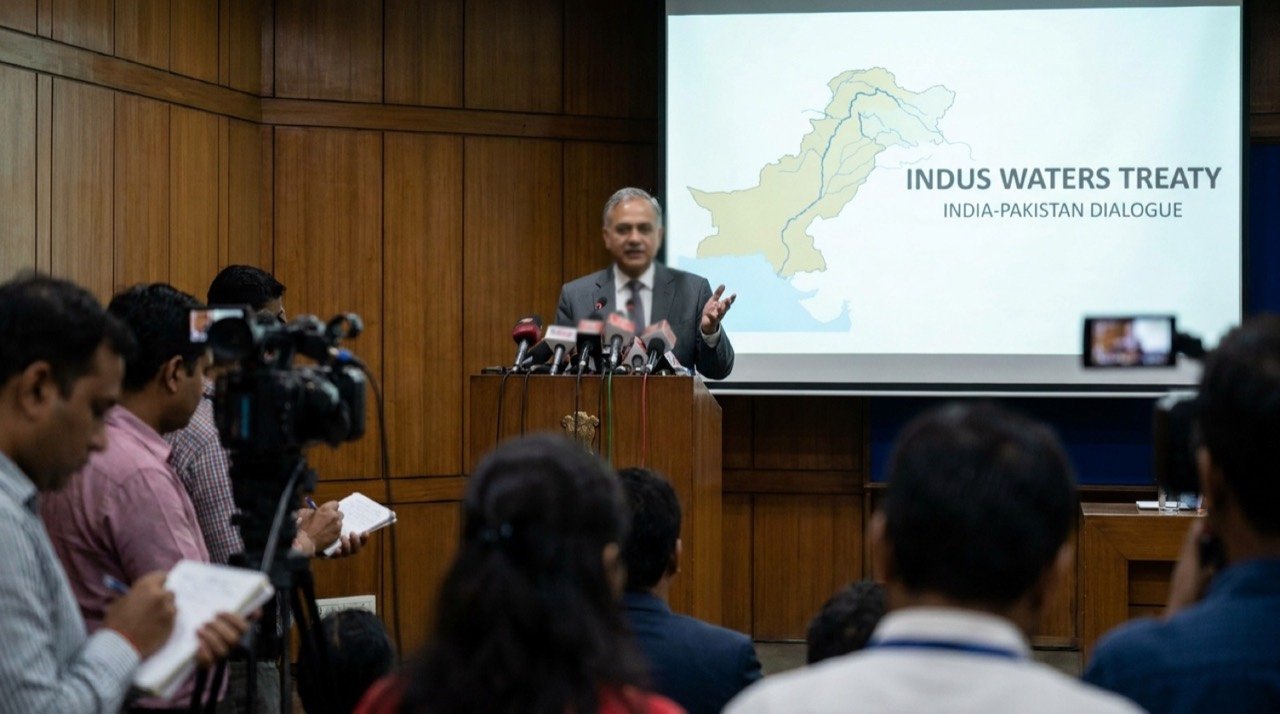
India has firmly rejected a warning by Pakistan's Defence Minister Khawaja Asif that Islamabad could go to war if its water security were threatened, with the Ministry of External Affairs characterising the remark as an attempt to deflect attention from Pakistan's own failings. The exchange marks the latest flashpoint in a relationship strained further by the suspension of the Indus Waters Treaty, and it illustrates how a decades-old technical arrangement over river flows has been pulled into the centre of an already fraught security relationship between the two neighbours.
New Delhi's response
Responding to Asif's comments, the External Affairs Ministry said the rhetoric was designed to distract from Pakistan's domestic and economic difficulties rather than to engage with the substance of the dispute. Indian officials kept the focus squarely on terrorism, rights and the conduct of administration in territory under Pakistan's control. The ministry pointed to protests in Pakistan-occupied Kashmir, arguing they reflect economic exploitation, denial of rights and administrative oppression rather than any external pressure. In doing so, New Delhi framed its statement as a deliberate refusal to be drawn into escalatory language, choosing instead to redirect the conversation towards governance failures it says lie closer to home for Islamabad. The Ministry of External Affairs put it plainly: "The statement is an attempt to deflect attention from Pakistan's own record on terrorism, rights and governance." That single line captures the strategy at work — rather than rebut the substance of a war threat, India questions the motive behind it, painting the warning as theatre rather than policy.
This approach is consistent with a pattern New Delhi has followed in recent years when confronted with inflammatory statements from Islamabad: decline to escalate in kind, but do not let the claim pass unanswered either. By pivoting immediately to Pakistan-occupied Kashmir, India signals that it regards the internal condition of Pakistan's administered territories as fair diplomatic ground whenever Islamabad raises the temperature on bilateral issues. It is as much a messaging exercise aimed at international observers as it is a rebuttal directed at Pakistan itself.
The treaty backdrop
The dispute is unfolding against the backdrop of the Indus Waters Treaty, the long-standing water-sharing arrangement that India suspended following the Pahalgam terror attack. That decision elevated water from a technical, bureaucratic file into a frontline issue in the broader security relationship between the two neighbours. For more than six decades, the treaty had been held up internationally as a rare example of India-Pakistan cooperation that survived wars and periods of acute hostility. Its suspension therefore represents a significant rupture, not merely in the management of shared rivers but in the broader architecture of restraint that had governed the relationship even during crises.
By tying its response to terrorism and governance, India signalled that questions of water cannot be separated from cross-border security concerns it has repeatedly raised with Islamabad. This linkage is deliberate: it tells Pakistan, and the wider world, that any return to normalcy on the treaty is contingent on progress on the security file, not a standalone negotiation that can be resolved in isolation. For Pakistan, a country heavily dependent on the Indus system for agriculture and drinking water, the suspension is not an abstract diplomatic gesture but a matter of acute practical concern, which helps explain why a defence minister would reach for war rhetoric rather than technical objections.
Why it matters
Water diplomacy carries unusual weight in South Asia, where rivers cross contested boundaries and feed agriculture for hundreds of millions of people. Each statement from either capital is parsed closely for signals about whether tensions will harden or ease, precisely because the stakes extend well beyond the immediate war of words. A treaty in abeyance means uncertainty for farmers, planners and provincial governments on both sides of the border who rely on predictable flows for irrigation and power generation. When a senior minister invokes the language of war over water, it raises the temperature of an already sensitive file and forces both governments to calibrate their public postures with unusual care.
The Indus Waters Treaty remains suspended after the Pahalgam attack, and India continues to link water issues to terrorism and cross-border security, a linkage that shows no sign of loosening. New Delhi has also cited rights and governance concerns in Pakistan-occupied Kashmir as part of its response, effectively broadening the frame of the dispute rather than narrowing it to river flows alone. Officials have framed Asif's warning as deflection rather than policy, suggesting India does not expect an actual military escalation over water but is nonetheless unwilling to let the comment go unchallenged. Taken together, these threads confirm that water has become a recurring pressure point in bilateral relations, one that surfaces whenever other aspects of the relationship deteriorate.
Stakeholder perspectives and what to watch next
For Pakistan, the war rhetoric may serve a domestic political purpose as much as a diplomatic one, allowing the government to project resolve to a domestic audience at a time when the country faces economic strain. For India, the calculated, low-key rebuttal serves to deny Islamabad the escalatory exchange it may be seeking, while still asserting that any resumption of treaty cooperation depends on Pakistan's conduct on terrorism. Regional observers and downstream stakeholders in both countries will be watching for any indication of a shift in New Delhi's position on the treaty's suspension, since that decision has implications reaching well beyond the current exchange of statements. Equally significant will be whether Pakistan's rhetoric intensifies further or whether, as India's characterisation suggests, it proves to be a passing flourish tied to short-term domestic pressures rather than a genuine shift in policy.
With the treaty in abeyance and rhetoric sharpening, both governments appear set for a prolonged standoff in which water, security and politics remain tightly entangled. New Delhi's measured but firm posture suggests it intends to keep the diplomatic initiative while declining to match Islamabad's escalatory tone, a strategy that allows India to appear both restrained and unyielding at the same time.
The NE Times View
Islamabad's war talk over water is theatre aimed at distracting from its own deepening crises, and New Delhi was right to refuse the bait. Still, the suspended Indus Waters Treaty is genuinely consequential, and bombast on either side obscures the real questions about flows, storage and downstream lives that ordinary people on both sides of the border depend on. Rhetoric of this kind may play well domestically for Pakistan's government, but it does little to address the practical uncertainty created by a treaty that has underpinned water-sharing arrangements for generations. The NE Times counsels firm rhetoric paired with quiet, technical clarity over what India actually intends for the treaty's future, since ambiguity on this point only invites further escalatory statements from Islamabad. A durable de-escalation will require more than an exchange of pointed statements; it will require both sides to eventually separate the security dispute from the technical management of a shared resource, however difficult that separation may currently seem.
Key takeaways
- India's Ministry of External Affairs rejected Pakistani Defence Minister Khawaja Asif's warning of war over water security, calling it a deflection from Pakistan's domestic and economic troubles.
- New Delhi tied its response to terrorism, rights and governance concerns, citing protests in Pakistan-occupied Kashmir rather than engaging directly with the war rhetoric.
- The Indus Waters Treaty remains suspended following the Pahalgam terror attack, linking water diplomacy directly to India's broader security concerns with Pakistan.
- Both governments appear headed for a prolonged standoff in which water, security and political messaging remain closely intertwined.
- The NE Times view is that firm rhetoric should be paired with clear, technical signalling on India's actual intentions for the treaty, to avoid further escalatory posturing.
You may also like to read
Indus Waters Treaty to Stay in Abeyance, India Reiterates
The Ministry of External Affairs has restated that the Indus Waters Treaty will remain in abeyance until Pakistan credibly and irrevocably abjures support for cross-border terrorism, keeping a landmark water pact suspended.

Odisha Minister's Nephew Arrested in Ganjam Student Death Case
Police in Ganjam have arrested the nephew of a serving Odisha minister over the alleged abetment of a young woman student's suicide, igniting a political storm and forensic probe.
Delhi's New Tree-Cutting SOP Adds Video Evidence and Arrest Warning
Delhi is preparing a tougher standard operating procedure for illegal tree felling, with video recording of enforcement and arrest warnings, as the capital battles heat, pollution and shrinking green cover.

Supreme Court Fines Samay Raina, Ranveer Allahbadia and Ashish Chanchlani for Non-Compliance
India's Supreme Court imposed Rs 3 lakh costs on Samay Raina, Ranveer Allahbadia and Ashish Chanchlani after finding non-compliance with directions in a disability-related case.
More from this section
More
AICTE Industry Fellowship 2026: Rs 1.5 Lakh Scheme Closes July 5
The AICTE Industry Fellowship Programme 2026, which places technical-education faculty inside leading companies on a Rs 1.5 lakh monthly stipend, reached its application deadline on July 5.
Bay of Bengal Low Pressure System Revives Monsoon Over Western India
A low-pressure system over the Bay of Bengal has pushed the monsoon back into an active phase, bringing steady heavy rain to Kerala, coastal Karnataka and Maharashtra, and putting Mumbai and Pune on preparedness watch.
Bishnoi Gang Suspects Injured in Haryana Encounter as Police Tighten Net
A joint Haryana-Delhi Police operation in Bahadurgarh left two suspected Lawrence Bishnoi gang members injured, spotlighting the multi-state coordination now central to India's fight against organised crime networks.