Assam Estate Sells India's First Home-Grown Matcha Batch
An Assam tea estate has sold the first batch of India-made matcha, a small-volume but symbolically significant step as the country's tea industry hunts for premium products and new consumers.
Commentary & Analysis ·
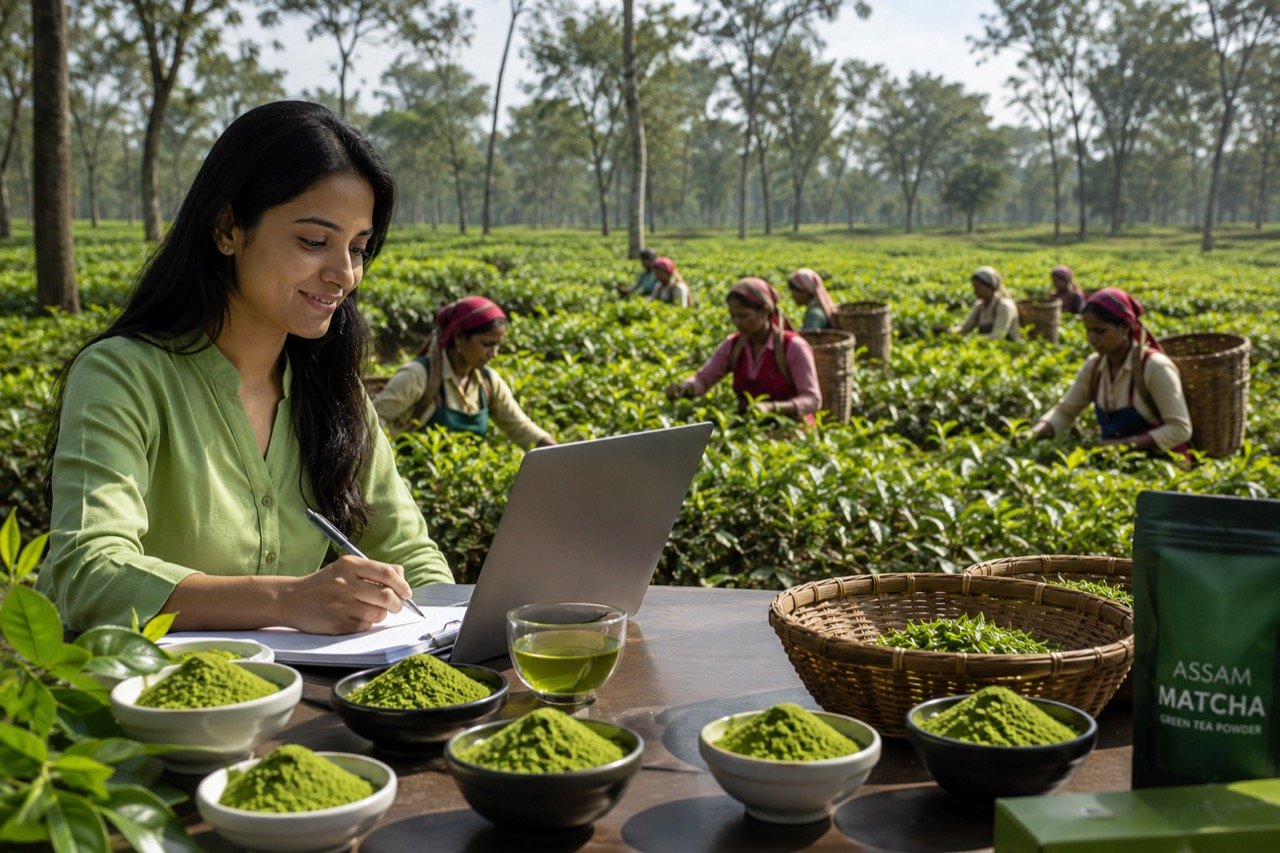
India's tea story has acquired an unexpected new chapter: an Assam estate has sold the country's first commercially produced batch of matcha, the finely powdered green tea long associated with Japan and the global wellness boom. The volumes involved are tiny beside Assam's traditional black tea output, but the symbolism is not. It marks a deliberate move by an Indian estate into a premium category that until now was entirely imported, and it invites a broader conversation about where India's most storied agricultural export goes from here.
A commodity sector looking for an exit
For decades, Assam's identity has been built almost entirely around bulk, orthodox and CTC black tea, sold in volumes that made India one of the world's largest producers but left growers exposed to the brutal economics of a commodity market. Prices for undifferentiated tea have stagnated even as the cost of production, labour and fuel has climbed. That squeeze has been compounded by climate pressures on the Assam valley, where erratic rainfall and rising temperatures have made yields less predictable from season to season. Against this backdrop, a single estate choosing to retool part of its operation for matcha is not simply a novelty product launch. It is a response to a structural problem that has been building in Indian tea for years: too much dependence on a category where India competes mainly on price rather than distinctiveness.
Why matcha, specifically
Matcha is an unusual choice precisely because it demands a different discipline from conventional tea-making. Indian tea producers are squeezed between changing consumer demand, climate pressures and stiff competition in commodity-grade tea, and matcha offers a way out of that trap because it commands premium prices and speaks to younger, urban and global consumers. Unlike bulk exports or standard blends, matcha is bought on the strength of provenance, ritual and lifestyle association, categories where price per kilogram is almost incidental to the buyer. For an Assam estate, entering that category is a bet that a legacy production base, with its existing land, labour and agronomic knowledge, can be redirected toward a niche that rewards quality and story over sheer tonnage. It is, in effect, an attempt to move up the value chain rather than simply producing more of the same tea more efficiently.
The gap between one batch and a industry
The challenge, however, is execution, and it should not be understated. Matcha-grade production demands shade-growing discipline, specialised processing and, above all, consistency, none of which can be improvised on top of infrastructure built for black tea. Shade-growing in particular alters the chemistry of the leaf in ways that require sustained agronomic control, not a one-season adjustment. Processing matcha into the fine, vividly green powder that consumers expect involves steps unfamiliar to most Indian factories geared toward withering, rolling and oxidising leaf for CTC or orthodox tea. One good batch does not establish a supply chain. It proves that the estate can produce a saleable product once, under conditions it may have controlled closely, but it says little yet about whether that quality can be repeated across seasons, scaled beyond a pilot volume, or defended against the inevitable variability of weather and labour.
A market that still has to be built
Beyond the production question sits an equally important demand-side one. Indian producers will also need to educate a domestic market that mostly knows matcha through cafe menus, where it appears as a flavouring in lattes and desserts rather than as a tea in its own right, valued for grade, origin and ceremony. That is a very different consumer relationship from the one Japanese matcha has cultivated over generations, where grading, ceremonial use and price tiers are well understood by a domestic buying public before any export ambition enters the picture. An Indian matcha brand will have to do the work of building that vocabulary among consumers largely from scratch, while simultaneously trying to convince a global audience already loyal to Japanese and, increasingly, Chinese matcha that an Assam-grown alternative deserves shelf space. That is two difficult marketing tasks bundled into one, and neither can be solved by a single successful harvest.
The signals worth watching
The milestone will only matter if buyers return, if more estates experiment with matcha-grade processing, and if Indian brands can position the product credibly against established Japanese and Chinese suppliers. Repeat orders, rather than a debut sale, are the real test of whether this is a viable business line or a one-off curiosity. Equally telling will be whether other Assam or Darjeeling estates follow with their own matcha experiments, since a single producer cannot build a category or a reputation for a national industry on its own. And ultimately, the credibility of Indian matcha will be judged not against domestic novelty but against the exacting standards of a global matcha market already served by well-established Japanese producers and a growing Chinese presence. Those are the signals to watch over the coming seasons, and they will take more than one harvest cycle to read clearly.
The NE Times View
This is exactly the kind of experiment India's tea sector needs more of, provided nobody mistakes a first batch for an industry transformation. Assam's real asset here is not the powder but the proof of concept: that a legacy estate can retool for a high-value niche instead of competing on volume in a declining commodity market. That is a meaningful shift in ambition, even if the commercial scale so far is negligible. The risk is the familiar Indian pattern of premium products chasing export validation while neglecting quality consistency, launching with fanfare, securing a flattering headline, and then failing to invest in the years of agronomic and processing discipline that premium categories actually require. Matcha, more than most tea products, punishes that shortcut, because its entire value proposition rests on a narrow, exacting quality band that Japanese producers have spent decades perfecting. If this estate treats matcha as a decade-long craft investment rather than a marketing novelty, it could open a genuinely new revenue lane for a sector that badly needs one. If it treats this batch as the finish line rather than the starting point, it will join a long list of Indian premium-tea ventures that generated attention without generating a sustainable market.
Key takeaways
- An Assam estate has sold India's first commercially produced batch of matcha, a category previously entirely imported into the country.
- The move reflects broader pressure on Indian tea producers, who face stagnant commodity prices, climate stress and a need for higher-margin products.
- Matcha's demands, shade-growing discipline, specialised processing and consistency, mean a single successful batch does not yet prove a repeatable supply chain.
- Success will depend on repeat buyer interest, other estates following suit, and India's ability to compete credibly against established Japanese and Chinese matcha suppliers.
- The lasting significance of this milestone rests on whether the estate commits to matcha as a long-term craft investment rather than a short-lived marketing moment.
You may also like to read

Mundra Airport Launches First Scheduled Flights, Linking Kutch to Mumbai and Goa
Adani's Mundra Airport began scheduled commercial operations on June 23, with Star Air connecting the Gujarat port town to Mumbai and Goa in a milestone for regional air connectivity in Kutch.
India and US Resume High-Level Trade Talks in Delhi to Finalise First Phase of Pact
Commerce Minister Piyush Goyal says his US counterpart is in Delhi for ministerial talks, with reports naming USTR Jamieson Greer for two days of negotiations on tariffs and market access.
RBI Sells Nearly $9 Billion in April as Rupee Faces Sustained Pressure
The central bank's net dollar sales in the spot forex market signal another month of intervention to smooth volatility, with importer demand and West Asia uncertainty weighing on the rupee.

India Wins FATF Vice Presidency for the First Time, Lifting Its Global Financial Standing
India's first-ever election to the vice presidency of the Financial Action Task Force hands New Delhi a stronger voice in shaping global rules on money laundering, terror financing and virtual-asset risk.
More from this section
More
Adani Case: US DOJ Pushes for Permanent Dismissal of Charges
The US Department of Justice has urged a judge to permanently dismiss charges against Gautam Adani, calling the case legally flawed — a reversal with consequences for markets, diplomacy and cross-border enforcement.

Akasa Air Inducts 40th Aircraft in Indian Aviation Scale-Up
Akasa Air's 40th aircraft, ferried to Bengaluru via Seattle, Reykjavik and Cairo, marks a fleet milestone for the young carrier and a fresh signal that India's aviation market remains firmly in expansion mode.

BARC Ratings Suspension Leaves Indian TV Industry Flying Blind
BARC's pause on television ratings has put India's broadcast measurement system under fresh scrutiny, leaving broadcasters, advertisers and media planners without the weekly audience data that anchors the TV economy.