IIT Madras, IIT Kanpur Launch Cybersecurity Degree With Field Training
IIT Madras and IIT Kanpur have jointly launched a practice-oriented Bachelor of Cybersecurity featuring two years of field deployment, a direct response to India's widening shortage of trained cyber defence professionals.
Commentary & Analysis ·
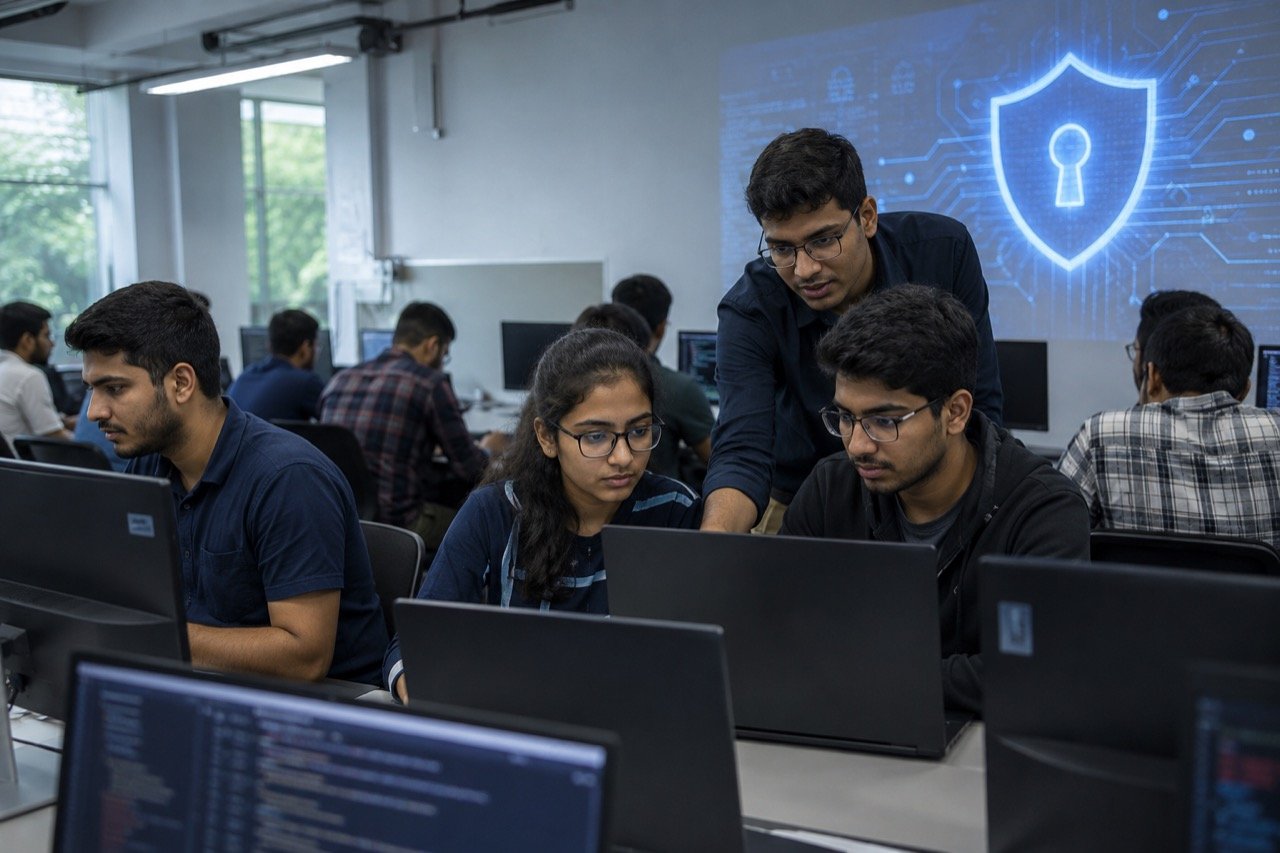
IIT Madras and IIT Kanpur have launched a joint Bachelor of Cybersecurity, a practice-oriented four-year degree that sends students into real-world field deployment for half the programme. Reports indicate the course begins in July 2026, positioning it as one of the most hands-on cybersecurity qualifications offered by Indian institutions. The structure is the headline feature: two of the four years are devoted to field deployment, placing students inside live environments rather than confining them to lecture halls and simulated exercises. Laboratory training and deployment exposure are woven through the curriculum from the outset.
On the surface, this reads as one more entrant in India's crowded technical-education landscape. But the design choices behind it mark a deliberate break from how the country has traditionally trained specialists in emerging technical fields. Rather than adding a security specialisation atop a general computer science degree, the two institutes have built an entirely new degree architecture around the assumption that cybersecurity cannot be taught primarily through lectures and problem sets. That assumption, and the curriculum built to match it, is what makes this launch worth examining closely.
Treating cyber defence as a craft, not a subject
The degree stands out because it treats cybersecurity as an applied discipline. Effective cyber defence depends on speed, judgment and familiarity with live systems under attack — capabilities that classroom instruction alone rarely builds. By the time graduates enter the workforce, they will have spent two years operating in the environments they are being hired to protect.
This distinction matters more in cybersecurity than in almost any other technical field. A software engineer who has only ever worked on toy projects can still, with reasonable onboarding, become productive on real production systems within months. A cyber defender who has only studied attack patterns in a controlled lab, however, faces a much steeper transition: live adversaries do not behave like textbook case studies, systems under real load fail in unpredictable ways, and the pressure of an active incident is not something a simulated exercise can fully replicate. The four-year structure appears designed explicitly to close that gap by making the live environment itself the primary teacher for half the degree.
A standard degree versus a practitioner's pipeline
For students weighing the programme against conventional computer science routes, the differentiator is precisely this practice orientation. A standard CS degree with a security elective produces theorists who must be trained on the job; this model aims to produce practitioners on day one. That has implications not just for the students themselves but for the employers who will eventually hire them.
Under the conventional model, a company hiring a fresh CS graduate into a security role typically absorbs a lengthy induction period — months of shadowing, supervised access to sensitive systems, and gradual exposure to real incidents before the new hire can operate independently. A graduate who has already spent two years embedded in field deployment arrives with much of that induction already completed. For banks, government agencies and infrastructure operators who cannot afford long ramp-up periods given the pace of current threats, this is a meaningfully different value proposition than a conventional degree offers.
A workforce answer to a national risk
The broader significance is workforce readiness. India's government systems, banking and finance networks, transport infrastructure and digital public infrastructure all face escalating cyber risk, while the supply of trained defenders has lagged badly behind demand. Two of the country's premier technical institutions building a dedicated pipeline signals that the skills gap is now being treated as a strategic problem, not just an industry complaint.
This shift in framing is itself notable. For years, discussion of India's cybersecurity shortfall has largely lived in industry reports and conference panels, with employers describing hiring difficulties and security vendors highlighting the scale of unfilled roles. When the institutions responsible for producing the country's technical elite redesign a degree from first principles around this problem, it suggests the shortfall has moved from an industry-side irritant to a matter treated with the seriousness of a national capability gap, alongside areas like semiconductor design or defence manufacturing where India has pursued similar institution-led pushes.
The residency logic, borrowed from medicine
The two-year deployment component is the real innovation, and it borrows from medicine's residency logic and applies it to a field where experience under live fire is everything. Medical education has long accepted that no amount of classroom instruction substitutes for supervised practice on real patients; residencies exist precisely because the stakes of getting it wrong are too high to leave learning entirely to theory. Cybersecurity, where a single unaddressed vulnerability can compromise critical infrastructure or financial systems, arguably carries similar stakes, even if the consequences are less immediately visible than a medical error.
Applying that logic to a technical undergraduate degree is unusual in the Indian context, where engineering education has traditionally emphasised theoretical rigour and left applied exposure to internships that are often brief, poorly supervised, or disconnected from the core curriculum. If the field deployment component genuinely mirrors the residency model — supervised, structured and central to the degree rather than an add-on — it represents a template that other technical disciplines facing similar readiness gaps could plausibly adapt.
The NE Times View
This is the kind of programme India's education system should have built five years ago, and it is welcome now. The two-year deployment component is the real innovation — it borrows from medicine's residency logic and applies it to a field where experience under live fire is everything. The risks are practical: field placements must be substantive rather than glorified internships, and the intake will be tiny against a national shortfall running into the hundreds of thousands.
The test of success is whether other institutes copy the template quickly. If IIT Madras and IIT Kanpur have created a replicable model rather than a boutique credential, this launch will matter far beyond its first cohort. Much will depend on execution details that are not yet public: how field placements are selected and supervised, whether the organisations hosting deployments are equipped to mentor undergraduates rather than merely use them as low-cost labour, and whether the credential is recognised widely enough across government and industry to justify the two years of applied training over a conventional degree. None of these questions can be answered from the launch announcement alone, and they will determine whether the model succeeds or simply produces a small, well-regarded cohort with limited system-wide effect.
Key takeaways
- IIT Madras and IIT Kanpur have launched a joint Bachelor of Cybersecurity beginning July 2026, with two of the four years devoted to field deployment in live environments rather than classroom or simulated exercises.
- The degree is designed to produce practitioners who are workforce-ready on graduation, in contrast to conventional computer science degrees that require substantial on-the-job training for security roles.
- The programme responds to a broader national concern: growing cyber risk to India's government, banking, transport and digital infrastructure systems, alongside a persistent shortage of trained defenders.
- The field deployment model draws on medicine's residency approach, treating supervised real-world experience as central to the degree rather than supplementary to it.
- The programme's long-term significance depends on whether the field placements are substantive and whether other institutions replicate the model, given that the initial intake will be small relative to India's overall skills shortfall.
You may also like to read
Connected Car Rules: India Plans Vehicle Software Update Norms
With cars increasingly run by software, the government is reportedly preparing update and security norms aimed at preventing vehicle hijacking and governing how connected cars in India are patched and protected.
Chinese E-Rickshaw Apps Banned in India Over Remote Disable Risk
The Centre has ordered the removal of three Chinese apps — BAT-BMS, Lossigy and Epoch-i-ion — over fears they could remotely disable battery-run e-rickshaws, turning mobility software into a public safety concern.

I4C Warns Indian Companies of Rising 'Boss Scam' CEO-Impersonation Cyber Fraud
India's cybercrime coordination agency has flagged an emerging 'Boss Scam' in which fraudsters impersonate regulators and executives to push urgent, fraudulent money transfers at companies.
Bajaj Auto Says Ransomware Attack Hit Company Systems
Bajaj Auto has disclosed that a ransomware attack affected systems at the company and its subsidiary Bajaj Auto Technology, intensifying concern over cyber risk across India's increasingly digital manufacturing sector.
More from this section
More
CG Semi Sanand Plant Opens, Boosting India's Semiconductor Drive
Prime Minister Narendra Modi inaugurated CG Semi's chip assembly and test facility in Sanand, Gujarat, giving India's semiconductor mission a working manufacturing milestone rather than another policy promise.
Chinese E-Rickshaw Apps Banned in India Over Remote Disable Risk
The Centre has ordered the removal of three Chinese apps — BAT-BMS, Lossigy and Epoch-i-ion — over fears they could remotely disable battery-run e-rickshaws, turning mobility software into a public safety concern.
Connected Car Rules: India Plans Vehicle Software Update Norms
With cars increasingly run by software, the government is reportedly preparing update and security norms aimed at preventing vehicle hijacking and governing how connected cars in India are patched and protected.