Gurugram Bike With 63 Pending Challans Impounded by Police
Gurugram traffic police impounded a motorcycle carrying 63 unpaid challans running into lakhs of rupees, turning one rider's record into a case study of how repeat violations slip through enforcement gaps.
Commentary & Analysis ·
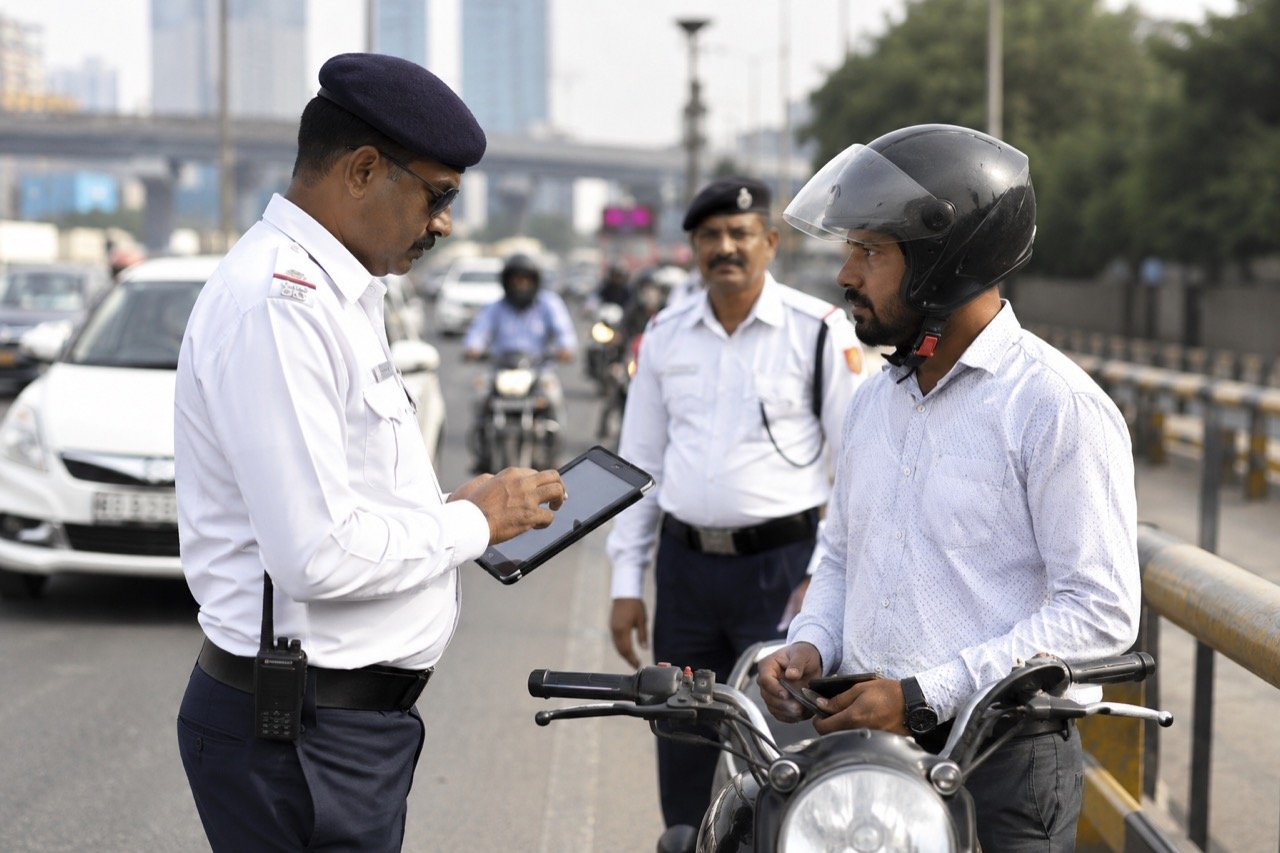
A single motorcycle in Gurugram has become an unlikely emblem of India's traffic enforcement gap. Police found the two-wheeler carrying 63 pending challans, with unpaid fines running into lakhs of rupees, and impounded the vehicle on the spot. The sheer number of violations attached to one bike is what turned a routine roadside check into a talking point. Each challan represents an offence that was recorded, often by camera, yet never resulted in payment or any visible consequence, until the tally finally caught up with the rider.
On the surface, this is a small story: one bike, one impoundment, one long-overdue reckoning. But the scale of the number is what makes it worth pausing over. Sixty-three separate violations is not a lapse or an oversight. It is a pattern sustained over a long period, across what was presumably many different intersections, cameras and enforcement zones, without a single one of those triggers producing an actual consequence until the vehicle was physically stopped. That gap between detection and enforcement is the real subject here, and the Gurugram case simply makes it visible in a way that is hard to ignore.
How dozens of challans pile up
Digital enforcement systems photograph violations and issue e-challans automatically, but the loop closes only when fines are actually recovered. If a rider simply ignores the notices, the penalties accumulate silently in a database while the vehicle stays on the road. The Gurugram case shows how long that gap can stretch before physical enforcement, in this instance an impoundment, finally intervenes.
The mechanics of this are worth spelling out, because they explain why a number as large as 63 was even possible. An e-challan system is built to detect and record, not to compel. Once a camera captures a violation and a notice is generated, the system's job is largely done from a technological standpoint. What happens next, whether the fine is paid within the stipulated window, contested, or simply ignored, depends on administrative follow-up that is far less automated. There is no real-time mechanism stopping a vehicle from being driven again the moment after a violation is logged. As long as registration, insurance and fitness paperwork remain in order on paper, a vehicle with an unpaid challan looks identical, at any subsequent checkpoint, to one with a clean record, unless an officer happens to run a specific check against the number plate.
This is precisely the seam that allowed the fines to compound for so long. Each new violation added to the pile did not, by itself, trigger any escalation. There was no threshold at ten unpaid challans, or twenty, or forty, that forced the system to intervene automatically. It took a manual roadside stop, and presumably a database lookup at that moment, for the accumulated record to surface and for consequences to finally arrive, all at once, in the form of impoundment and fines running into lakhs of rupees.
Why the case resonates
For traffic police, seizing a vehicle laden with unpaid challans sends a clear deterrence signal to habitual offenders. It demonstrates, at least in this one instance, that the record does eventually catch up with the rider, and that the consequences, when they arrive, are substantial rather than trivial. For a force trying to project the credibility of its enforcement regime, a case like this is a useful, if belated, proof point.
For ordinary commuters, though, the episode raises more uncomfortable questions than it answers. How many other vehicles are circulating on the same roads with similarly long, unresolved records? Was this bike an outlier, or simply the one that happened to be stopped and checked thoroughly? And why does follow-up on unpaid fines take so long that a rider can rack up 63 separate violations before anything happens? These are not questions the Gurugram case itself answers, but they are the natural questions any reasonable person would ask on reading about it, and they point to a system whose visible enforcement moments are the exception rather than the rule.
The episode underlines that modern traffic enforcement depends as much on data trails and recovery mechanisms as on the constable at the crossing. A camera that photographs a violation has done only the first half of the job. The second half, actually recovering the fine or otherwise compelling compliance, is where the system in this case visibly failed for a long stretch of time.
The incentive problem at the heart of the gap
It is worth thinking through why a rider would ignore 63 challans rather than paying even the first few. Part of the answer is straightforward: if there is no immediate, tangible cost to ignoring a notice, and no near-term checkpoint at which the unpaid fines will be discovered and enforced, then the rational response for many riders is simply to keep driving and deal with it later, if at all. The e-challan, in that sense, functions less like a bill that must be paid and more like a piece of correspondence that can be filed away and forgotten, precisely the framing captured in the phrase that a challan never collected is not a penalty but a suggestion.
This is not a claim about any individual rider's character so much as an observation about incentives. Systems that record violations diligently but enforce them sporadically will, over time, produce exactly this kind of outcome: a long tail of habitual offenders whose paper trail grows steadily while their actual behaviour goes unchecked. The Gurugram bike is simply the case where that long tail became visible enough to make the news.
What closing the gap would require
States should link challan recovery to insurance renewal, vehicle transfer and fitness certificates so that ignoring fines becomes practically impossible. The logic of this is simple: if unpaid challans block a vehicle owner from renewing insurance, transferring ownership, or securing a fitness certificate, then the fines stop being an easily ignorable notice and become a real obstacle that must be cleared before the vehicle can continue to be used normally. This kind of linkage does not require new detection technology; the cameras and the e-challan databases already exist. What it requires is administrative integration between the traffic enforcement system and the other bureaucratic checkpoints that a vehicle owner cannot avoid indefinitely.
Until such linkages are built and enforced consistently, cases like the Gurugram bike will likely keep surfacing, each one a reminder that the existence of a digital record is not the same thing as the existence of a consequence. Deterrence works when consequences are swift and predictable, not when they arrive years late in a lump sum, and a system that only produces consequences during rare, manual, roadside stops is not one that most habitual offenders will take seriously.
The NE Times View
A challan that is never collected is not a penalty; it is a suggestion. The Gurugram bike with 63 violations is less a story about one errant rider than about a system that records offences diligently and enforces them sporadically. Deterrence works when consequences are swift and predictable, not when they arrive years late in a lump sum. States should link challan recovery to insurance renewal, vehicle transfer and fitness certificates so that ignoring fines becomes practically impossible. Until then, India's roads will keep producing repeat offenders who treat e-challans as junk mail.
Key takeaways
- A Gurugram motorcycle was impounded after police discovered 63 pending challans attached to it, with unpaid fines running into lakhs of rupees.
- E-challan systems are effective at recording violations through cameras, but the enforcement loop only closes when fines are actually recovered, leaving a wide gap for habitual offenders.
- The case raises broader questions about how many other vehicles carry similarly long unresolved records and why follow-up on unpaid fines is so slow.
- Deterrence depends on swift, predictable consequences rather than penalties that accumulate silently for years before a single roadside check surfaces them.
- Linking challan recovery to insurance renewal, vehicle transfer and fitness certification would make ignoring fines far harder in practice than it is today.
You may also like to read
Bengaluru Police Reject Claim That Congress Rally Delayed NEET Aspirant
Bengaluru Traffic Police say CCTV footage does not support viral claims that a Congress rally caused a NEET candidate to miss her re-exam slot, citing a late departure and a longer route.
Expressway Pothole Row Puts Maharashtra Road Upkeep in Spotlight
Chief Minister Devendra Fadnavis' reported claim that the Pune-Mumbai Expressway has only two potholes has escalated a monsoon maintenance complaint into a statewide debate over highway accountability.
Himachal Bailey Bridge Collapse Sends Truck Into Sutlej, Renewing Hill-Road Safety Fears
A Bailey bridge on National Highway 5 in Himachal's Kinnaur district gave way under a passing truck, plunging it into the Sutlej, with the driver surviving and questions over mountain-road maintenance resurfacing.
Ahmedabad Car Crash Renews Focus on Road Safety and Medical Emergencies at the Wheel
A late-night crash in Ahmedabad that killed one woman and injured six has revived debate over urban road safety, after the driver may have suffered a seizure behind the wheel.
More from this section
More
AICTE Industry Fellowship 2026: Rs 1.5 Lakh Scheme Closes July 5
The AICTE Industry Fellowship Programme 2026, which places technical-education faculty inside leading companies on a Rs 1.5 lakh monthly stipend, reached its application deadline on July 5.
Bay of Bengal Low Pressure System Revives Monsoon Over Western India
A low-pressure system over the Bay of Bengal has pushed the monsoon back into an active phase, bringing steady heavy rain to Kerala, coastal Karnataka and Maharashtra, and putting Mumbai and Pune on preparedness watch.
Bishnoi Gang Suspects Injured in Haryana Encounter as Police Tighten Net
A joint Haryana-Delhi Police operation in Bahadurgarh left two suspected Lawrence Bishnoi gang members injured, spotlighting the multi-state coordination now central to India's fight against organised crime networks.