AI and Climate Deals Power a Busy Week for Indian Startup Funding
Indian startups raised roughly $400 million across about 20 rounds in a busy mid-June week, with sovereign AI, verifiable AI and climate technology emerging as the dominant investment themes.
Commentary & Analysis ·
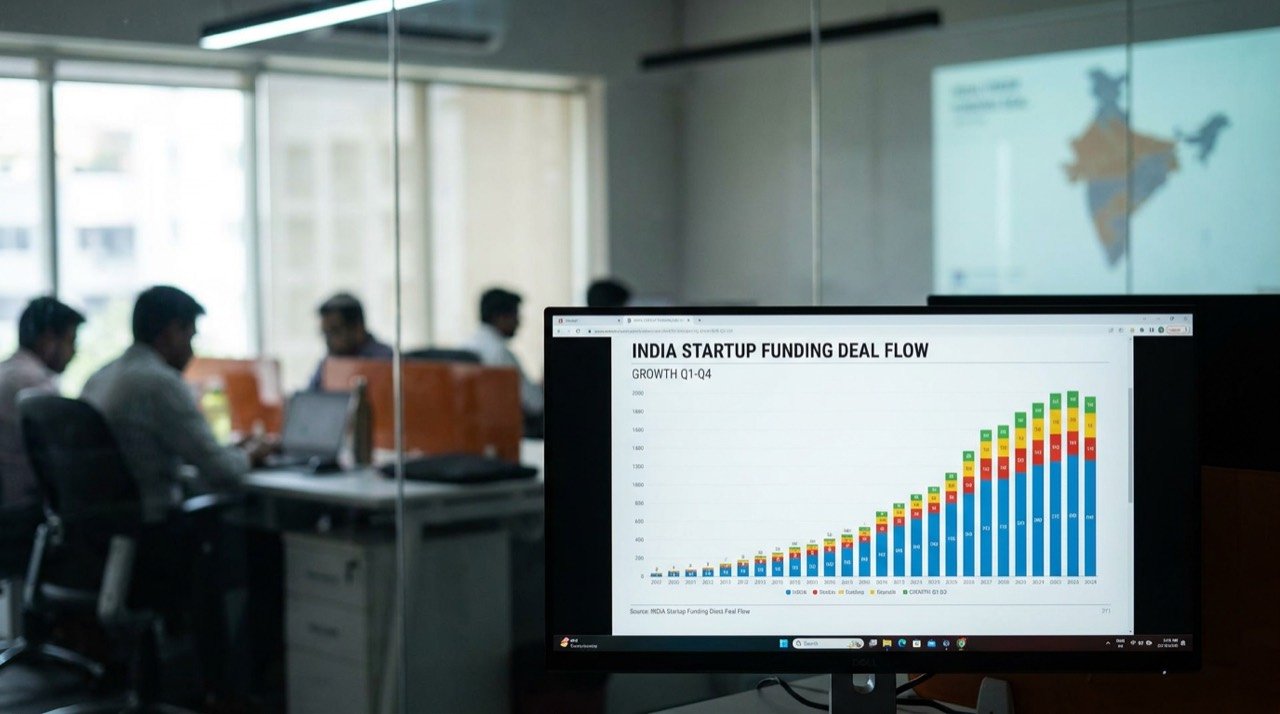
Indian startups closed a busy stretch of dealmaking in the third week of June, raising roughly $400 million across about 20 rounds, with artificial intelligence and climate technology setting the pace. On the surface this is simply another data point in a year of steady but selective venture activity. Looked at more closely, though, the week is a useful snapshot of where investor conviction in India's startup ecosystem currently sits: not in the consumer apps and marketplace models that once dominated headlines, but in harder, infrastructure-grade bets tied to national priorities in technology sovereignty and energy transition.
A week that favoured substance over spectacle
What stands out about the week is not any single marquee transaction but the breadth of activity. Around 20 rounds closing in a single week, cumulatively worth about $400 million, is a meaningful cluster even though no individual deal appears to have been a headline-grabbing "whale" round. That breadth matters. A single large financing can be the product of one investor's conviction, one founder's network, or one company's unusual moment. Twenty separate rounds closing in the same window, across different themes and presumably different investor syndicates, is harder to explain away as coincidence. It points instead to a genuine, if narrow, current of capital moving toward specific sectors that investors have decided are worth backing right now.
That current, this week at least, ran through two channels: artificial intelligence and climate technology. Both are sectors with strong policy tailwinds in India, and both are large enough markets that early bets can plausibly compound into durable businesses rather than remaining niche curiosities.
AI dominates the week, but not in one form
Artificial intelligence was comfortably the strongest theme of the week, and notably it was not concentrated in a single type of AI company. Startups raised capital across distinct niches: sovereign and multilingual model-building, verifiable AI, and infrastructure that helps firms bid for and win contracts. This spread is instructive. It suggests investors are not simply chasing a single fashionable idea, such as building a large language model from scratch, but are backing the wider stack of tools and services that make AI genuinely usable inside Indian businesses and government processes.
The emphasis on sovereign and multilingual models is particularly significant in the Indian context. A country with dozens of major languages and a population whose primary digital fluency is often not in English has an obvious structural need for AI systems trained and tuned for its own linguistic and cultural terrain. Investors backing this niche are, in effect, betting that foreign-built, English-first models will not adequately serve India's domestic market, and that there is durable commercial value in building the alternative locally.
Verifiable AI is a different but complementary wager. As AI systems are deployed into higher-stakes settings, the ability to check, audit and trust their outputs becomes as commercially valuable as the raw generative capability itself. And AI infrastructure for contract bidding speaks to a more mundane but no less important use case: helping businesses navigate procurement and compliance processes more efficiently, a persistent friction point in India's commercial and government contracting environment.
This appetite mirrors a broader national push toward AI that is built and controlled within the country, reinforced by government programmes channelling compute, data and skilling resources into the ecosystem. For founders, the message from this week's activity is fairly clear: capital is available for credible, India-specific AI propositions, particularly those addressing structural gaps that global AI providers are unlikely to prioritise.
Climate tech finds its own momentum
Climate and energy startups also featured prominently in the week's deal table, reflecting rising investor interest in decarbonisation, clean energy and resource efficiency. This is not a new theme in Indian venture capital, but its persistence alongside AI is notable. As India targets ambitious renewable energy and emissions goals, ventures working on green hydrogen, bioenergy and grid technologies are increasingly being treated by investors as long-term structural bets rather than niche or philanthropic-adjacent plays.
The pairing of AI and climate at the top of the week's deal table captures something important about where smart money is currently gravitating: toward sectors with strong policy tailwinds and large, durable markets, rather than toward businesses reliant purely on consumer discretionary spending or advertising economics. Both sectors also benefit from a degree of government alignment, whether through compute and skilling initiatives for AI or through renewable energy targets and incentives for climate tech, which gives investors some confidence that policy will not abruptly work against the businesses they are funding.
The wider picture: selective, not broad-based, capital flow
The active week fits a pattern that has held across the first half of 2026. Larger, later-stage rounds have dominated the headline numbers for Indian startups this year, while early-stage and first-time fundings have been comparatively harder to secure. In other words, capital has been flowing steadily but selectively, favouring companies and sectors that already carry some validation, whether through revenue, policy alignment or founder pedigree, over the earliest and riskiest bets.
For now, founders working at the intersection of AI and India's biggest structural challenges, namely language, energy and infrastructure, appear best placed to attract backing. This is a rational response by investors to a market where global capital is more cautious generally, and where India-specific theses, tied to demographic and policy realities that foreign investors and founders cannot easily replicate, offer a clearer rationale for allocating scarce venture dollars. Whether this momentum eventually broadens to earlier-stage and more diverse startups, beyond AI and climate, will be an important marker of the underlying health of the ecosystem in the months ahead. A market that only rewards later-stage, thematically fashionable companies risks starving the pipeline of the next generation of breakout businesses.
What founders and investors should watch next
Several questions arising from this week's activity are worth tracking. First, whether the sovereign and multilingual AI niche produces companies that can scale commercially, or whether it remains a policy-adjacent category propped up largely by strategic and government-linked capital. Second, whether climate tech funding continues to favour capital-intensive categories such as green hydrogen and grid technology, or whether it eventually broadens to smaller, more commercially nimble clean-tech applications. Third, whether the apparent breadth of this week, twenty rounds rather than one dominant deal, is repeated in coming weeks, which would suggest a genuine widening of investor interest rather than a one-off cluster of coincidental closings.
The NE Times View
The themes are telling: sovereign AI, verifiable AI and climate tech are exactly where strategic and commercial logic now overlap in India. A brisk week of mid-sized rounds suggests investor conviction is broadening beyond consumer apps toward harder, infrastructure-grade problems that map onto the country's actual structural needs, its linguistic diversity, its trust deficit in unverified systems, and its energy transition targets. The encouraging sign is the spread across roughly twenty deals rather than one whale transaction; sustained breadth like this, more than any single week's headline number, is what signals genuine ecosystem depth. The less encouraging sign, and one this newspaper will continue to watch closely, is that this depth still appears concentrated among later-stage and thematically favoured companies. A truly healthy ecosystem needs that breadth to extend down to first-time founders and earlier-stage bets as well.
Key takeaways
- Indian startups raised roughly $400 million across about 20 rounds in the third week of June, with AI and climate technology as the leading themes.
- AI funding spanned sovereign and multilingual models, verifiable AI, and infrastructure for contract bidding, reflecting investor interest in the broader AI stack rather than a single niche.
- Climate and clean-energy startups, including those in green hydrogen, bioenergy and grid technology, drew significant investor interest tied to India's renewable and emissions goals.
- The week's breadth, roughly twenty deals rather than one large round, is a more meaningful signal of ecosystem depth than any single transaction.
- Larger, later-stage rounds continue to dominate 2026 funding overall, with early-stage and first-time fundings still comparatively scarce, a pattern to watch for signs of broadening.
You may also like to read
India Tech Funding Climbs to $7.2 Billion in H1 2026 Even as Deal Count Slumps
Indian tech startups raised $7.2 billion in the first half of 2026, up 12 per cent year-on-year, but the number of funding rounds fell sharply as capital concentrated in a handful of mega-deals.
Sarvam AI Joins Unicorn Club As India's Startup Funding Engine Roars Back
A $234 million round catapulted Sarvam AI into the unicorn club in June 2026, capping a busy stretch in which Indian startups raised hundreds of millions across AI, climate and deeptech deals.

India's Deeptech Bet Deepens as Funding Tops $8 Billion for 2026
With 112 unicorns and a surge of AI and robotics startups, India took 120 deeptech firms to France's Bharat Innovates 2026 showcase.

Homegrown Startup Closes Mega Funding Round, Eyes Global Expansion
A fast-growing Indian technology firm has raised a large new round, signalling renewed investor appetite for the country's startup story.
More from this section
More
CG Semi Sanand Plant Opens, Boosting India's Semiconductor Drive
Prime Minister Narendra Modi inaugurated CG Semi's chip assembly and test facility in Sanand, Gujarat, giving India's semiconductor mission a working manufacturing milestone rather than another policy promise.

Chinese E-Rickshaw Apps Banned in India Over Remote Disable Risk
The Centre has ordered the removal of three Chinese apps — BAT-BMS, Lossigy and Epoch-i-ion — over fears they could remotely disable battery-run e-rickshaws, turning mobility software into a public safety concern.

Connected Car Rules: India Plans Vehicle Software Update Norms
With cars increasingly run by software, the government is reportedly preparing update and security norms aimed at preventing vehicle hijacking and governing how connected cars in India are patched and protected.