Inside Delhi's Zero-Waste Colony: A Working Alternative to Landfills
A Delhi residential colony is keeping most of its daily waste out of landfills through segregation, composting and resident participation, offering a practical, scalable model for the capital's mounting garbage crisis.
Commentary & Analysis ·
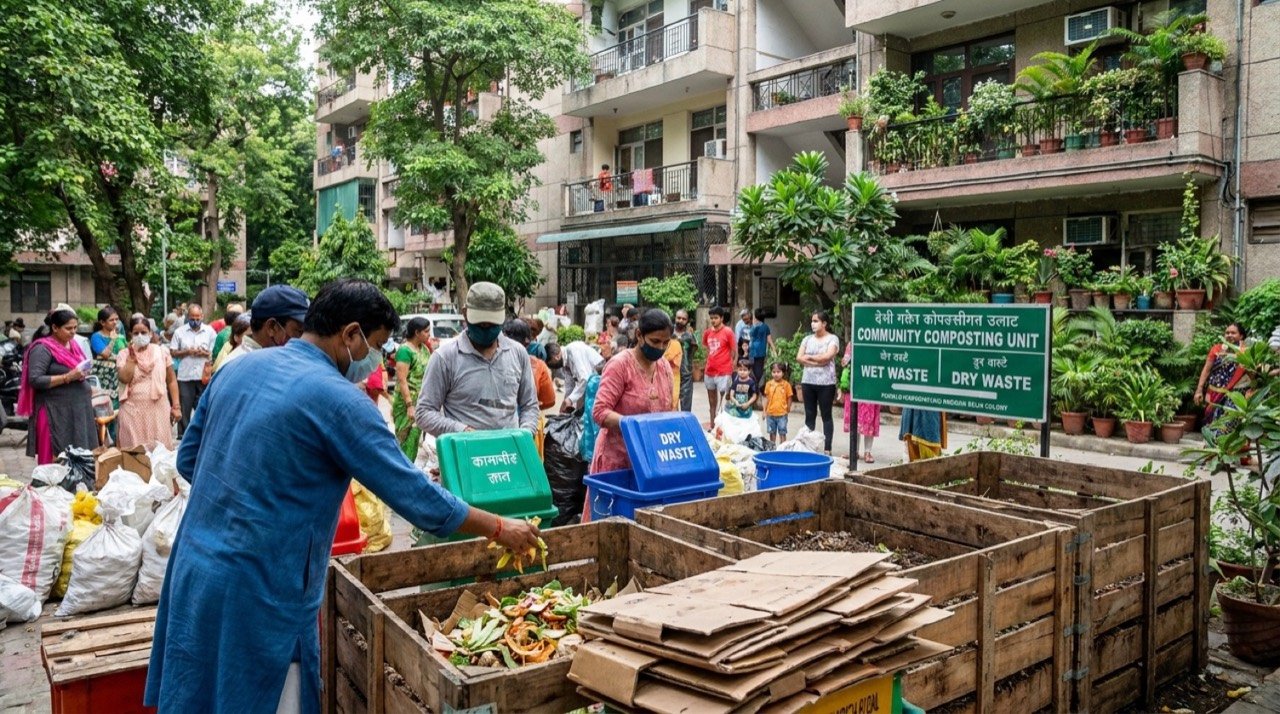
While Delhi's towering landfills remain a stubborn symbol of urban dysfunction, one residential colony in the capital is quietly demonstrating that the mountain of daily garbage is not inevitable. By keeping much of its waste out of landfills through disciplined segregation, local composting and active resident participation, the colony has become a small but instructive case study in how communities can take charge of their own refuse. It is a modest, unglamorous story, but in a city struggling with the visible failure of its waste systems, modest and unglamorous may be exactly what works.
Habits, not hardware
Public-interest reporting on the model makes one point clear: success depends less on any single machine and more on routine, repeated habits. Households separate wet and dry waste at source, maintain a collection discipline that keeps streams from mixing, and use compost locally rather than trucking organic matter across the city. None of this requires a novel technology or a large capital outlay. It requires consistency, and consistency is precisely the thing large civic systems find hardest to engineer.
The least glamorous ingredient may be the most decisive: persuading neighbours to cooperate, day after day. Without broad buy-in, even the best-designed system collapses into the familiar pattern of mixed, unusable garbage that has nowhere to go but the landfill. This is worth dwelling on, because it inverts the usual assumption in Indian civic policy debates that infrastructure spending is the primary lever. Here, the binding constraint is social, not mechanical — whether residents will actually do the sorting, every day, without being supervised or coerced.
Why it matters for Delhi
Delhi's landfill burden is a long-running civic problem, with overflowing sites posing fire, health and groundwater risks for surrounding communities. These landfills did not appear overnight; they are the accumulated result of decades of waste being collected, mixed and dumped rather than processed. Once organic and inorganic waste are mixed at the household level, the possibility of efficient downstream recycling or composting effectively disappears, and the material has only one destination left.
Decentralised, community-level systems can ease that pressure by intercepting waste before it ever reaches a dumping ground. Every kilogram of wet waste composted within a colony is a kilogram that never enters a collection truck, never adds to a transfer station's load, and never contributes to the slow-burning fires and leachate that make landfill sites hazardous to nearby residents. Crucially, the colony's experience shows that municipal services and residents are not adversaries but partners. When household segregation aligns with reliable collection and processing, the volume of waste requiring disposal drops sharply. This is a far more constructive framing than the adversarial one that often dominates public discussion, in which residents blame municipal bodies for poor collection and municipal bodies blame residents for poor segregation. The colony's example suggests the two failures are, in fact, mutually reinforcing, and that fixing one side of the equation can unlock progress on the other.
The economics of doing it locally
There is also a quieter efficiency argument embedded in this model. Transporting waste across a sprawling city like Delhi consumes fuel, vehicle capacity and civic manpower, all of which are finite and increasingly stretched. Composting organic waste on-site removes an entire leg of that logistics chain. The resulting compost, rather than being wasted as a byproduct, is put to direct use within the same community for gardens and greenery — turning what would have been a disposal cost into a small but tangible benefit for residents. This closed-loop quality is what separates the model from token gestures. It is not simply diversion from landfill; it is a functioning local cycle in which the waste generators are also the beneficiaries of proper processing.
Lessons that can scale
The model is replicable precisely because it relies on behaviour rather than expensive infrastructure. Other colonies and resident welfare associations can adopt the same principles with modest investment, provided they sustain the discipline over time. The essential steps are straightforward to list, even if they are harder to sustain in practice: separate wet and dry waste at the household level, every day; maintain strict collection discipline so streams stay unmixed; compost organic waste locally instead of sending it to landfills; use the resulting compost within the community for gardens and greenery; and, above all, build neighbour cooperation, which the reporting identifies as the single biggest factor in success.
What makes this list encouraging is that none of it depends on Delhi's civic bodies solving their hardest structural problems first. A colony does not need the Municipal Corporation of Delhi to fix landfill management before it can start segregating its own waste. That independence from top-down reform is exactly why the model is worth publicising: it gives residents associations across the capital a template they can act on immediately, rather than waiting on policy change that may be years away.
At the same time, replication is not automatic. What works in one colony, with a particular set of engaged residents and perhaps a few committed champions driving the effort, will not necessarily transplant itself elsewhere without similar levels of organisation. Resident welfare associations vary enormously in capacity and cohesion across Delhi, and a model that depends on sustained daily cooperation is inherently more fragile than one that depends on a single piece of equipment or a one-time subsidy. This is the trade-off inherent in any behaviour-based solution: it is cheap to start and hard to sustain, the mirror image of infrastructure-based solutions, which are expensive to start but, once built, run largely on their own.
The NE Times View
One colony composting its own waste will not flatten Ghazipur's toxic landfill mountains, but it proves the principle that segregation at source works when residents actually participate. That is not a small thing. Much of the scepticism around waste segregation in Indian cities rests on the assumption that residents simply will not cooperate reliably enough to make source segregation viable at scale. This colony's experience is a direct rebuttal to that fatalism, even if it is only one data point.
The NE Times View: Delhi's civic bodies should study and incentivise this model rather than merely admire it. Admiration is cheap and changes nothing; incentives, technical support and public recognition for colonies that replicate this discipline could meaningfully expand the practice. The missing ingredient is not technology but the political will to make segregation non-negotiable citywide. Until municipal authorities are prepared to enforce and reward source segregation as a baseline civic expectation rather than an optional virtue, isolated successes like this one will remain isolated, however instructive they may be for the colonies willing to try.
Key takeaways
- A Delhi residential colony has cut its landfill contribution significantly through household-level waste segregation and local composting.
- Success depends primarily on sustained resident cooperation and daily discipline, not on expensive machinery or infrastructure.
- Delhi's landfills pose ongoing fire, health and groundwater risks, and decentralised composting reduces the volume of waste that ever reaches these sites.
- The model is low-cost and replicable by other colonies and resident welfare associations, though it remains dependent on sustained community buy-in.
- The NE Times View holds that civic bodies should actively incentivise and scale this approach rather than treat it as a curiosity, since political will, not technology, is the binding constraint.
You may also like to read

Ambubachi Mela Opens at Kamakhya Temple, Drawing Pilgrims and Livelihoods
The annual Ambubachi Mela at Guwahati's Kamakhya Temple has begun, drawing lakhs of pilgrims, sadhus and traders to one of India's most revered Shakti Peethas on Nilachal Hill.
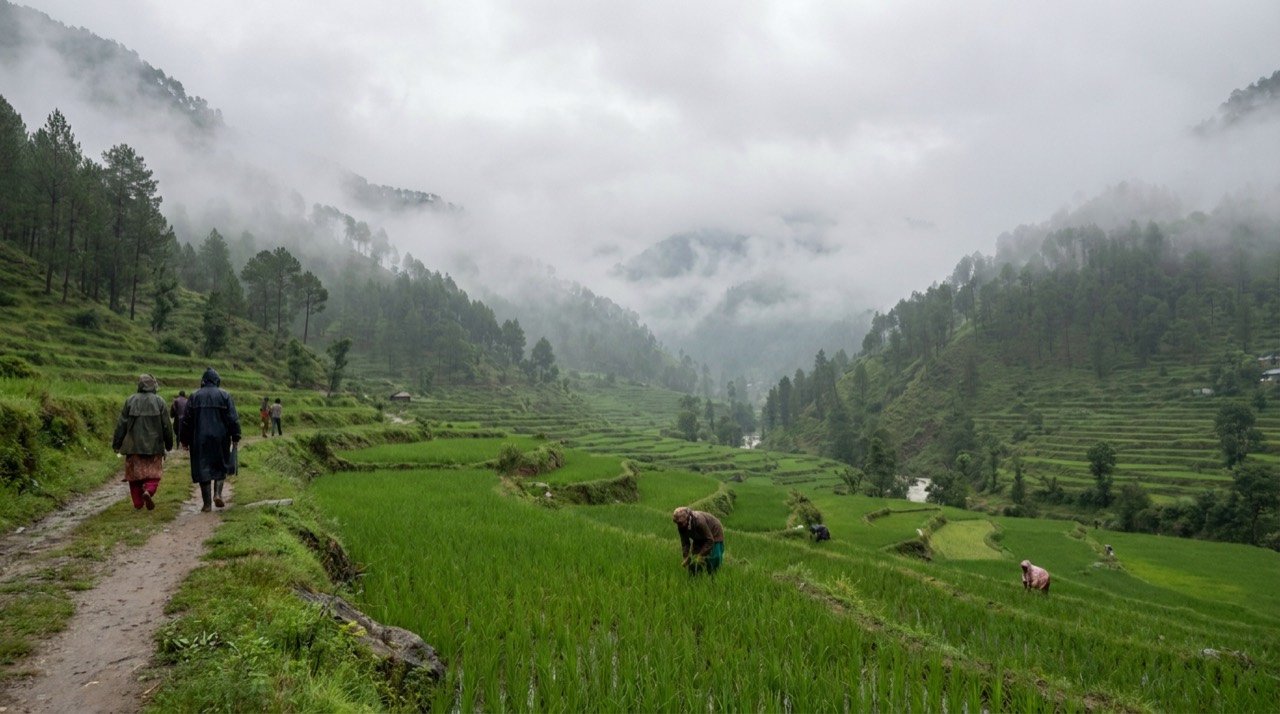
Misty Valleys and Cheaper Fares: India's Offbeat Monsoon Travel Boom in 2026
With domestic fares falling sharply and travellers seeking solitude, offbeat Himalayan hamlets, the rain-soaked Northeast and Ladakh's rain-shadow deserts are redrawing India's monsoon travel map in 2026.

Bengaluru Lamborghini-Auto Swap: Entrepreneur's Gesture Goes Viral
A Bengaluru entrepreneur's spontaneous decision to trade seats with an auto-rickshaw driver, putting the cabbie behind a Lamborghini's wheel, has charmed social media and become the city's feel-good story of the week.

Young India Walks Away From the Savings Account as SIP Inflows Hit Record Highs in 2026
Monthly SIP inflows have surged past record levels and active accounts near 10 crore, as a generation of young Indians treats savings accounts as liquidity tools and turns to market-linked wealth creation.
More from this section
MoreBengaluru Lamborghini-Auto Swap: Entrepreneur's Gesture Goes Viral
A Bengaluru entrepreneur's spontaneous decision to trade seats with an auto-rickshaw driver, putting the cabbie behind a Lamborghini's wheel, has charmed social media and become the city's feel-good story of the week.

India's Monsoon Plate Returns to Its Roots as Seasonal Eating Goes Mainstream in 2026
From Kerala's ten-leaf stir-fries to jamun, rasam and warming spices, India's monsoon kitchens are blending ancestral ritucharya wisdom with the 2026 obsession with gut health and immunity.
Misty Valleys and Cheaper Fares: India's Offbeat Monsoon Travel Boom in 2026
With domestic fares falling sharply and travellers seeking solitude, offbeat Himalayan hamlets, the rain-soaked Northeast and Ladakh's rain-shadow deserts are redrawing India's monsoon travel map in 2026.